


Reviewed by ThaiLawOnline, a licensed Thai law firm practising in Thailand since 2006. Thai lawyer of record: Wichuda Atthamethakon, LL.M., Thai Bar Licence 3149/2556.
Last updated on
The laws about drug testing in Thailand have changed a lot in recent years. This has created a complex legal system that every expatriate needs to understand. The country’s drug enforcement uses strict penalties and strong police powers. It is important for foreigners to know their rights and duties under Thai law. So here’s our guide about mandatory drug testing laws in Thailand and what you should know. If you need more information about criminal law in Thailand, look at this page here.
Table of Contents
Legal Framework and Authority
Thailand’s drug control system follows the Narcotics Code B.E. 2564 (2021). Section 4 of the Act Promulgating the Narcotics Code repealed 24 instruments and put the Code in their place: the Narcotics Act B.E. 2522 and its seven amendments, the four Prevention and Suppression of Narcotics Acts, the Psychotropic Substances Act B.E. 2559, the Narcotic Addict Rehabilitation Act B.E. 2545, the volatile-substances and suppression-of-offenders legislation, and four National Council for Peace and Order instruments. The Code took effect on 9 December 2021. It created new categories for controlled substances and updated enforcement procedures.
The testing power is section 115 of the Narcotics Code. It lets ONCB officers, administrative officials and police search a person whose conduct gives reasonable grounds to suspect drug use, and test a person for drugs in the body, or order them to be tested, where there is a need to and reasonable grounds to believe the person has used drugs in a dwelling, any place or a vehicle. They do not need to find drugs or see anyone using them. A person who tests positive may be held for up to 24 hours from the test while the officer arranges treatment. Section 58/1, which most English guides still cite, belonged to the Narcotics Act B.E. 2522, which the Code repealed.
The idea of “reasonable suspicion” in Thai law is widely understood. It can involve being in areas where drugs are common, increasing the risk of illicit drug encounters. It can also mean looking drunk or being reported by anonymous sources. This may lead to more questions about drug use in Thailand. The National Human Rights Commission of Thailand has stressed that officers need real reasons for suspicion. They cannot act only on anonymous complaints without further investigation.
You should know that it is not rare that the police goes to some clubs and raid them as they are opened after hours, do not have proper licenses, because minors are involved or drugs are suspected to be there. For instance, here’s a police raid in Bangkok in August 2025.
Recent Developments in Cannabis Regulation
Significant changes occurred in June 2025 when Thailand reversed its previous liberal cannabis policies. The Ministry of Public Health published a new notification in the Royal Gazette on 25 June 2025, in force on 26 June 2025, requiring doctor’s prescriptions for cannabis purchases and effectively ending recreational cannabis access. Under the new Ministry of Public Health Notification on Controlled Herbs (Cannabis) B.E. 2568, cannabis sellers can only sell to customers with valid medical prescriptions. These prescriptions must come from licensed Thai medical practitioners.
This represents a dramatic shift from Thailand’s position as the first Asian country to decriminalize cannabis in 2022. The new rules rest on cannabis being a controlled herb (samunphrai khuapkhum) under section 44 of the Protection and Promotion of Traditional Thai Medicine Wisdom Act B.E. 2542, which is the power the Minister uses to declare a herb controlled by Gazette notification. Studying, exporting, selling or processing the controlled herb for trade without a section 46 licence carries up to one year in prison or a fine of up to 20,000 baht, or both (section 78 of that Act). Smoking cannabis in public can be treated as a nuisance under the Public Health Act B.E. 2535; disobeying a local official’s order to stop it carries up to three months in prison, a fine of up to 25,000 baht, or both (section 74).
Procedures and Methods related to Mandatory Drug Testing Laws in Thailand
Thai police use two types of rapid urine screening kits: one screening methamphetamines only and another screening multiple drugs. These early tests must be confirmed at hospitals with the right testing facilities. This is especially important for urine tests for drug use. This follows the rules set by the Department of Medical Sciences. However, police often arrest people based only on initial positive results. This happens even before confirmatory tests are done. This raises concerns about how people who use drugs are treated.
Recent regulatory changes in September 2024 expanded police authority regarding impaired driving. New rules let officers take urine samples from drivers who refuse breath tests. They can also take drivers to hospitals for blood tests, especially if there is reasonable suspicion of drug use. Drivers who refuse a medical exam without a good reason are assumed to have drunk too much alcohol. This is similar to how people suspected of using drugs are treated under current drug policy.
The testing process typically involves roadside checkpoints, particularly in tourist areas and “red zones” where drug activity is suspected. Police also conduct operations around methadone clinics and use civilian volunteers to identify potential drug users, contributing to the broader drug policy. Mass testing campaigns, like the “X-ray” operations ordered by Prime Minister Srettha Thavisin in 2024, need urine tests. These tests are for everyone aged 16 and older in high-risk areas.
Rights and Obligations of Foreigners
Foreigners have specific rights during drug testing procedures, though these are not always respected in practice. Thonglor police were reported in December 2014 as saying that foreigners may refuse a test. That predates the Narcotics Code, which lets an officer order a test under section 115, and makes refusing a test in an ONCB investigation an offence under section 176.
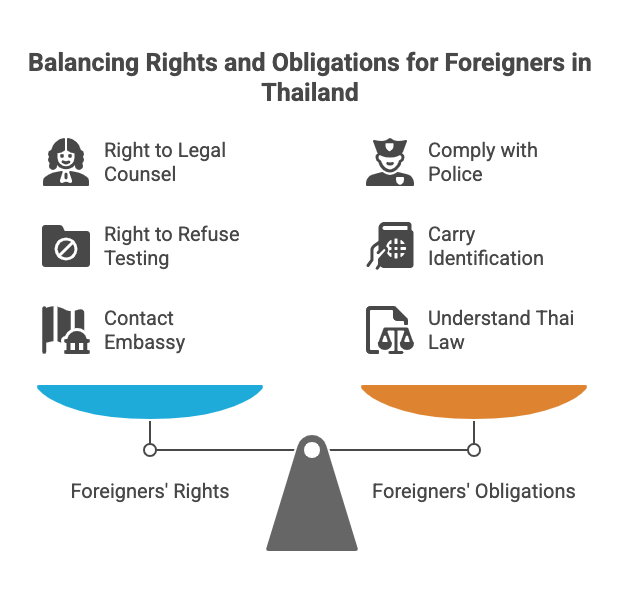
Key rights include:
- Right to remain silent until represented by legal counsel
- Refusing a test is risky: an officer with reasonable grounds may order one under section 115, and refusing a test in an ONCB investigation is itself an offence under section 176, carrying up to one year, a fine of up to 20,000 baht, or both
- Right to contact embassy or consulate for assistance and notification of family regarding potential drug use.
- Right to legal representation by an English-speaking attorney familiar with Thai drug laws
Critical obligations include:
- Carrying proper identification at all times, as foreigners without passports may face additional complications during police encounters
- Complying with lawful police requests for identification and basic questioning
- Understanding that Thai law applies equally to foreigners and nationals, with no special exemptions
Enforcement Patterns and Problem Areas
Drug testing enforcement has intensified significantly since 2011, with particular focus on tourist areas in Bangkok. The Sukhumvit area between Asoke and Thong Lor stations is now a main enforcement zone. There are many reports of foreign nationals facing searches and drug tests. Other high-risk areas include Khao San Road, Patong, Nana, and various nightlife districts.
Enforcement typically occurs through:
- Roadside checkpoints set up at night and in red zones
- Random stops of foreigners in tourist areas, where drug use may be more prevalent.
- Surveillance around entertainment venues and transportation hubs
- Home raids based on tip-offs or previous arrests
Unfortunately, corruption and extortion remain serious concerns in drug testing enforcement. Many documented cases show police officers asking for payments between 2,000 and 80,000 baht. They demand this money to avoid drug charges. The Public Sector Anti-Corruption Commission and Crime Suppression Division have investigated numerous cases of officers extorting money from motorists during urine testing procedures.
Penalties and Legal Consequences
Penalties for drug offenses vary significantly based on the substance category and nature of the offense. Under the 2021 Narcotics Code, Thailand maintains five categories of controlled substances, with Category I (heroin, methamphetamines, MDMA) carrying the harshest penalties.
For possession offenses:
- Category I (section 145): up to 15 years and a fine of up to 1.5 million baht; 2 to 20 years and 200,000 to 2 million baht where the offence is for trade or has another aggravating feature
- Category II or IV (section 146): up to 10 years and a fine of up to 1 million baht
- Category V, for example the opium plant (section 148): up to 5 years and a fine of up to 500,000 baht; 1 to 15 years and 100,000 to 1.5 million baht where the offence is for trade or has another aggravating feature
- Possession for personal use of Category I, II or V (section 164): up to 2 years, a fine of up to 40,000 baht, or both. A small quantity below the ministerial threshold is presumed to be for use (section 107)
For consumption offenses:
- Using Category I, II or V (section 162): up to 1 year, a fine of up to 20,000 baht, or both, but a user who volunteers for treatment before being found (section 113), or who is found and volunteers while not facing another imprisonable charge and not posing a danger to others (section 114), and then completes treatment, commits no offence
Refusing a drug test in an ONCB investigation carries up to one year, a fine of up to 20,000 baht, or both (section 176). The presumption against a driver who refuses a test is a separate rule of the road traffic law, not of the Narcotics Code.
Medical Prescription and Legal Drug Importation
Foreigners may legally bring prescription medications containing controlled substances under specific conditions. For Category 2 narcotics like codeine, fentanyl, morphine, and oxycodone, travelers need permits from the Thai FDA. You must get these permits at least two weeks before you arrive. They allow up to 90 days of prescribed medication. However, this can be checked under drug policy if there are signs of illegal drug use. Travelers can bring up to 30 days’ worth of certain medications. These medications are in Categories 2, 3, and 4. Travelers must have the right medical prescriptions and certificates.
Required documentation includes:
- Valid medical prescription from prescribing physician
- Patient identification and medical condition details
- Medication names, strengths, and usage instructions
- Physician’s name, address, and license number
Travelers must declare Category 2 narcotics at customs red channels upon arrival and departure, while other medications are considered personal belongings if properly documented.
Practical Guidance for Expatriates
To minimize risks of drug-related complications, expatriates should:
Avoid high-risk areas and situations, particularly late-night entertainment districts and areas known for drug enforcement activity. Carry proper identification at all times, including original passport or certified copies. Understand that prescription medications legal elsewhere may be prohibited in Thailand, requiring advance research and permits.
If stopped by police, remain calm and polite while requesting to see proper identification. Exercise your right to remain silent until a lawyer is present. Speaking without knowing Thai legal procedures can hurt you. Contact embassy or consulate immediately if arrested or detained, as they can provide attorney lists and notify family members.
Stay informed about changing cannabis laws. Regulations are evolving, with new rules for medical prescriptions and stricter penalties for not following them. Report any corruption or extortion attempts to appropriate authorities, including the Public Sector Anti-Corruption Commission.
FAQs about Mandatory Drug Testing Laws in Thailand
What are the drug testing regulations in Bangkok?
The drug testing regulations in Bangkok are governed by strict laws set forth by the Office of the Narcotics Control Board (ONCB). These regulations include mandatory urine tests for drug use, especially in cases of suspected drug-related offences. Police officers can do these tests at police stations. Not following the rules can lead to serious legal problems.
How does the Thai government address drug possession?
The Thai government has enacted punitive measures to address drug possession. Drug-related problems are taken seriously, with penalties ranging from fines to imprisonment. Under current drug laws, having narcotics like cocaine and opium can lead to serious consequences. Trafficking Category I drugs can carry the death penalty where the offender leads, directs or manages a criminal network, or the offence affects national security or public safety (Narcotics Code section 145).
What is the role of the Narcotics Control Board?
The Narcotics Control Board plays a crucial role in drug law enforcement in Thailand. This government agency is responsible for formulating and implementing drug policies, including harm reduction strategies. They oversee the healthcare services related to drug rehabilitation and promote initiatives to combat drug trafficking.
How does the Bangkok Post report on drug policies?
The Bangkok Post frequently covers issues related to drug policies and law enforcement in Thailand. Their articles often show the current state of drug trafficking. They discuss the government’s view on drug-related crimes. They also cover the effects of mandatory testing on the people. This gives readers important insights into the challenges the Thai government faces in fighting illegal drug use.
What are the implications of the new drug law?
The new drug law in Thailand aims to reclassify certain substances and change the approach to drug-related offences. This law emphasizes rehabilitation over punishment for users, aligning with international harm reduction principles. However, it maintains strict penalties for trafficking and possession of illicit drugs.
How has drug testing evolved since the late 1990s?
Since the late 1990s, drug testing in Thailand has changed a lot. This change happened mainly under Prime Minister Thaksin Shinawatra. He started a war on drugs that included strict drug testing policies. Over the years, drug policies have changed. They now focus more on rehabilitation and public health instead of just punishment.
Current Legal Landscape and Future Changes
Thailand’s drug enforcement continues evolving under the 2021 Narcotics Code, emphasizing rehabilitation over punishment while maintaining strict penalties for serious offenses. The code introduced alternatives to imprisonment and reduced minimum sentences for many drug offenses, though implementation remains inconsistent.
Enforcement intensity has risen, and the community “X-ray” testing directive issued under the Srettha government in 2024 was the escalation that set the current pattern. It has outlasted the administration that ordered it, so treat it as the standing approach rather than as a new announcement. These “X-ray” operations focus on people aged 16 and older in high-risk communities. This means that foreigners living in these areas may have to be tested more often.
The government is now focusing more on drug rehabilitation instead of just punishment. This gives hope for better treatment of drug users. However, the way police enforce laws on the streets may not change right away. Expatriates need to stay alert about legal changes. Thai drug laws are some of the strictest in the world. There is little tolerance for violations, no matter your nationality or situation.
Understanding these complex regulations and maintaining compliance represents an essential aspect of expatriate life in Thailand. The legal framework offers some protections. However, how these laws are enforced can differ a lot from what is written. It is important for anyone facing drug-related legal issues in the Kingdom to be aware of the situation. They should seek good legal advice.
Links:
Last reviewed: 5 September 2026. The instrument behind the June 2025 cannabis rules was corrected: cannabis is a controlled herb under section 44 of the Protection and Promotion of Traditional Thai Medicine Wisdom Act B.E. 2542, and the one-year / 20,000 baht penalty quoted here is section 78 of that same Act, not the Herbal Product Act. The Narcotics Code framework, the section 58/1 testing power and the category structure were checked and left as written. The per-category prison terms and fine ranges are NOT verified here: the only copy of the Narcotics Code available to us is a 333-character summary record, not the Code, so those figures need the Gazette text before they can be relied on. Updated on 4 October 2026: the Gazette text of the Code (volume 138, part 73 Kor, 8 November 2021) has since been obtained and was read in Thai, sections 107, 115, 145, 146, 148, 162, 164 and 176. Every penalty figure on the page was wrong or came from the repealed Narcotics Act and has been replaced from the Code, the testing power is now cited as section 115 rather than the old Act’s section 58/1, and the refusal penalty is section 176.
Thai Law Updates, free by email
Plain-English updates on Thai law changes that affect foreigners: property, visas, marriage, business and wills. One short email a month from a firm practicing since 2006. No spam, unsubscribe anytime.