


Reviewed by ThaiLawOnline, a licensed Thai law firm practising in Thailand since 2006. Thai lawyer of record: Wichuda Atthamethakon, LL.M., Thai Bar Licence 3149/2556.
Last updated on
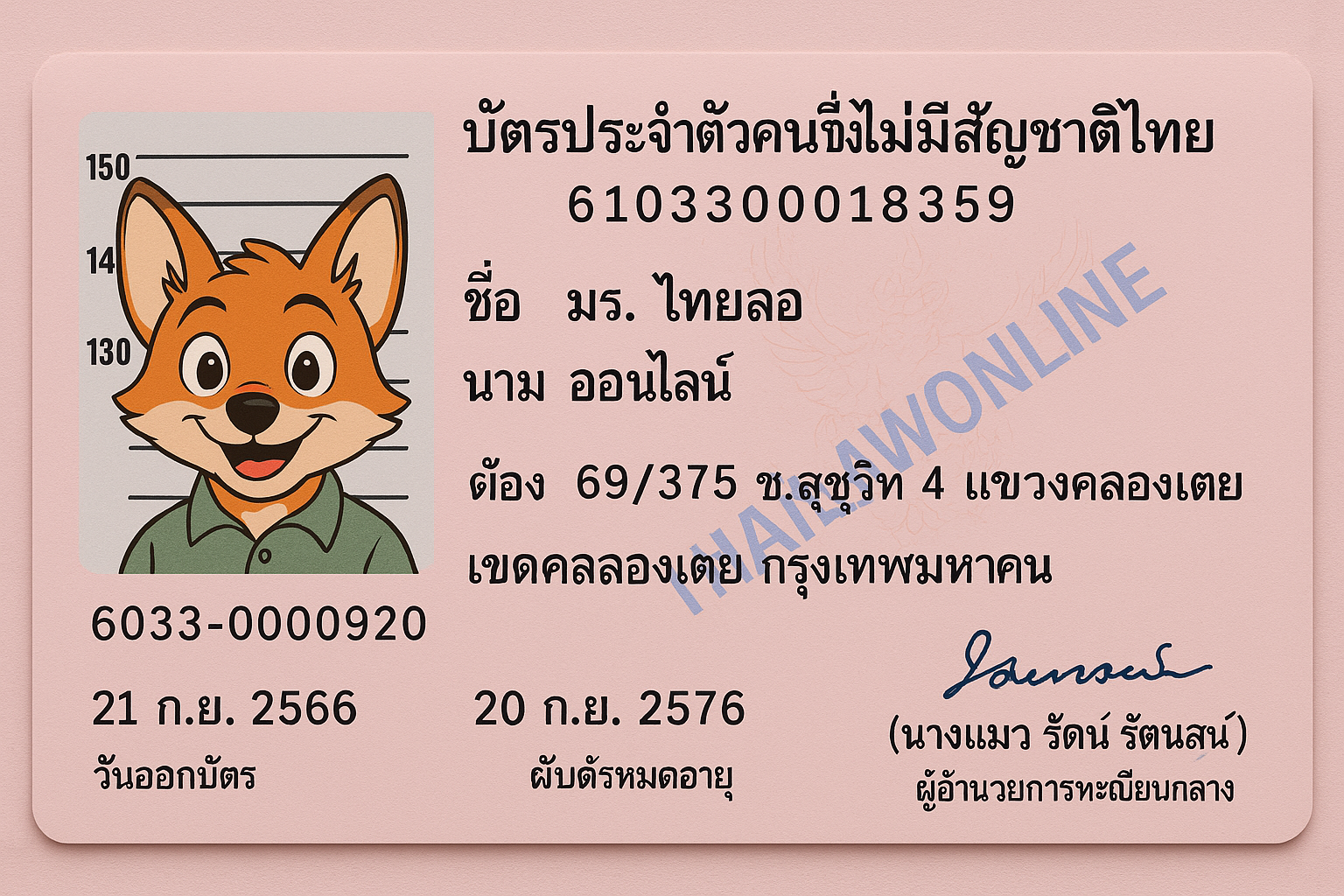
Table of Contents
Where to apply for Pink ID Card
When considering where to apply for Pink ID Card, it’s essential to know the requirements and processes involved.
First, let’s clarify what we’re talking about:
- The “pink ID card” (บัตรประจำตัวคนซึ่งไม่มีสัญชาติไทย or “Pink Card”) is an official ID. It is issued to non-Thai people whose names are on a Thai house register, either the blue Tor Ror 14 (for example holders of permanent residency) or the yellow Tor Ror 13. Under the Central Registry’s regulation on the card (B.E. 2551, clause 5), a non-Thai person aged five to seventy on such a register must obtain it within 60 days of turning five or of being added to the register.
- It’s pink in color (hence the nickname) and includes details like name, photo, address, and a 13-digit personal identification number.
- Who gets it? Typically, it’s for:
- Stateless individuals (e.g., some ethnic minorities like hill tribe people from northern Thailand).
- Long-term residents without Thai nationality (e.g., migrants from neighboring countries with permanent residency permits under special programs).
- Certain refugees or displaced persons granted residency.
- Foreigners staying on a visa or extension that gives them at least six months of continuous permission to stay. Clauses 2(3) and 4(3) of the Ministerial Regulation of 25 December 2019 on civil registration by persons without Thai nationality bring them into house registration and the card, and clause 5 gives them 30 days from that visa or extension to apply to be added to a yellow house register.
- It’s not the same as the blue Thai national ID card (for citizens) or the yellow house registration book (Tabien Baan) for foreigners. It’s also distinct from work permits or visas.
- The card is a useful identity document in daily life, for example with banks, hospitals, schools and government offices. It is valid for 10 years from issue, and a card still valid when the holder turns 70 lasts for life (clause 9). A new card is needed within 60 days if the name or date of birth on the house register changes (clause 5).
This card is managed under the authority of the Ministry of Interior, specifically through DOPA, which oversees civil registration.
Roles of Amphur and Tessaban in Thailand
To understand why issuance varies, it’s helpful to know the administrative structure:
- Amphur (อำเภอ): This is the district office, a sub-provincial level government body. It is the main authority for most civil registrations. This includes births, deaths, marriages, and ID cards in rural areas. Amphurs handle a wide range of services and are found in every district across Thailand.
- Tessaban (เทศบาล): This refers to municipal offices, which are local government bodies in urban or town areas. There are different levels:
- Tessaban Nakhon (for large cities such as Chiang Mai). Bangkok is not a municipality: it has its own district (khet) offices, and Pattaya is a separately constituted city.
- Tessaban Mueang (for medium-sized towns).
- Tessaban Tambon (for smaller sub-district towns).
- A Tessaban runs its own registry office, and its registrar (the local registrar) keeps the house registers for addresses inside the municipality.
The Amphur is part of the Ministry of Interior. A Tessaban is an elected local government under the Municipality Act B.E. 2496 (1953), supervised by the Ministry but not part of it.
Why Is the Pink ID Card Issued at Amphur in Some Places and Tessaban in Others?
The location for issuing or renewing a pink ID card depends on several factors, primarily geographic location, population density, and administrative delegation. Here’s the breakdown:
Default Issuance at Amphur:
If you want to know where to apply for a Pink ID Card, there are specific places for this.
- In most cases, especially in rural districts or smaller provinces (e.g., outside major cities like in Isan or the North), the pink ID card is usually handled at the local Amphur office.
- Why? Amphurs are the primary civil registration hubs under DOPA. They have the full infrastructure for verifying documents, taking photos, and entering data into the national registry. For non-Thai residents in these areas, the process is simple. You need to submit applications with proof of residency and photos. These applications go directly to the Amphur. After approval, the Amphur will issue the card.
- Legal basis: the Central Registry’s regulation on the card (B.E. 2551, clause 6) lets you apply either to the district registrar or to the local registrar, at a registry office with the computerised ID card system, in the district or locality where your name is on the house register.
2. Issuance at Tessaban in Urban Areas:
- Where your house register is held by a municipality, as in Phuket City or Chiang Mai, you can apply at the municipal registry office instead of the Amphur. In Bangkok you apply at the district (khet) office.
- Why the difference?
- Who holds your register: A municipality keeps the house registers for addresses inside it, so its registrar handles the card for people registered there, provided the office has the computerised ID card system.
- Local Convenience: Tessabans are near city centers, making them “one-stop shops” for people living in urban areas. In Bangkok, there are Khet offices, similar to Amphurs, but with city oversight. Some Tessaban branches manage pink ID cards directly.
- Legal basis: the local registrar is a registrar in its own right under the civil registration rules, not a delegate. The one practical condition in the card regulation is that the office must have the computerised ID card system (clause 6).
- Key Factors Influencing Where It’s Done:
- Location: Rural = Amphur; Urban/Municipal = Tessaban (or a mix).
- Applicant’s Address: The card is issued based on your registered address (from the Tabien Baan or residency permit). If it’s in a Tessaban jurisdiction, you’ll go there.
- Type of Application: the regulation treats first cards, replacements and changes the same way: you apply where your name is on the register (clause 6). The Director of the Central Registry may also designate other registry offices to issue cards.
- Fee and attendance: The card costs 60 baht, and a first card for a child under 15 is free (clauses 9 and 10 of the 2019 Ministerial Regulation). You apply in person, because the registrar takes your fingerprints and photograph (clause 7 of the card regulation).
- Exceptions: the Director of the Central Registry may designate other registry offices to issue cards (clause 6), which is how mobile or special registration units operate.
Step-by-Step Process for Getting a Pink ID Card, Where to apply for Pink ID Card
Regardless of the office, the process is similar. Read our other article on the pink Thai ID that explains everything.
Tips and Potential Challenges
- How to Confirm Where to Go: Check your residency documents or call the Department of Provincial Administration’s registration and ID card hotline, 1548, or see its website (www.dopa.go.th).
- For Foreigners/Expats: Pink cards are not only for permanent residents. A foreigner on a long-stay visa first needs their name added to a yellow house register (Tor Ror 13); the card follows from that entry. See our main page on the pink ID card for the documents.
- Common Issues: There may be delays in rural Amphurs because of heavy workloads. Tessabans might need appointments in busy cities. Always bring Thai translations if your documents are in another language.
- Legal Note: The card identifies you; it does not grant or extend permission to stay, which remains a matter for Immigration. If your permission to stay ends, the card ends with it (clause 9 of the card regulation).
The full guide to eligibility, documents and what the card is actually used for is on our main page about the Thai pink ID card for foreigners.
Last reviewed: 22 September 2026. Read end to end. Clauses 4 to 9 of the Central Registration Office Regulation on the card, B.E. 2551, and clauses 2, 4, 5, 9 and 10 of the Ministerial Regulation on civil registration by persons without Thai nationality, B.E. 2562 (Royal Gazette volume 137 part 1 Kor, 7 January 2020), were read in Thai. The fee and the six-month rule match our main pink ID card page.
Thai Law Updates, free by email
Plain-English updates on Thai law changes that affect foreigners: property, visas, marriage, business and wills. One short email a month from a firm practicing since 2006. No spam, unsubscribe anytime.