


Reviewed by ThaiLawOnline, a licensed Thai law firm practising in Thailand since 2006. Thai lawyer of record: Wichuda Atthamethakon, LL.M., Thai Bar Licence 3149/2556.
Last updated on
In Thailand, there are strict rules about what cannot be included in a prenuptial agreement. The Thai Civil and Commercial Code (CCC) allows prenuptial agreements only for property issues. It also makes some clauses invalid (see Civil Code Section 1465). If a clause goes against Thai law, public order, or good morals, it cannot be enforced. This means it will be an unenforceable term in a prenuptial agreement under Thai law. This includes clauses that try to apply foreign law to the marriage. Here are important examples of invalid or unenforceable prenuptial clauses in Thailand. This includes What Not to Include in a Thai Prenuptial Agreement:
For the wider context on marital property and what the courts will enforce, see our guide to Thai family law.
Last reviewed: 31 August 2026. Sections 1457, 1458, 1465 and 1466 of the Civil and Commercial Code were read against the Thai text in our own annotated Code, paragraph by paragraph. Supreme Court Decision 2553/2526 was read in full in Thai, to its final order, including the reduction of the agreed penalty. The correction made at this review is stated plainly because the page previously said the opposite: a clause keeping the spouses’ property separate is valid under section 1465, not void. What section 1465 voids is a clause contrary to public order or good morals, or one applying the law of another country to the property.
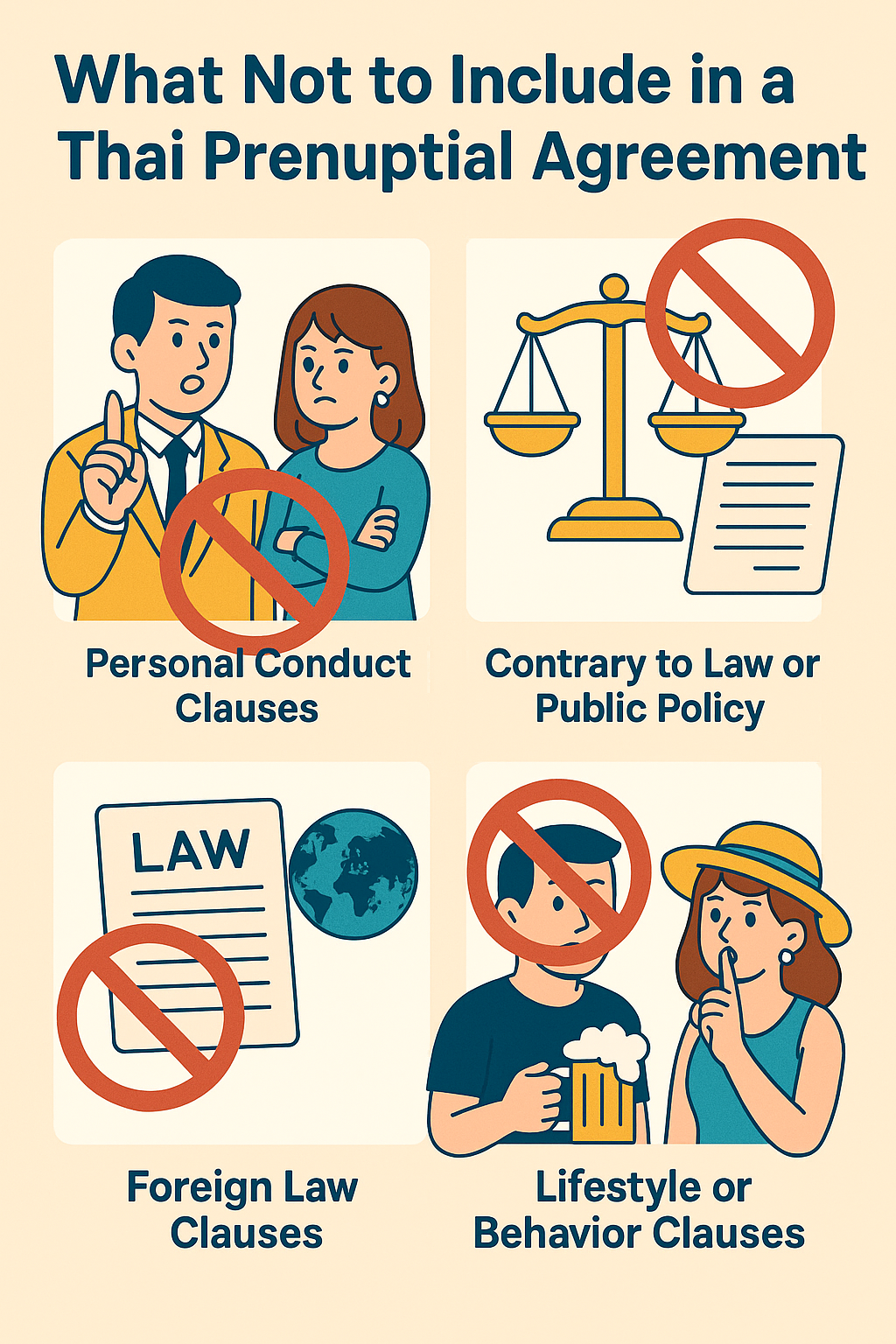
Table of Contents
Prenuptial agreements in Thailand are important legal tools. They help couples protect their assets and set clear property rights before marriage. However, the Thai legal system imposes strict limitations on what can and cannot be included in these agreements. Understanding these restrictions is essential for ensuring the validity and enforceability of prenuptial contracts under Thai law. This analysis looks at the rules that are not allowed in Thai prenuptial agreements. It uses the Civil and Commercial Code, Supreme Court decisions, and legal precedents.
Legal Framework Governing Prenuptial Agreements in Thailand
The Thai legal system follows a civil law framework. Prenuptial agreements are governed by Sections 1465 to 1469 of the Civil and Commercial Code. This comprehensive legal framework establishes both the permissible scope and absolute limitations of prenuptial agreements in Thailand. Unlike common law areas, prenuptial agreements in Thailand have strict rules. These rules aim to protect public policy, moral standards, and the rights of others.
Under Section 1465 of the Civil and Commercial Code, prenuptial agreements have important rules. Some clauses are void from the start. The section states that any part of the prenuptial agreement that goes against public order or good morals is not valid. It also says that if the agreement mentions that property relations will be governed by foreign law, that part is void as well. This establishes two primary categories of prohibited provisions that form the foundation of our analysis.
The procedural requirements outlined in Section 1466 further emphasize the formal nature of prenuptial agreements in Thailand. These agreements must be written down. They need to be signed by both spouses and at least two witnesses. They should be registered when the marriage is registered. Failure to comply with these procedural requirements renders the entire agreement void, regardless of its content.
Fundamental Prohibitions Under Section 1465: Public Order and Good Morals
Provisions Contrary to Public Order or parts of what not to include in a Thai prenuptial agreement
The idea of “public order” in Thai law includes basic principles. These principles help keep social stability and protect society’s interests. Prenuptial agreements cannot contain provisions that undermine these essential legal principles. Read section 1465 carefully before assuming a clause is void, because its first paragraph says the opposite of what is often published: the Code’s property regime applies only where the spouses have not made a special agreement about property before the marriage. Agreeing a different regime is therefore the very thing a prenuptial agreement is for, and a clause keeping each spouse’s earnings and assets separate is valid. What the second paragraph voids is narrower and specific: a clause contrary to public order or good morals, and a clause providing that the law of another country governs the property. A clause stripping one spouse of everything can fail the first of those on its own facts, and that is a question of degree rather than a rule that separation of property is forbidden.
What a prenuptial agreement cannot reach at all: the limit is one of subject matter rather than of degree. The agreement governs property. It cannot settle matters the Code puts elsewhere, and Thai courts will not enforce a private agreement that tries to. The grounds for divorce, the court’s power to decide parental power and the maintenance of a child are set by law and are not for the spouses to contract away, whatever the agreement says about who owns what.
A clear example of an invalid provision is: “The property relations between the spouses shall be governed by the law of England and Wales.” Section 1465 paragraph two voids that clause in terms, and it is the single commonest defect we see in an agreement drafted abroad and brought to Thailand. By contrast a clause reading “the spouses agree that there shall be no marital property between them and that each shall keep what they earn” is a normal, valid Thai prenuptial clause, and is what most of our clients come for.
Waiver of Fundamental Rights: Prenuptial agreements cannot include provisions that waive fundamental rights protected by Thai law. This includes efforts to give up the right to seek court help in property disputes. It also covers excluding court control over marriage issues. Such provisions are considered contrary to public order because they undermine the judicial system’s role in protecting individual rights.
Provisions Contrary to Good Morals
The “good morals” standard in Thai law reflects societal values and ethical principles that govern acceptable behavior. This standard is deliberately broad, allowing courts to evaluate provisions based on evolving social norms and ethical considerations.
Unconscionable Financial Arrangements: Prenuptial agreements cannot contain provisions that create grossly unfair financial arrangements between spouses. Thai law lets couples change how they manage their property. However, agreements that are very unfair or leave one spouse without financial protection may be considered immoral.
Provisions Restricting Personal Liberty: Generally, prenuptial agreements cannot include clauses that excessively restrict personal liberty or autonomy. However, the Supreme Court has interpreted this area in different ways. This is discussed in the landmark case analysis below.
Supreme Court Decision No. 2553/2526: Behavioral Clauses and Their Validity
One important Supreme Court decision about prenuptial agreements is Decision No. 2553/2526. This case involved a prenuptial agreement with behavioral rules. This case provides crucial guidance on what types of behavioral clauses may be permissible under Thai law.
Facts of the Case
The case involved a couple who made a written agreement before getting married. The agreement stated that “the wife shall not act against tradition and customs. She shall live with the husband as a wife and care for him. She shall not commit adultery against the husband.” When either party violates these conditions, they agree to pay a fine of 50,000 baht”.
The Supreme Court’s Reasoning
The Supreme Court supported this agreement. They said it was a written undertaking as to the wife’s conduct of the kind section 1516(8) of the Civil and Commercial Code recognises, breach of which gives the other spouse a ground for divorce. The Court found that such agreements are valid when they:
- Are made in writing regarding conduct that would constitute grounds for divorce
- Do not violate good morals or restrict personal liberty excessively
- Are not expressly prohibited by law
- Do not obstruct public order or good morals
Implications for Prenuptial Agreements
This decision establishes that behavioral clauses are not automatically void in Thai prenuptial agreements, provided they meet specific criteria. However, the allowed behavioral restrictions are limited to actions that could lead to divorce under Thai law.
The part of that decision most often left out is what happened to the money. The Supreme Court held the agreement valid and enforceable, and then held the agreed penalty of 50,000 baht excessive and cut it in half, ordering 25,000 baht. So a penalty clause in a Thai prenuptial agreement is not void for being a penalty, but the figure in it is not the last word either: a court may reduce a penalty it considers disproportionate. Write the number expecting it to be looked at.
Permissible Behavioral Clauses might include:
- Agreements regarding fidelity and adultery
- Provisions relating to traditional marital conduct
- Penalty clauses for behavior constituting divorce grounds
Prohibited Behavioral Clauses would include:
- Excessive restrictions on personal freedom
- Provisions that violate human dignity
- Clauses that restrict legitimate personal choices unrelated to marital conduct
Prohibition of Foreign Law Governance
Section 1465 Foreign Law Restriction
Section 1465 of the Civil and Commercial Code explicitly prohibits prenuptial agreements from specifying that property relations between spouses should be governed by foreign law. This restriction reflects Thailand’s commitment to maintaining sovereignty over matrimonial property matters involving marriages registered within its jurisdiction. Thai law does not allow a Thai prenup to be governed by foreign law. Section 1465 of the CCC says that any rule stating a couple’s property will follow foreign law is not valid in marriage in Thailand. In practical terms, you should consult a law firm to understand your rights as a husband and wife. A “choice of law” clause that favors foreign law may seem smart. However, it may not apply in many places.
Practical Implications
This prohibition means that prenuptial agreements cannot include clauses (or these clauses could be void in foreign countries) such as:
- “This agreement shall be governed by the laws of [foreign country]”
- “Property disputes shall be resolved according to [foreign] law”
- “The validity of this agreement shall be determined under [foreign] legal principles”
The restriction applies specifically to property relations between spouses, not to other contractual matters that might be included in international prenuptial agreements. However, couples must ensure that any property-related provisions comply with Thai law requirements.
Even if a couple has ties to other countries, the agreement made in Thailand must follow Thai law. You cannot say that California law or English law will govern your marital property arrangements in Thailand. Couples in cross-border marriages often solve this by signing separate prenups for each country. A Thai prenup will not override foreign legal rules in the event of a contested divorce.
Conflict of Laws Considerations
The prohibition of foreign law governance creates complex issues for international couples. While the prenuptial agreement cannot specify foreign law governance for property matters, Thailand’s Conflict of Laws Act may still apply foreign law in certain circumstances. This creates a distinction between contractual choice of law (prohibited) and judicial application of foreign law under conflict of laws principles (potentially permissible).
Child-Related Provisions: Absolute Prohibitions
Child Custody Arrangements
Thai law maintains an absolute prohibition against including child custody provisions in prenuptial agreements. This restriction reflects the principle that children’s interests cannot be predetermined by parental agreements made before the children’s birth. Prenuptial agreements in Thailand cannot cover personal matters like child custody or future child support. These issues are handled by separate laws. Courts decide them based on the child’s best interests if a divorce happens.
Prohibited Child Custody Clauses include:
- Predetermined custody arrangements in case of divorce
- Agreements designating which parent will receive custody
- Provisions limiting one parent’s access to future children
- Clauses restricting parental rights or responsibilities
The reason for this rule is that child custody decisions should focus on what is best for the child at that time. Courts cannot be limited by agreements made before children are born. These agreements cannot consider the real needs of actual children.
Child Support Restrictions
Child support obligations cannot be waived or predetermined in prenuptial agreements. Thai law says that both parents must support their children financially until the children turn 20 years old.
Invalid Child Support Provisions include:
- Waivers of child support obligations
- Predetermined child support amounts
- Agreements limiting child support duration
- Provisions transferring child support obligations to third parties
The Civil and Commercial Code treats child support as a fundamental obligation that cannot be contracted away. Courts retain exclusive jurisdiction to determine appropriate child support amounts based on the children’s needs and parents’ financial circumstances at the time of determination.
Maintenance and Spousal Support Limitations
The Maintenance Rights Framework
Section 1598/38 of the Civil and Commercial Code sets the rules for maintenance between spouses. It creates rights that cannot be fully given up in prenuptial agreements. This section states that “a husband or wife, or a parent and child, can claim maintenance. This is true when the person who needs support has not received it, or has received too little for their needs.”
Restrictions on Maintenance Waivers
Thai law does not require spousal support in every case. However, you cannot completely give up the right to seek maintenance in prenuptial agreements. This principle, found in many legal sources, shows that courts can order maintenance when needed.
Prohibited Maintenance Clauses include:
- Complete waivers of spousal support rights
- Agreements preventing courts from ordering maintenance
- Provisions that would leave a spouse eligible for public assistance
- Clauses that eliminate maintenance rights entirely
Permissible Maintenance Provisions
Prenuptial agreements may include limited provisions regarding maintenance, such as:
- Agreements on calculation methods for maintenance
- Provisions specifying factors to consider in maintenance determinations
- Clauses establishing maintenance duration guidelines
- Arrangements for maintenance modification procedures
However, these rules cannot take away the basic right to seek support. They also cannot stop courts from making fair support orders based on the situation at the time of divorce.
Third Party Rights Protection
Section 1468 and Third Party Protections
Section 1468 of the Civil and Commercial Code offers important protection for third parties. It states that “clauses in the prenuptial agreement shall have no effect on the rights of third persons acting in good faith. This is true even if they are changed or canceled by a Court order.”
Prohibited Third Party Provisions
This protection means that prenuptial agreements cannot include provisions that would:
- Affect the rights of creditors who deal with the spouses in good faith
- Impair the ability of third parties to rely on apparent ownership of property
- Create hidden restrictions on property that would mislead potential purchasers
- Establish secret arrangements that would defraud creditors
Practical Applications
The third party rights protection has significant practical implications for prenuptial agreements. For example, if a prenuptial agreement says that certain property belongs to one spouse, things can change. If that spouse uses the property as collateral for a loan, the lender’s rights remain safe. This is true as long as the lender acted in good faith.
Unconscionable Provisions and Procedural Fairness
Standards for Unconscionability
Thai law does not clearly define “unconscionable” in prenuptial agreements. However, legal experts and court rulings suggest that agreements can be invalid if they are very unfair or harsh. This standard applies both to the circumstances of the agreement’s execution and to its substantive terms.
Procedural Unconscionability
Procedural unconscionability may arise from:
- Inadequate time for consideration before signing
- Failure to provide full financial disclosure
- Pressure or duress in the signing process
- Lack of opportunity to obtain independent legal advice
The Supreme Court has stated that prenuptial agreements can be invalid. This can happen if one spouse was pressured by the other spouse, their lawyer, or family to sign the agreement. Similarly, agreements may be void if signed without adequate time for consideration.
Substantive Unconscionability
Substantive unconscionability involves the fairness of the agreement’s terms themselves. Thai law allows a lot of freedom in property agreements. However, agreements that create extreme inequality or leave one spouse unprotected may be seen as unfair.
Estate Planning and Inheritance Restrictions
Prohibition of Testamentary Provisions
Prenuptial agreements cannot include provisions that function as wills or estate planning documents. This rule shows that estate planning and prenuptial agreements have different legal purposes. They are also governed by different laws.
Prohibited Estate Planning Clauses include:
- Provisions designating inheritance rights
- Agreements specifying how estates should be distributed
- Clauses affecting statutory inheritance rights
- Provisions that conflict with legitimate testamentary instruments
Inheritance Rights Limitations
Prenuptial agreements can help clarify property ownership during marriage. However, they cannot decide inheritance rights in ways that go against Thai inheritance law. The Thai Civil and Commercial Code establishes statutory inheritance rights that cannot be completely eliminated through prenuptial agreements.
Procedural Violations That Void Agreements
Registration Requirements
Section 1466 of the Civil and Commercial Code establishes that prenuptial agreements are void if they are not properly registered. This creates several categories of procedural violations that can invalidate otherwise valid agreements.
Registration-Related Voids include:
- Failure to register the agreement at the time of marriage registration
- Improper registration procedures
- Failure to note the agreement in the marriage register
- Registration after the marriage has been completed
Signature and Witness Requirements
Prenuptial agreements must be signed by both spouses and at least two witnesses to be valid. Violations of these requirements include:
- Agreements signed by only one spouse
- Insufficient number of witnesses
- Witnesses who do not meet legal requirements
- Signature by representatives rather than the spouses themselves
Writing Requirements
All prenuptial agreements must be in writing to be enforceable. Oral agreements or understandings between spouses regarding property matters are not legally binding, regardless of their substance.
Contemporary Legal Developments and Enforcement
Recent Supreme Court Interpretations
Supreme Court Decision No. 6711/2537 provides additional guidance on the scope of permissible prenuptial provisions. This case was about an agreement between spouses. One spouse promised that personal property would become marital property. The Court upheld this agreement as valid. It did not go against public order or good morals.
Enforcement Challenges
Thai courts face ongoing challenges in enforcing prenuptial agreements, particularly in cases involving:
- Cross-border marriages with international elements
- Agreements drafted under foreign legal principles
- Conflicts between prenuptial agreements and subsequent conduct
- Disputes over the interpretation of public order and good morals
Impact of Legal Reforms
Recent legal changes have brought up new questions about prenuptial agreement rules. One significant change is the recognition of same-sex marriage in 2025. These developments suggest that the legal framework governing prenuptial agreements continues to evolve.
Practical Guidance for Legal Practitioners
Drafting Considerations
- Strict Compliance with Procedural Requirements: Ensuring proper registration, witnessing, and execution procedures
- Avoidance of Prohibited Clauses: Eliminating any provisions that violate the restrictions discussed above
- Focus on Property Management: Concentrating on permissible property arrangement and management provisions
- Clear Language: Using precise language that clearly defines property rights and obligations
Legal practitioners drafting prenuptial agreements in Thailand must carefully navigate the restrictions outlined in this analysis. Key drafting principles include:
Risk Management Strategies
To minimize the risk of invalidity, legal practitioners should:
- Conduct thorough reviews of agreement provisions against legal restrictions
- Ensure full financial disclosure between parties
- Provide adequate time for consideration and independent legal advice
- Document compliance with all procedural requirements
- Regular review of agreements for compliance with evolving legal standards
Cross-Border Considerations
For international couples, additional considerations include:
- Understanding the interaction between Thai law and foreign legal systems
- Ensuring compliance with both Thai and foreign legal requirements
- Addressing potential conflicts of law issues
- Coordinating with foreign legal counsel when necessary
Comparative Analysis with International Standards
Common Law vs. Civil Law Approaches
The Thai approach to prenuptial agreement restrictions differs significantly from common law jurisdictions. While common law systems usually allow more freedom in contracts, Thai civil law has stricter rules. These rules aim to protect public policy and individual rights.
Regional Comparisons
Within Southeast Asia, Thailand’s approach to prenuptial agreements reflects regional legal traditions that emphasize:
- Protection of traditional family structures
- Maintenance of judicial oversight over family matters
- Preservation of public order and social stability
- Protection of weaker parties in matrimonial relationships
Conclusion and Future Considerations
The rules for prenuptial agreements in Thailand balance two things. They allow people to make contracts freely. At the same time, they protect basic rights and public interests. Understanding these limitations is crucial for legal practitioners, couples, and courts involved in matrimonial property matters.
Key takeaways from this analysis include:
- Fundamental Prohibitions: Prenuptial agreements cannot include provisions contrary to public order, good morals, or foreign law governance
- Child-Related Restrictions: Absolute prohibitions exist for child custody and support provisions
- Maintenance Limitations: While modification is possible, complete waiver of maintenance rights is prohibited
- Procedural Requirements: Strict compliance with registration and execution procedures is mandatory
- Third Party Protection: Agreements cannot impair the rights of third parties acting in good faith
Future developments in Thai prenuptial law may include:
- Further clarification of public order and good morals standards
- Adaptation to changing social norms and family structures
- Integration with international legal frameworks
- Enhanced protection for vulnerable parties in matrimonial relationships
Family law in Thailand is changing. Practitioners need to keep up with legal updates. They must also follow established rules closely. The Supreme Court will keep interpreting these rules. This will likely give more guidance on what prenuptial agreements can include.
Couples thinking about prenuptial agreements in Thailand should know the rules. This helps them make valid agreements that protect their interests and follow Thai law. Lawyers must balance what clients want with legal rules. They need to make sure prenuptial agreements work as intended and follow Thai marriage laws.
The Civil and Commercial Code provides clear rules for prenuptial agreements. The Supreme Court’s interpretation helps explain these rules. It shows what should be avoided in these agreements. By following these principles and keeping up with legal changes, lawyers can help clients understand Thai matrimonial property law. This way, they can avoid mistakes that might make their agreements invalid or hard to enforce
FAQS about what you can NOT include in a prenuptial agreement in Thailand
What Should Not Be Included in a Prenuptial Agreement in Thailand?
When creating a prenuptial agreement in Thailand, you should not include illegal terms. You also need to avoid terms that go against good morals. For instance, clauses that waive spousal support or dictate how children will be raised are not permissible. Also, any terms that go against public policy or Thai law may make the agreement unenforceable in Thailand.
Can a Prenuptial Agreement Protect Personal Assets in Thailand?
Yes, a prenuptial agreement can protect personal assets in Thailand. A prenup clearly outlines how to divide property and personal assets. This gives both parties peace of mind and legal security if they divorce. This is especially crucial for foreigners marrying in Thailand, as it helps clarify asset ownership and protection.
How Can Foreigners Create a Valid Prenuptial Agreement in Thailand?
Foreigners can make a valid prenuptial agreement in Thailand. They just need to follow the legal rules of Thai law. This means you need to sign the agreement before the marriage. It must be registered at the district office and follow the Thailand civil code. Seeking legal expertise can help navigate the specific provisions needed for enforceability.
What Are the Legal Requirements for a Prenuptial Agreement in Thailand?
In Thailand, a prenuptial agreement must be in writing. It must be signed by both parties in front of witnesses. Finally, it needs to be registered at the district office. The agreement must follow the rules of the Thailand civil code. This is necessary for it to be legally binding and enforceable in Thailand.
What Happens if a Prenuptial Agreement is Not Registered?
If a prenuptial agreement is not registered at the district office, it might not be valid under Thai law. To make an agreement enforceable in Thailand, it must be documented and registered. This helps both parties have legal options if there is a dispute or divorce.
Can a Prenuptial Agreement Include Child Custody Provisions?
No, a prenuptial agreement cannot include child custody provisions. Thai law says that child custody and support must be handled separately. They cannot be decided in a prenup. This is to ensure that the best interests of the child are prioritized at the time of divorce.
What Are Common Mistakes to Avoid When Signing a Prenuptial Agreement?
Common mistakes to avoid when signing a prenuptial agreement include not getting legal advice. Other mistakes are not disclosing all assets or including invalid terms. Both parties should make sure they understand the agreement’s terms before signing. Misunderstandings can cause disputes later.
Formalities Matter: Remember that a well-written prenup will be void if it does not follow Thailand’s legal rules. Under Civil Code Section 1466, the agreement must be in writing, signed by both parties and two witnesses. It must be registered when the marriage is registered. Any prenuptial agreement not in the Marriage Register is considered invalid. You cannot add or enforce new prenup terms after the marriage registration. Post-marital agreements will not be recognized unless a Thai court formally approves a change according to Section 1467. Always ensure your prenup is executed properly to avoid it being thrown out on technical grounds.
Why These Restrictions Exist: Thailand’s prenuptial rules are meant to protect public order, good morals, and fair marriage laws. The law stops couples from adding unfair or harmful conditions. These conditions could hurt one spouse’s legal rights or go against social standards. A prenup in Thailand is a tool for financial clarity. It is not meant to control behavior or avoid Thai family law. Unenforceable clauses can weaken your prenuptial agreement and lead to litigation. If someone challenges them, the court may cancel those terms. It might even question the whole prenup’s validity. To keep your prenuptial agreement legally sound and effective, stick to permissible content and avoid the above forbidden clauses.
Do not use templates for a prenuptial agreement. You have no idea who made it, if a Thai registered lawyer drafted it, if the content is updated. The consequences are too high. ThaiLawOnline offer professional agreements at lower fees than most international law firms. We also have experiences and work as a team. You will rarely see so much accurate and precise information on internet about prenuptial agreements. It says something.
Thai Law Updates, free by email
Plain-English updates on Thai law changes that affect foreigners: property, visas, marriage, business and wills. One short email a month from a firm practicing since 2006. No spam, unsubscribe anytime.