

Last updated on April 17, 2026
Is Gay Marriage Legal in Thailand? Yes, Thailand legalized same-sex marriage on January 23, 2025. This makes Thailand the first Southeast Asian nation to grant marriage equality, and the third in Asia (after Taiwan and Nepal). If you’re planning to marry a same-sex partner in Thailand, relocate as a couple, or understand your rights here, this guide covers everything from the law itself to property rights, adoption, and cross-border recognition.
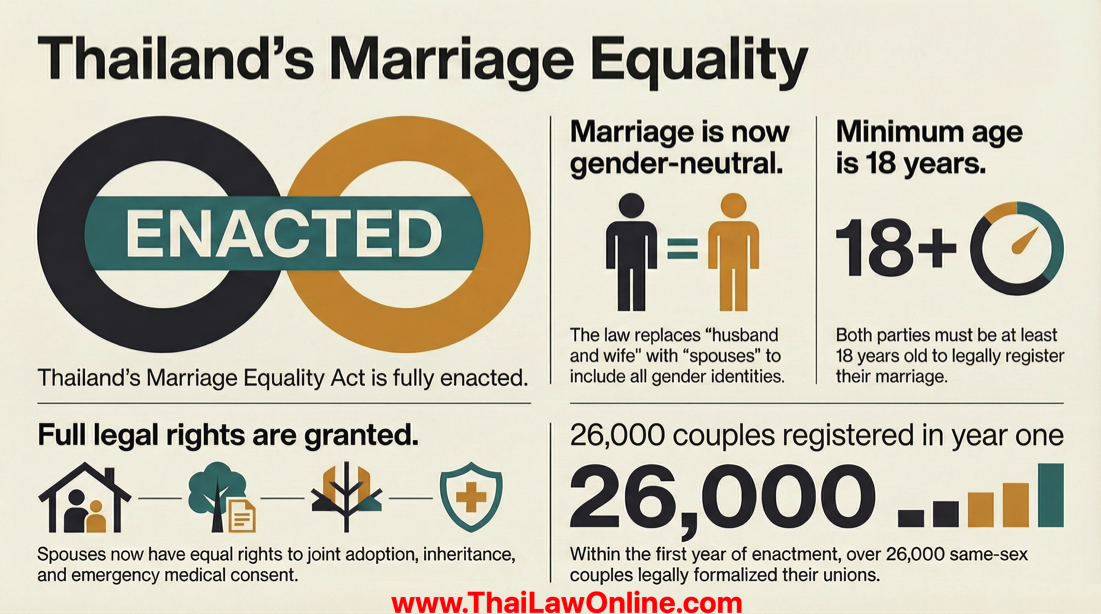
Table of Contents
Thailand’s Marriage Equality Act: What Changed on January 23, 2025
The Marriage Equality Act B.E. 2567 (Amendment No. 24 to the Civil and Commercial Code) became law on September 24, 2024, and took effect on January 23, 2025. On that first day alone, 1,754 same-sex couples registered marriages. By January 2026, the number had reached 26,287.
Here’s what actually changed in the law. The Thai Civil and Commercial Code once defined marriage as between “husband and wife.” Those gendered terms excluded same-sex couples. The new law replaced those gendered terms with gender-neutral language throughout 60+ sections. “Spouses” replaced “husband and wife.” “Individuals” replaced “men and women.” The result is that Thai marriage law now applies equally regardless of the gender of either person.
The amendment touched seven core areas: marriage formation, marital property rights, inheritance and succession, spousal maintenance, parental power and adoption, divorce, and legitimacy of children. Every section that referenced gender has been rewritten.
The Legislative Journey
This didn’t happen overnight. The House of Representatives voted 400 to 10 to pass the bill on March 27, 2024. The Senate voted 130 to 4 on June 18, 2024. It received Royal assent on August 12, 2024, and appeared in the Royal Gazette on September 24, 2024. That publication was the official trigger for implementation.
The speed was extraordinary for Thai law. Most legal changes take years. This one moved through Parliament in months, signaling strong public and political support. We covered the milestone in detail in our article on same-sex marriage in Thailand.
Rights Same-Sex Couples Now Have in Thailand
Property Rights (Sin Somros and Sin Suan Tua)
Thai law distinguishes two types of property in marriage: communal property (sin somros) and separate property (sin suan tua). This distinction matters for anyone buying property in Thailand as a couple.
Sin somros includes all property acquired by either spouse during the marriage, regardless of whose name is on the deed. This applies equally to same-sex couples. If one spouse bought a condo with their salary during the marriage, that condo is sin somros. Both spouses own it equally, unless they signed a prenuptial agreement saying otherwise.
Sin suan tua is property owned before the marriage or inherited or gifted during the marriage. This stays separate. Same-sex spouses have the same right to keep sin suan tua separate as opposite-sex spouses.
If you divorce, sin somros is divided 50/50 unless you had a written agreement. Sin suan tua goes back to whoever owned it. This applies regardless of sexual orientation.
We recommend a prenuptial agreement for any couple (same-sex or opposite-sex) who want to define property division differently. It must be registered at the district office to be valid.
Inheritance and Succession
Thai law gives spouses a statutory share of a deceased spouse’s estate. Under the amended Civil and Commercial Code (Section 1625), a surviving same-sex spouse now inherits the same share as any surviving opposite-sex spouse.
Specifically, if a spouse dies without a will, the surviving spouse’s share depends on who else survives. If there are children, the surviving spouse gets one-third of the estate; children split two-thirds. If there are no children, the surviving spouse gets half; parents (if alive) get the other half.
This right is automatic. You don’t need to register it. But we strongly recommend making a will anyway, because it clarifies your wishes and avoids disputes. A will lets you give more to your spouse, name them as executor, or provide for specific items you want them to have.
Adoption
Same-sex married couples can now adopt children in Thailand under the same rules as opposite-sex couples. Section 1598/17 of the amended Civil and Commercial Code makes this explicit.
The adoption process is the same: apply to the district office or family court, show you can support and care for the child, and demonstrate it’s in the child’s best interest. Both spouses must meet the age requirements under Thai law. Thai law also allows unmarried couples (same-sex or opposite-sex) to adopt jointly, provided they meet the same criteria.
Adoptive children have the same rights to inheritance, legitimacy, and family status as biological children. If you adopt a child and then divorce, both parents retain rights and obligations to the child. Same rules as opposite-sex couples.
Healthcare and Medical Decisions
Marriage gives spouses the legal right to make medical decisions for each other if the other spouse is incapacitated. This applies equally to same-sex spouses under Thai law. If your spouse is in a coma or otherwise unable to consent to treatment, doctors will honor your decisions as the spouse.
We recommend signing a power of attorney or healthcare directive as well, making it explicitly clear in writing. This removes any ambiguity and protects your spouse if medical personnel are unfamiliar with Thai law.
Spousal Visa and Immigration
Same-sex spouses can now apply for spousal visas (Non-Immigrant O visas) in Thailand on the same basis as opposite-sex spouses. You need a marriage certificate from a Thai district office, proof of income or assets (Thai spouse needs 40,000 THB monthly income or 800,000 THB in a Thai bank account), and a letter of consent from your spouse.
The visa is valid for one year and renewable. This opens the door for same-sex couples to live together in Thailand on a legal, stable visa basis.
Before and After the Marriage Equality Act
| Right | Before January 23, 2025 | After January 23, 2025 |
|---|---|---|
| Legal Marriage Registration | Not allowed for same-sex couples | Allowed; full marital rights apply |
| Communal Property (Sin Somros) | No legal recognition | Equal to opposite-sex spouses; 50/50 division on divorce |
| Inheritance Rights | No statutory share for same-sex partners | Surviving spouse inherits same share as opposite-sex surviving spouse |
| Adoption | Not available to same-sex couples | Available; same process as opposite-sex couples |
| Medical Decision-Making | Limited; no automatic spousal authority | Spouse has full authority over medical decisions |
| Spousal Visa | Not available | Available; Non-Immigrant O visa on spousal basis |
| Spousal Maintenance | No obligation between same-sex partners | Equal obligation to provide maintenance (Section 1461) |
| Child Legitimacy | Limited rights for children of same-sex couples | Full legitimacy presumptions apply (Sections 1536-1545) |
| Divorce and Asset Division | No legal marriage to dissolve | Same divorce process and asset division as opposite-sex couples |
| Tax and Succession Planning | No spousal tax deductions or exemptions | Access to spousal succession rights and joint asset planning |
How Foreigners Can Register a Same-Sex Marriage in Thailand
If you’re a foreign national wanting to marry a Thai citizen or another foreigner in Thailand, the process is straightforward but document-heavy. We’ve written a detailed same-sex marriage registration guide as well. Here’s the step-by-step breakdown.
Step 1: Affidavit of Freedom to Marry
You need an affidavit from your home country proving you’re free to marry. That means you’re not already married, not underage, and not barred by law. This is called a Certificate of No Impediment or Freedom to Marry affidavit.
Request this from your embassy or consulate in Thailand. Most embassies issue them on the spot, though some require advance notice. You’ll need your passport, any previous divorce decrees, and sometimes a birth certificate.
The affidavit must be in English or Thai. If it’s in English, you’ll need to have it translated to Thai by an official translator and legalized (apostille or consular stamp).
Step 2: Translation and Legalization
All foreign documents must be translated to Thai by an official court-approved translator. Get a list from the district office. The translation costs 300–500 THB per page.
After translation, the original English document needs to be legalized. This means getting an apostille (a special stamp from your home country’s Ministry of Foreign Affairs) or a consular legalization (your embassy stamps it). The apostille or consular stamp proves the English version is genuine.
This step typically takes 1–2 weeks if you apply through your embassy.
Step 3: District Office Registration
Once you have the translated, legalized affidavit (and your Thai partner’s ID and household registration if applicable), go to the district office where you want to marry.
Bring both passports, the affidavit with translation, a health certificate (some districts require one; they’re cheap at any clinic), and completed marriage registration forms (District Officer will provide). Both of you must be present and at least 18 years old.
The registration takes about 30 minutes. You’ll get a marriage certificate on the spot (in Thai and English). Cost is roughly 25 THB. Negligible.
Required Documents Checklist
- Passport (valid)
- Affidavit of Freedom to Marry from your embassy
- Translation of affidavit to Thai (certified translator)
- Apostille or consular legalization of original affidavit
- Birth certificate (original or certified copy; may be required)
- Health certificate (from any Thai clinic; some districts ask for this)
- Marriage registration form (provided by district office)
- Thai spouse’s ID card and household registration (if marrying Thai citizen)
- Witness(es) if required by district (usually not)
Processing typically takes 1–3 days from first visit to finished certificate, provided all documents are in order.
Prenuptial Agreements for Same-Sex Couples
A prenuptial agreement is optional but smart. It lets you and your spouse specify how property will be divided if you divorce, protect assets from before the marriage, or establish different rules than Thai law provides.
Under Section 1463 of the amended Civil and Commercial Code, both same-sex and opposite-sex couples can agree in writing to divide property differently than the 50/50 sin somros default. The agreement must be registered at the district office to be valid.
A prenuptial agreement is especially valuable if one spouse is significantly wealthier, if one has children from a previous relationship, if both own property before marrying, or if you’re concerned about creditor claims.
We draft prenuptial agreements for 8,900 THB. We review your assets, discuss your concerns, and draft language that protects both of you fairly. The agreement is then registered at the district office.
Same-Sex Divorce in Thailand
Same-sex divorce follows the exact same legal process as opposite-sex divorce. We cover the full process in our divorce in Thailand guide. There are two routes: mutual agreement divorce and contested divorce.
Mutual agreement divorce is fast and cheap. Both spouses agree to divorce and sign a divorce agreement covering property division and child custody (if children). You register the agreement at the district office. No court is involved. It takes about 30 minutes, and costs roughly 100 THB.
Contested divorce requires family court involvement if spouses disagree over property division, custody, or other terms. A judge will decide based on Thai family law. This takes months and costs more in legal fees, but you’re protected by court order.
Property division rules are identical for same-sex and opposite-sex couples. Sin somros is divided 50/50 unless you had a prenuptial agreement. Sin suan tua goes to whoever owns it. Child custody follows the child’s best interest, regardless of sexual orientation.
For complex divorces involving significant assets or custody disputes, we recommend hiring a lawyer. Our divorce service starts at 5,000 THB and includes court representation if needed.
Broader LGBTQ+ Rights in Thailand
Gender Equality Act B.E. 2558 (2015)
Thailand passed an anti-discrimination law, the Gender Equality Act, in 2015. It prohibits discrimination based on gender, sexual orientation, and gender identity in employment, education, housing, and public services.
This means employers cannot fire you for being gay, schools cannot deny enrollment, landlords cannot refuse to rent, and businesses cannot refuse service. At least in theory. Enforcement is uneven, but the law exists and gives LGBTQ+ people a legal basis to challenge discrimination.
If you face discrimination, you can file a complaint with the Ministry of Social Development and Human Security or take civil action. Our family law guide for expats covers related protections.
Gender Recognition Bill (Pending)
Thailand has several gender recognition bills pending in Parliament since 2016. These would allow transgender and non-binary individuals to update their legal gender on official documents (ID card, passport, etc.) without medical procedures.
The bills have stalled due to disagreements over details (e.g., age requirements, parental consent, medical assessments). As of April 2026, no bill has passed. We’ll update this guide if that changes.
Workplace Protections
Under the Labor Protection Act and the Gender Equality Act, employers cannot discriminate based on sexual orientation or gender identity. You cannot be fired, demoted, or harassed because you’re gay or transgender.
If you experience workplace discrimination, file a complaint with the Department of Labor or consult an employment lawyer.
Will Your Same-Sex Marriage Be Recognized Back Home?
This is critical to understand before marrying in Thailand. Thai law recognizes your marriage, but your home country might not.
Countries that typically recognize Thai same-sex marriages: Canada, Australia, New Zealand, most of Western Europe (UK, France, Germany, Netherlands, Scandinavia), and many others. If you’re from one of these countries, your Thai same-sex marriage should be recognized. We still recommend checking with your embassy to be sure.
Countries with limited or no recognition: Some countries don’t recognize same-sex marriage at all (parts of Asia, Africa, Middle East). Some recognize it conditionally. Some recognize it for immigration purposes but not tax/inheritance purposes.
What you should do: Before marrying in Thailand, check with your home country’s embassy in Bangkok. Ask explicitly whether a Thai same-sex marriage will be recognized. Some countries recognize it automatically; others require registration or a court order. Get it in writing.
If your marriage won’t be recognized back home, consider what that means for inheritance, taxes, immigration, and property ownership in your home country. You might need separate legal documents (power of attorney, will, healthcare directive) in your home country to protect your spouse.
Do You Still Need a Will?
Yes. Marriage equality does not make a will optional. In fact, a will becomes more important.
Thai inheritance law gives a surviving spouse a statutory share, but that share might not be what you want. If you have children from a previous relationship, if you own separate property you want to go to specific people, or if you want to ensure your spouse gets the most, a will is essential.
A will lets you override the statutory shares, name your spouse as executor, specify funeral wishes, and distribute specific items. Without a will, your estate goes through intestacy succession under Thai family law, which can take months and create family disputes.
We draft last wills for 3,900 THB. The will is registered at the district office and kept safe. When you pass, your executor (usually your spouse) produces the will and inheritance is straightforward.
Costs and Fees
| Service | Government Fee | Legal Service Fee | Total (approx) |
|---|---|---|---|
| Marriage Registration (same-sex) | 25 THB | 0 (if you handle documents yourself) | 25 THB (DIY) or 2,000–3,000 THB (with lawyer help) |
| Prenuptial Agreement | 50 THB (registration) | 8,900 THB | 8,950 THB |
| Last Will and Testament | Variable (registration) | 3,900 THB | 3,900–4,500 THB |
| Mutual Agreement Divorce | 100 THB | 0 (if spouses agree) | 100 THB (DIY) or 2,000–3,000 THB (with lawyer help) |
| Contested Divorce (court) | 600–2,000 THB | 5,000–15,000 THB (or hourly rate) | 5,600–17,000 THB+ |
| Spousal Visa Application (Non-Immigrant O) | 2,000 THB | 0 (if you apply yourself) | 2,000 THB (DIY) |
| Embassy Affidavit (Freedom to Marry) | Variable by embassy | N/A | $50–150 USD (typical) |
| Official Translation (per page) | N/A | 300–500 THB | 300–500 THB/page |
Frequently Asked Questions Is Gay Marriage Legal in Thailand
Is gay marriage legal everywhere in Thailand?
Yes. The Marriage Equality Act applies nationwide. Every district office in Thailand can register same-sex marriages. No district has an exemption.
What if my partner and I already cohabited before the law changed? Do we get automatic marriage rights?
No. Cohabitation (even for 20 years) does not create marriage rights in Thai law. You must formally register at a district office to be married. Even if you’d planned to marry eventually, register now to get the legal benefits.
Can we marry if one of us is not legally an adult in our home country but is 18 in Thailand?
Thailand’s marriage law requires both spouses to be at least 18. That’s the floor. But your home country’s laws apply to you in your home country. If you’re under the age of majority in your home country, your home country might not recognize a Thai marriage. Check with your embassy first.
Do we need witnesses to marry in Thailand?
Usually yes. However, the staff of the amphur normally does that work as witnesses only need to be 20 yo and older and be sound of mind.
If we divorce, do we split everything 50/50?
Only communal property (sin somros) acquired during the marriage splits 50/50. Separate property (owned before the marriage, or inherited, or gifted) stays with the original owner. If you had a prenuptial agreement, that controls instead. Without agreement, the default is 50/50 for sin somros.
Can we adopt an orphan even if we’re not married?
Yes. Unmarried couples (same-sex or opposite-sex) can adopt jointly in Thailand if they meet the adoption criteria. Marriage is not required. But we recommend marrying first for inheritance protection and medical decision-making clarity.
What if one spouse is Thai and the other is a foreigner? Does that change anything?
No. Thai law applies equally regardless of nationality. The foreigner spouse still needs a marriage affidavit from their home country, but once registered, they have the same marital rights as any Thai spouse.
Is there a marriage registry or public record showing we’re married?
Yes. The district office keeps marriage records. You can request a certified copy of your marriage certificate anytime. It’s a public record, though copies are typically released only to the spouses, their children, or with written consent.
If my spouse dies without a will, can I challenge the will if one exists?
You cannot challenge a valid will your spouse made. But you can claim your statutory share as a surviving spouse. If your spouse left you nothing, Thai law still guarantees you a share (one-third or one-half, depending on other heirs). Consult a lawyer if you think a will is invalid or you have questions about your share.
Can we get married in Thailand and then move back to our home country with that marriage recognized?
It depends on your home country. Many will recognize it; others won’t. Always check with your embassy before marrying. If recognition is uncertain, bring your Thai marriage certificate and have it officially registered or recognized in your home country when you arrive.
How ThaiLawOnline Can Help
Same-sex couples navigating Thai family law need clear, practical guidance. We’ve handled hundreds of marriage registrations for foreign couples, drafted prenuptial agreements, and guided couples through divorce and adoption.
Here’s what we offer:
- Marriage Registration Assistance: We prepare your documents, translate and legalize them, and accompany you to the district office.
- Prenuptial Agreement Drafting: 8,900 THB. We draft a tailored agreement, register it, and explain your options.
- Last Will and Testament: 3,900 THB. We draft a will ensuring your spouse is protected and your wishes are clear.
- Divorce Support: Starting at 9,900 THB. We draft the divorce agreement or represent you in court if contested.
- Spousal Visa Assistance: We guide you through the Non-Immigrant O visa process.
All of our work is reviewed by Thai-qualified lawyers. We handle marriage equality cases confidently and professionally. Contact us at info@thailawonline.com or call +66 8 7225 1340.