


Reviewed by ThaiLawOnline, a licensed Thai law firm practising in Thailand since 2006. Thai lawyer of record: Wichuda Atthamethakon, LL.M., Thai Bar Licence 3149/2556.
Last updated on
Thailand removed cannabis from the Category 5 narcotics list in 2022, but the retail market is now tightly restricted. Since 26 June 2025, cannabis flower (inflorescence) has been regulated as a controlled herb under the Protection and Promotion of Traditional Thai Medicine Wisdom Act, not re-listed as a Category 5 narcotic. A licensed shop cannot make an ordinary retail sale of flower without the prescription or licence conditions required by the controlled-herb rules. Public smoke or odour and cannabis extracts sit under separate legal regimes, with different offences and penalties. Read the rule tied to the conduct before assuming a narcotics charge.
So, Is Marijuana Legal in Thailand?
This guide covers everything you need to know about Thailand’s criminal law framework. It shows as it applies to cannabis in 2026, including the legal history. We also talk about the current regulations, penalties, Supreme Court rulings, and what the rules mean for foreigners.
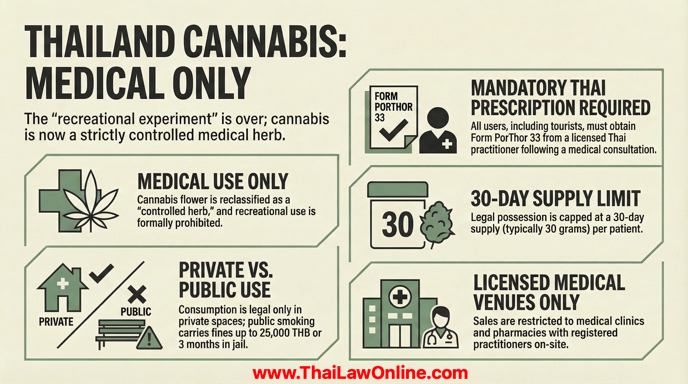
Table of Contents
Last reviewed: 4 September 2026. The 2026 regulatory content on this page was read against primary texts rather than against summaries. The Ministry of Public Health notification on controlled herbs (cannabis) B.E. 2568 was read in full from the Government Gazette (volume 142, special part 229 Ngor, page 8, 25 June 2025): clause 1 (in force the day after publication, so 26 June 2025), clause 2 (repeal of the B.E. 2565 notification), clause 3 (only the inflorescence is the controlled herb) and every limb of clause 4, which carries the licensee’s record and reporting duty, the sale-only-to-licensees rule and its prescription exception, the GACP sourcing requirement, the ban on selling for smoking at the premises, the vending machine and online bans, the advertising ban, the list of places where sales are prohibited, and the thirty-day limit on a prescription. The Ministerial Regulation on permitting the research, export, sale or processing of controlled herbs for trade B.E. 2559 as amended by Ministerial Regulation (No. 2) B.E. 2569 was read in the Department of Thai Traditional and Alternative Medicine’s own consolidated text: the new clause 8/1 eligibility list, clause 4/1, clause 10 paragraph two (odour and smoke extraction), clause 11 paragraphs two and three (renewal, and the direction to refuse it), clause 14 (existing flower licences run to their own expiry) and clause 15. The Protection and Promotion of Traditional Thai Medicine Wisdom Act B.E. 2542 was read section by section for the penalty table: sections 45, 46, 49, 52, 54 and the whole penal chapter, sections 77 to 82. The Public Health Act B.E. 2535 was read for the public smoking rule: sections 25, 26, 27, 28 and 74. THC thresholds were checked against the Ministry of Public Health notification specifying Category 5 narcotics B.E. 2565, clause 1(3), and the hemp figure against clause 3 of the Ministerial Regulation on Category 5 narcotics, hemp only, B.E. 2559 and the Narcotics Control Committee announcement in force from 29 January B.E. 2564. The page’s four Supreme Court citations were separately read to their dispositions in Thai on 3 September 2026.
What this review does not cover: the Ministerial Regulation on cannabis and hemp extracts B.E. 2569 itself. It is not in any law library we hold and the Government Gazette cannot be searched by keyword, so its publication date of 26 March 2026, its thirty-day commencement, its repeal of the B.E. 2563 and B.E. 2564 regulations and the 31 December 2026 expiry of licences issued under them are taken from Thai press reporting of the instrument and from the arithmetic of the commencement clause, not from the text. Treat those four points as reliable but unverified at source, and confirm a date you are going to act on with the Food and Drug Administration.
A Brief History of Cannabis Law in Thailand
Cannabis has a long and complex legal history in Thailand. Understanding how the law evolved helps explain the current regulatory landscape.
Cannabis as a Category 5 Narcotic (1979-2022)
Under the Narcotics Act B.E. 2522 (1979), cannabis was classified as a Category 5 narcotic alongside opium and psilocybin mushrooms. Possession, production, sale, and consumption were all criminal offenses carrying severe penalties, including imprisonment of up to 15 years for possession with intent to distribute.
The law was enforced strictly. In Supreme Court Decision No. 979/2538 (1995), the Court examined a case involving cannabis possession for sale. The defendant was charged under Section 26 and Section 75 of the Narcotics Act B.E. 2522. The Court ultimately acquitted the defendant due to contradictory police testimony and circumstantial evidence, establishing an important precedent on evidentiary standards in narcotics cases, a reminder that even under strict anti-cannabis laws, the burden of proof remained with the prosecution.
Medical Legalization (2018-2019)
In December 2018, Thailand became the first Asian country to legalize medical cannabis through the Narcotics Act (No. 7) B.E. 2562 (2019). This amendment allowed licensed medical practitioners to prescribe cannabis-based treatments and enabled approved research institutions to cultivate cannabis for medical purposes.
Full Decriminalization (June 9, 2022)
On June 9, 2022, the Ministry of Public Health issued the Notification Re: Specifying Names of Category 5 Narcotics B.E. 2565, issued under Section 29, paragraph 2 of the Narcotics Code. This announcement effectively removed the cannabis plant from the Category 5 narcotics list, making Thailand the first country in Asia to fully decriminalize cannabis.
This regulatory change had profound legal consequences. In Supreme Court Decision No. 1225/2567 (2024), the Court addressed a case where a defendant had been convicted of producing and possessing cannabis without authorization under the Narcotics Act B.E. 2522 (Sections 26/2, 26/3, 75, and 76). The Court ruled that because the 2022 Notification removed cannabis from the Category 5 narcotics list, the defendant’s actions were no longer criminal offenses.
Applying Section 2, paragraph 2 of the Criminal Code (the principle that a subsequent law decriminalizing conduct applies retroactively), the Court of Appeals Region 6 was authorized to reverse the conviction on its own motion, as this constituted a legal issue of public order under Sections 185(1) and 195(2) of the Criminal Procedure Code.
Cannabis flower becomes a controlled herb (26 June 2025)
The period of broad decriminalization was short-lived. Concerns over unregulated recreational use, particularly among minors, led to a sharp policy reversal. The instrument was the Ministry of Public Health Notification on Controlled Herbs (Cannabis) B.E. 2568, signed by the Minister of Public Health on 23 June 2025, published in the Royal Gazette on 25 June 2025 and in force from 26 June 2025. It classified the cannabis flower as a controlled herb under the Protection and Promotion of Traditional Thai Medicine Wisdom Act B.E. 2542, so selling it now requires a prescription from one of the recognised professions, and it tightened the rules on sale, processing and advertising. Note what it did not do: it did not put cannabis back on the Category 5 narcotics list. Cannabis was removed from that list in 2022 and has stayed off it, which is why the Supreme Court decisions on retroactive decriminalization set out below still stand. Calling this a re-criminalization, as much of the English-language coverage does, tells you the wrong thing about your exposure: the risk sits in licensing and prescription rules, not in the narcotics schedule. Reported figures put roughly 7,300 of Thailand’s 18,433 cannabis shops as having closed under the tighter rules, leaving about 11,100 trading. We have not been able to trace those numbers to an official release, so treat them as an order of magnitude rather than a count.
Two Ministerial Regulations in 2026, and They Do Different Jobs
2026 brought two separate instruments, one published on 26 March and in force from 26 April, the other published on 30 April. English-language coverage routinely merges them, which is how operators end up applying to the wrong regulator. One governs extracts, which are narcotics; the other governs the flower, which is a controlled herb.
Extracts, in force 26 April 2026. The Ministerial Regulation on permission to produce, import, export, dispose of or possess extracts of cannabis or hemp B.E. 2569 was published in the Royal Gazette on 26 March 2026 and comes into force once thirty days from publication have elapsed, which is 26 April 2026. It repealed and replaced two earlier regulations, the hemp regulation of B.E. 2563 and the cannabis regulation of B.E. 2564, so extract licensing now sits in a single instrument administered by the Food and Drug Administration. Its transitional provision is the one to diarise: a licence issued under either repealed regulation is valid only until 31 December 2026, and an operator who wants to carry on must apply under the new regulation before the old licence expires and must actually hold the new licence before continuing. Applying is not permission. Licences granted under the new regulation run to 31 December of the third year counting from the year of issue.
The flower, published 30 April 2026. Ministerial Regulation (No. 2) B.E. 2569 amended the B.E. 2559 regulation issued under the Protection and Promotion of Traditional Thai Medicine Wisdom Act B.E. 2542, which is the statute that governs the cannabis flower as a controlled herb. Its new clause 8/1 is the change that reshapes the retail market, because it decides who may hold a licence to sell, process or export the flower. In addition to the general criteria, an applicant must:
- own the premises or hold a possessory right over them, or attach the owner’s written consent;
- have a storage area of a size appropriate to the volume handled, with equipment that keeps the flower in good condition, stored separately, not mixed with anything else and not in contact with the floor;
- be one of the following: the holder of a licence to operate a healthcare establishment under the law on healthcare establishments; a licensed manufacturer or seller of herbal products; a licensed manufacturer or seller of medicines; the holder of a licence to produce Category 5 narcotics limited to cannabis or hemp extracts under the Narcotics Code; or a certified traditional folk healer under the law on the practice of Thai traditional medicine. Alternatively, the applicant may be a grower whose site supplies licensees under section 46 of the Act;
- have at least one worker trained by the Department of Thai Traditional and Alternative Medicine present in the establishment at all times it is open.
The same regulation adds a duty to install an effective odour and smoke extraction system, and directs the licensing authority to refuse renewal where the licensee has previously been suspended for failing to comply with a Ministry of Public Health notification on controlled herbs made under sections 44 and 45 of the Act. That is clause 11 paragraph three, and it is written as an instruction to the licensor, not as a discretion it may decline to exercise. Existing flower licences issued under the B.E. 2559 regulation are not cancelled: clause 14 lets them run to their own expiry, which under section 46 paragraph 3 of the Act is 31 December of the third year counting from the year of issue. The practical effect for an ordinary dispensary is a deadline rather than a ban, and the question on renewal is whether it can meet clause 8/1 at all.
Current Cannabis Law in Thailand (2026)
Since 26 June 2025, the cannabis flower has been regulated under the Protection and Promotion of Traditional Thai Medicine Wisdom Act B.E. 2542 (1999). Be precise about what was designated: clause 3 of the Ministry of Public Health notification on controlled herbs (cannabis) B.E. 2568 makes only the inflorescence of a plant of the genus Cannabis a “controlled herb” (samunphrai khuapkhum). So the flower is a controlled herb and is not a narcotic, while an extract can still be a Category 5 narcotic under the Narcotics Code. This is an important legal distinction, and it is the one most often lost in English-language coverage.
Medical Use: Legal with Prescription
Cannabis remains legal for medical purposes. To legally purchase and use cannabis, you must:
- Obtain a valid prescription (bai sang chai). Clause 4 paragraph two of the 26 June 2025 notification lists who may write one: a physician, a Thai traditional medicine practitioner, an applied Thai traditional medicine practitioner, a folk healer, a practitioner of the art of healing in the Chinese medicine branch, a pharmacist, or a dentist. It must be for a medical purpose.
- The prescription is what makes the sale lawful. Clause 4(3) otherwise requires a licensed seller to sell the flower only to another licence holder, so without a prescription an ordinary buyer is not someone the shop may lawfully sell to at all.
- The prescriber sets the quantity, and clause 4 paragraph three requires it to be what the treatment needs, for the patient’s own use, and not more than thirty days’ supply.
- There is no weight limit in the notification. Figures such as “30 grams a month” circulate widely and are not in the instrument; the quantity is a clinical judgement bounded by the thirty-day rule.
- There is also no age threshold in the current notification. The under-20 rule people remember was in the B.E. 2565 notification, which clause 2 of the B.E. 2568 notification repealed. The gate now is the prescription, and whether to prescribe for a person under 20 is the practitioner’s clinical decision.
- A shop may not sell the flower for smoking on its own premises. That is clause 4(5), and its only exception is a sale by one of the listed practitioners used in treating their own patient.
Recreational Retail: Restricted
The law does not create a single standalone offence called recreational use of cannabis flower. The practical restriction falls mainly on the licensed seller: clause 4(3) prevents an ordinary retail sale of flower unless the customer is another licensee or holds a qualifying prescription. The one-year/20,000-baht penalty under the B.E. 2542 Act applies to specified licensing offences, while public smoke or odour is dealt with under the Public Health Act and cannabis extracts remain subject to the Narcotics Code where applicable.
THC Limits
An extract of cannabis or hemp is a Category 5 narcotic unless it falls inside the exception. What makes it one is the Ministry of Public Health notification specifying Category 5 narcotics of B.E. 2565, issued under section 29 paragraph 2 of the Narcotics Code. Clause 1(3) of that notification makes an extract of any part of a cannabis or hemp plant a Category 5 narcotic and then excepts an extract containing not more than 0.2 per cent THC by weight where the plant was grown in Thailand and the extraction was licensed, and it excepts extracts of the seeds.
Two cautions, because this is where CBD sellers get into trouble. First, falling outside Category 5 is not the same as being unregulated: a compliant low-THC extract is still a herbal product, cosmetic or food, and it needs whatever registration those laws require. Second, the 0.2 per cent figure is about the extract. It is not the definition of hemp. Hemp is Cannabis sativa L. subsp. sativa, a subspecies of the cannabis plant, containing not more than 1.0 per cent THC by dry weight: that is clause 3 of the Ministerial Regulation on Category 5 narcotics, hemp only, B.E. 2559, and the Narcotics Control Committee announcement in force from 29 January B.E. 2564 requires that test to be run on the flowering tops, not on the leaves. Quoting the wrong one of those two numbers at a customs officer or an inspector is a common and expensive mistake.
Public Smoking Ban
Smoking cannabis in public is treated through the nuisance machinery of the Public Health Act B.E. 2535 (1992), and it is worth knowing how that actually works before you rely on the number everyone quotes. A Ministry of Public Health announcement of B.E. 2565 declares that causing the smell or smoke of cannabis is a public nuisance (het ramkhan) for the purposes of section 25. Sections 26 to 28 then give the local official power to order the nuisance stopped. The penalty of up to 3 months’ imprisonment or a fine of up to 25,000 baht, or both, is section 74, and section 74 punishes failing to comply with that order or obstructing the official, not the act of smoking in itself. In practice that still ends badly: you are told to stop, and ignoring it is the crime. A dispensary faces a separate and stricter rule, because clause 4(5) of the controlled-herb notification forbids selling the flower for smoking at the premises at all.
Penalties for Cannabis Offenses in 2026
Understanding the penalties is critical, especially for foreign nationals who may face additional immigration consequences. The current penalties under the controlled herb framework are:
| Offense | Penalty | Legal Basis |
|---|---|---|
| Selling, processing for trade, researching or exporting the flower without a licence | Up to 1 year imprisonment or a 20,000 THB fine, or both | Traditional Thai Medicine Wisdom Protection and Promotion Act B.E. 2542, section 46 for the licence requirement and section 78 for the penalty. Note what section 46 does not reach: buying or consuming the flower without a prescription is not an offence under this Act. The exposure there is the seller’s |
| Ignoring a local official’s order to stop cannabis smoke or odour, or obstructing the official | Up to 3 months imprisonment or a 25,000 THB fine, or both | Public Health Act B.E. 2535, section 74, read with section 25 and the B.E. 2565 nuisance announcement. The penalty attaches to defying the order, not to the act of smoking |
| Licensee breaking a condition of the controlled-herb notification, for example selling without a prescription | Suspension for up to 90 days at a time, or revocation for a serious breach. Trading on after either is what carries up to 1 year or 20,000 THB, or both | Act B.E. 2542, suspension section 52, revocation section 54, and section 78 for trading while suspended or after revocation. Renewal must also be refused where the licensee was previously suspended for breaching the notification |
| Selling the flower or a product processed from it through a vending machine, an electronic channel or a computer network | Breach of a licence condition: suspension or revocation, then section 78 if trading continues | Ministry of Public Health notification on controlled herbs (cannabis) B.E. 2568, clause 4(6) |
| Selling the flower or a processed product in a temple or place of religious ceremony, a dormitory, a public park, a zoo or an amusement park | Breach of a licence condition, as above | Notification B.E. 2568, clause 4(8). That is the whole list, it bites on sales made in those places, and it says nothing about a distance from a school |
| Advertising the controlled herb through any channel for trade | Breach of a licence condition, as above | Notification B.E. 2568, clause 4(7) |
| Producing, importing, exporting, selling or possessing a cannabis or hemp extract that is a Category 5 narcotic, without a licence | Up to 5 years imprisonment and a fine up to 500,000 THB, with heavier penalties where the act is for trade, spreads the drug among the public, or is a sale to a person under 18 or at a school, a place of religious worship or a government office | Narcotics Code, sections 93 and 148 |
| Possessing such an extract for one’s own consumption | Up to 2 years imprisonment or a fine up to 40,000 THB, or both | Narcotics Code, sections 107 and 164 |
| Consuming such an extract | Up to 1 year imprisonment or a fine up to 20,000 THB, or both | Narcotics Code, sections 104 and 162 |
Important for foreigners: A cannabis-related criminal conviction in Thailand can result in deportation, visa revocation, and a re-entry ban. It may also affect your ability to obtain a police clearance certificate in the future.
Supreme Court Decisions on Cannabis
Thai Supreme Court (Dika) decisions provide crucial guidance on how cannabis laws are interpreted and applied. Here are three landmark rulings that shaped the current legal landscape.
Decision No. 1225/2567 (2024): Retroactive Decriminalization
This pivotal ruling addressed whether a person convicted of cannabis production and possession under the old Narcotics Act could have their conviction overturned after the 2022 decriminalization. The Court held that under Section 2, paragraph 2 of the Criminal Code, when a subsequent law declares that conduct is no longer criminal, the person who committed the act is absolved of the offense. The Court of Appeals was authorized to overturn the cannabis-related convictions on its own initiative, even though the defendant did not appeal those specific charges.
Practical significance, and the part usually reported wrongly: the principle is real, but this defendant was not freed. Read to its disposition, 1225/2567 is a methamphetamine and firearms case in which cannabis counts were only two charges among many. The prosecution asked for punishment under Penal Code sections 32, 33, 80, 91, 138, 140, 289 and 371, Narcotics Act sections 4, 7, 8, 15, 26/2, 26/3, 66, 75, 76, 100/1 and 102, and the Firearms Act. The Supreme Court varied the judgment: 2 years for resisting officers with a firearm (section 138 paragraph two with section 140 paragraphs one and three, three years reduced by a third), which together with possession of a firearm, carrying it in public and selling methamphetamine for trade came to 7 years 6 months and a fine of 300,000 baht. The attempted-murder charge was dismissed. So the case shows that a cannabis count is struck out retroactively even inside a conviction that otherwise stands. It does not show anyone walking free.
Decision No. 2591/2566 (2023): No Refund of Fines Already Paid
While the decriminalization freed individuals from ongoing punishment, the Supreme Court drew a clear line at completed penalties. In this case, a defendant convicted of producing and possessing cannabis under the Narcotics Act B.E. 2522 (Sections 26/2, 26/3, 75 and 76) had paid his fine, and sought it back once cannabis ceased to be a narcotic. The Court ruled that Section 2, paragraph 2 of the Criminal Code separates the offence from the enforcement of a final judgment: whatever is still being enforced stops, but a penalty already carried out is finished and cannot be reopened. So the Court dismissed the charge and ordered the seized cannabis returned, and in the same breath held he was not entitled to a refund of the fine he had already paid.
Practical significance: Decriminalization releases you from future punishment but does not compensate for penalties already completed.
Case citations reviewed: 17 September 2026. Decisions 2591/2566 and 2939/2565 were read in Thai against the published judgments. The account of 2939/2565 below is accurate in every particular checked, including the 747 bars weighing 772.30 kilograms, the separate 15-year sentence and 900,000 baht fine, the return of all 17 items, and the Court taking the point of its own motion. For 2591/2566 the stated fine figure was removed, because that sentence was varied twice and the judgment does not record which amount was paid; what it holds is unchanged and its disposition is now given. The 2026 regulatory content on this page was reviewed separately on 4 September 2026.
Decision No. 2939/2565 (2022): Asset Forfeiture and Cannabis
This is not a criminal appeal but a forfeiture case, which is what makes it useful. The state applied to forfeit 17 items of property to the narcotics fund after a seizure of 747 bars of dried cannabis weighing 772.30 kilograms. The first objector had separately been sentenced to 15 years and a 900,000 baht fine in his own criminal case. The Court began from the definition in section 3 of the Measures for Suppression of Narcotics Offenders Act B.E. 2534: property can be forfeited only if it is connected with a narcotics offence. Once the 2022 Notification took cannabis off the Category 5 list, Penal Code section 2 paragraph two absolved the conduct and the right to prosecute lapsed under Criminal Procedure Code section 39 (5), so the property was no longer connected with any narcotics offence at all.
Practical significance: the Court did not merely note that the change “affected” the forfeiture, it ordered all 17 items returned to their owners, holding they were not property connected with an offence under sections 2, 27 and 29 of that Act. It also took the point of its own motion, because it goes to public order, under Criminal Procedure Code sections 195 paragraph two and 225. Scale was no obstacle: 772 kilograms was still cannabis, and cannabis was no longer a narcotic.
Cannabis Dispensary Rules in 2026
If you are considering visiting or operating a cannabis dispensary in Thailand, the framework is the Ministry of Public Health notification on controlled herbs of B.E. 2568, in force since 26 June 2025, as tightened by Ministerial Regulation (No. 2) B.E. 2569 of 30 April 2026. Between them they impose:
Licensing and Compliance
- Medical supervision: the sale of cannabis flower is prescription-only, so a licensed practitioner has to be involved in every lawful sale. Whether a shop must also have one physically present throughout opening hours is a staffing rule applied administratively; it is not a clause of either instrument above, and it is widely repeated online without a citation. Confirm the current staffing requirement with DTAM before you hire against it, and before you assume you can trade without it.
- GACP certification: this one is a clause, not a custom. Clause 4(4) of the 26 June 2025 notification requires that the controlled herb a licensee sells or exports come from a source certified by DTAM to the good cultivation and harvesting practice standard. What the notification does not fix is the administration around it: the processing time, the validity period and which certifying bodies are recognised are set administratively and do change, so confirm those three with DTAM before you plan around them.
- Sales license: A “License to Sell or Process Controlled Herbs for Trade” is required
- Reporting: A licence holder must report its operations to the licensing authority at least once a year, stating the quantity of controlled herb sold, exported or processed. That is clause 10(2) of the Ministerial Regulation on permitting the research, export, sale or processing of controlled herbs for trade, B.E. 2559, and under clause 11 a renewal application is filed within the last 60 days before the licence expires, so the window opens 60 days out rather than closing then. A second duty sits in the notification itself: clause 4(1) requires the licensee to keep records of the source of the herb, its use and the quantity held at the premises, and to report that to the registrar on the form the Director-General prescribes. The licence and application forms in the 2559 regime are the Phor.Tor. 9 to Phor.Tor. 13 series prescribed by the DTAM notification of 7 February B.E. 2560; the report form, the per-export notification and the prescription form are prescribed separately under clause 6 of the 2568 notification. Operators are sometimes told to file monthly; treat any monthly schedule as an administrative requirement to confirm with DTAM rather than something the regulation itself imposes.
Prohibited Activities
- Selling through an electronic channel or a computer network, or through a vending machine (clause 4(6))
- Selling in a temple or place of religious ceremony, a dormitory, a public park, a zoo or an amusement park (clause 4(8)). That is the complete list, and it is about selling in those places; the notification sets no distance from schools
- Advertising the controlled herb through any channel for trade (clause 4(7))
- Selling the flower for smoking at the premises, unless the seller is a listed practitioner treating their own patient (clause 4(5))
- Selling to anyone who is neither another licence holder nor the holder of a prescription (clause 4(3))
What This Means for Tourists and Expats
If you are a tourist or an expat living in Thailand, here is what you need to know:
For Tourists
- No casual purchases: You cannot simply walk into a dispensary and buy cannabis without a medical prescription from a licensed Thai practitioner
- Medical consultation available: Some clinics and dispensaries offer on-site consultations with licensed practitioners who can issue prescriptions if medically appropriate
- Do not create a public nuisance: Cannabis smoke or odour can trigger an order under the Public Health Act. If an official orders the nuisance stopped, ignoring the order can lead to the Section 74 penalty described above.
- Keep your prescription: If you do obtain legal cannabis, carry your prescription at all times as proof of legal use
For Expats and Long-Term Residents
- The same medical prescription rules apply regardless of your visa type
- A cannabis conviction can jeopardize your 90-day reporting, visa renewal, and long-term residency plans
- CBD below 0.2% THC sits outside Category 5 of the Narcotics Code, which is not the same as being unregulated: the product still has to comply with the herbal product, cosmetic or food rules that apply to whatever it is sold as
For Business Owners
If you operate or plan to open a cannabis-related business, consult with a Thai lawyer before proceeding. The regulatory landscape is evolving rapidly. Enforcement is real, and most of the attrition has come from shops failing to renew rather than from prosecutions. The reported closure figures, and a note on how far we can stand them up, are in the FAQ below. Businesses that want to survive need to meet the GACP standard for what they grow, employ the practitioners the prescription rules require, and keep the licence and reporting obligations current.
For company registration related to cannabis businesses, additional regulatory approvals from the Department of Thai Traditional and Alternative Medicine are required beyond standard business registration.
The ownership trap, which is where foreign operators actually get hurt. A cannabis licence is issued to a person or a company, and both of the 2026 regulations ask who the applicant is, not who stands behind them. Retail sale is a service business, so a company with majority foreign ownership needs a foreign business licence or a treaty route before it can carry it on at all. The usual workaround, putting Thai names on 51 per cent of the shares while the foreigner funds and controls the company, is the offence in section 36 of the Foreign Business Act: up to three years in prison, or a fine of 100,000 to 1,000,000 baht, or both, for the Thai nominee and for the foreigner who consents, plus a court order to unwind the shareholding and a further 10,000 to 50,000 baht a day if that order is ignored. The Supreme Court decides these cases on where the capital came from rather than on the register, so a compliant-looking 49/51 split proves nothing. We set out how the courts test it, and what a genuine restructuring looks like, in our guides to Thai nominee shareholders and the 2026 nominee crackdown.
Commonly Missed Legal Nuances
Most guides on cannabis in Thailand focus only on the headline rules. Here is what they often overlook:
- Cannabis is not reclassified as a narcotic. It is a “controlled herb” under the Thai Traditional Medicine Act, a legally distinct category with different penalties and enforcement mechanisms than narcotics
- No growing license is required. Personal cultivation is technically still permitted, but all cannabis produced must comply with GACP standards if sold commercially
- Retroactive effect of law changes. As established by Supreme Court Decision No. 1225/2567, changes in cannabis classification have full retroactive effect under Section 2 of the Criminal Code, meaning past convictions were overturned
- Police detention limits. If detained for a cannabis offense, police can hold you for a maximum of 48 hours for questioning, and judicial detention cannot exceed 84 days pending sentencing
- The 0.2% THC threshold applies to extracts and products, the cannabis plant itself (flower, leaf) is subject to the controlled herb rules regardless of THC content
Frequently Asked Questions
Is weed legal in Thailand in 2026?
Cannabis is legal in Thailand for medical use with a prescription from a licensed Thai practitioner. It was not re-criminalized. The instrument of 26 June 2025 is the Ministry of Public Health notification on controlled herbs, which made the flower a controlled herb and put its sale behind a prescription; it did not return cannabis to the Category 5 narcotics list. Unlicensed controlled-herb activities, and trading while suspended or after revocation, can carry up to 1 year imprisonment or a 20,000 baht fine, or both, under sections 46 and 78 of the Protection and Promotion of Traditional Thai Medicine Wisdom Act B.E. 2542. Extracts are a different regime and carry much heavier narcotics penalties.
Can tourists buy marijuana in Thailand?
A licensed shop may sell cannabis flower to an ordinary customer only under the prescription exception in clause 4(3). A tourist therefore needs a qualifying prescription for a lawful retail sale. The rule is directed at the licensed seller; simple purchase or consumption of flower is not the section 46 offence carrying the one-year/20,000-baht penalty.
What is the penalty for smoking weed in Thailand?
Two different things get merged here. Selling or supplying the flower without a licence is the offence that carries up to 1 year or a 20,000 baht fine, or both, under sections 46 and 78 of the Traditional Thai Medicine Wisdom Act; buying or smoking it yourself is not an offence under that Act. Public smoking runs through the Public Health Act B.E. 2535 instead: cannabis smoke and odour is a declared public nuisance, the local official can order it stopped, and section 74 punishes ignoring that order with up to 3 months, or a fine of up to 25,000 baht, or both. Extracts are a separate and much heavier narcotics regime.
Are CBD products legal in Thailand?
Largely yes, but calling them unrestricted overstates it. An extract containing not more than 0.2 per cent THC by weight, from a plant grown in Thailand and lawfully extracted, is outside the Category 5 narcotics list under the Ministry of Public Health notification of B.E. 2565, so it needs no narcotics licence and no prescription. It is still a herbal product, cosmetic or food and must meet the registration and labelling rules of whichever of those laws applies. An extract above that threshold is a Category 5 narcotic whatever it is called on the label.
Can I grow cannabis at home in Thailand?
Personal cultivation is not explicitly prohibited, but any cannabis grown must comply with the controlled herb regulations. Commercial sale of home-grown cannabis requires GACP certification and a sales license from the Department of Thai Traditional and Alternative Medicine.
What happened to people convicted of cannabis offenses before 2022?
Supreme Court Decision No. 1225/2567 confirmed that the 2022 decriminalisation applies retroactively under section 2 of the Criminal Code, so a cannabis count is struck out even inside a conviction that otherwise stands. Read to its disposition that case is a methamphetamine and firearms prosecution in which the defendant was left serving 7 years 6 months and a 300,000 baht fine, so it is not authority that everyone convicted of a cannabis offence walked free. Decision No. 2591/2566 adds that fines already paid are not refunded.
How many cannabis dispensaries are still open in Thailand?
Reported figures put roughly 11,100 dispensaries still trading out of an original 18,433, with about 7,300 closed. We flag those as reported rather than official: they circulate widely in Thai and trade press coverage and we have not been able to trace them to a DTAM or Ministry of Public Health release. What the closed shops failed to meet came from the controlled-herb notification of 26 June 2025, which put sales behind a prescription so that a licensed practitioner has to be involved in every sale, and the pressure has increased since, because Ministerial Regulation (No. 2) B.E. 2569 of 30 April 2026 now limits new flower licences to healthcare establishments, pharmacies, herbal-product sellers, licensed extract producers and certified folk healers.
Need Legal Advice on Cannabis Law in Thailand?
Cannabis regulations in Thailand are changing rapidly, and the consequences of non-compliance can be severe, from criminal penalties to deportation for foreign nationals. Whether you are a tourist with questions about the current rules, an expat concerned about legal risks, or a business owner navigating the dispensary licensing requirements, professional legal guidance can protect your interests.
At ThaiLawOnline.com, our team offers transparent, affordable legal consultations starting at 5,000 THB. We provide AI-assisted legal research backed by human lawyer review, ensuring both speed and accuracy.
Start your case today or book a consultation with our team.
Links : Royal Thai Police
The Cannabis Industry: Opportunities and Legal Risk
The history of cannabis laws in Thailand has created new opportunities for economic growth. This is especially true in the medical and hemp industries. The history of cannabis laws in Thailand has opened new chances for economic growth. This is especially true in the medical and hemp sectors. As of August 2025, there are many chances for licensed businesses in growing, product development, and exports. The industry is expected to reach 50 billion THB by 2026. However, risks include strict licensing requirements, THC compliance, and potential changes from the pending Cannabis Control Bill.
Expats who want to start a cannabis business in Thailand must have majority Thai ownership. This means partnerships are very important. Unauthorized operations face closures and fines. Understanding these dynamics can help integrate cannabis ventures with other expat concerns like property ownership or corporate matters. Learn more about our corporate law services for expats to explore safe opportunities.Recognizing the dynamic history of cannabis laws in Thailand empowers informed decisions. For help on how these laws affect you as an expat, visit ThaiLawOnline.com or contact us for a consultation.
- The Thai Penal Code, for the offence provisions the narcotics penalties above sit alongside
- Drug offences in Thailand: arrest, bail and defence, if the question is no longer regulatory
Thai Law Updates, free by email
Plain-English updates on Thai law changes that affect foreigners: property, visas, marriage, business and wills. One short email a month from a firm practicing since 2006. No spam, unsubscribe anytime.