


Reviewed by ThaiLawOnline, a licensed Thai law firm practising in Thailand since 2006. Thai lawyer of record: Wichuda Atthamethakon, LL.M., Thai Bar Licence 3149/2556.
Last updated on
Learn about the contested divorce in Thailand. This knowledge will help you protect your rights and assets. If you are a Western expat husband in Bangkok, you may be going through a contested divorce with your Thai spouse. It’s important to understand this process. To get a divorce in Thailand, you must prove one of the legal reasons listed in the Civil and Commercial Code.
LAWYER-DRAFTED TEMPLATE · ฿990
Divorce Settlement Agreement (Bilingual English & Thai): Same-Day Amphur Divorce, Made Safe
Property division with transfer deadlines, custody, child support, debts and the full-and-final clause, prepared before you reach the registrar’s counter. Includes the land rule for foreign spouses, three ready-to-fill schedules and recognition-abroad guidance. Word + PDF, updated August 2026. บันทึกข้อตกลงท้ายทะเบียนการหย่า ฉบับสองภาษา
For how a contested case sits alongside the other family remedies, see our overview of family law in Thailand.
You will need to handle Thai-language documents and evidence. You may also have to go through mediation, which the court may suggest. You will present your case at trial. The divorce takes effect when the judgment becomes final (CCC s.1531). You then register it at the district office: until you do, it cannot be raised against a third party acting in good faith, and the civil records still show you as married. The courts’ own target for a contested first-instance case is one year from filing.
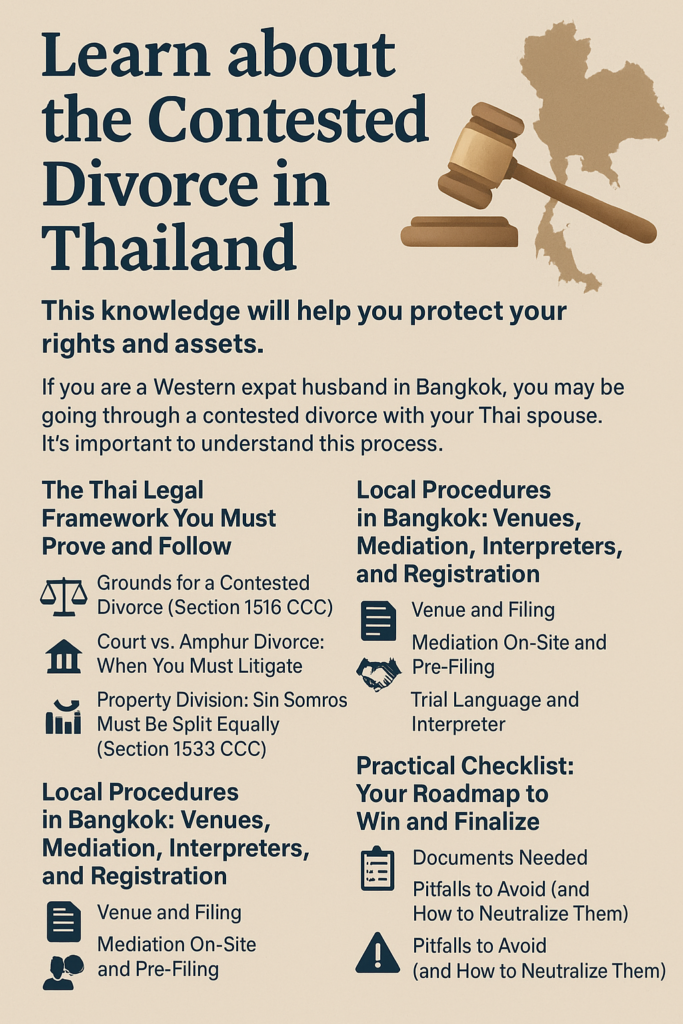
Table of Contents
The Thai Legal Framework You Must Prove and Follow
Grounds for a Contested Divorce (Section 1516 CCC)
A contested divorce in Thailand is based on fault. The person filing must prove at least one reason from Section 1516 of the Civil and Commercial Code. These reasons include :
- adultery;
- serious misconduct, or causing severe shame;
- serious physical or mental harm;
- desertion for one year;
- separation for more than three years, by agreement or under a court order;
- a spouse declared missing by the court, or gone from home for more than three years without news;
- Imprisonment for over one year;
- failure to provide support;
- insanity lasting more than three years that is unlikely to be cured and makes living together intolerable;
- Breaking a good-behavior bond;
- Having an incurable communicable disease;
- a permanent physical condition that makes sexual relations impossible (section 1516(10)).
Proof is needed, not just allegations. (If you both agree, you do not need a ground at all: see uncontested divorce.) If the plaintiff agreed to adultery or misconduct, it can stop the claim. This is according to Section 1517 of the Thai civil and commercial code. Also, if the plaintiff forgives, it can end the right to sue under Section 1518. Thai courts look at evidence based on civil standards.
They expect clear proof and support. For example, claims of adultery need more than just hearsay or single messages. These claims are stronger with witness testimony, photos, financial records, hotel receipts, or other supporting documents. Even if one reason is too late to use, those facts can still help other reasons. Successful divorce cases can also lead to compensation under Sections 1523 to 1526 when appropriate.
Court vs. Amphur Divorce: When You Must Litigate
Thailand has two main ways to get a divorce. The first is an administrative “Amphur” divorce. This happens at the district office when both spouses agree on everything. The second is a contested court divorce. This takes place in the Juvenile and Family Court when there is disagreement or when legal reasons must be shown to end the marriage.
If both spouses agree on all terms (assets division, custody of children, support), they can register an administrative divorce. This can be done at the Amphur where the marriage was recorded or at another authorized office. Both parties must be present to sign. This option is only available when there is full agreement and proper documentation. If there are disputes over terms, or if a foreign marriage needs to end under Thai law, a court case is needed. In Bangkok, the Bangkok Family Court is the right place for this. They often offer mediation services to help resolve family cases.
Property Division: Sin Somros Must Be Split Equally (Section 1533 CCC)
When a couple divorces, Sin Somros (property gained during marriage) is split equally (50/50) by default under Section 1533. Sin Suan Tua (personal property) stays with the original owner. The spouse claiming personal status must provide proof. Title name alone does not break the marital presumption for property gained during marriage. Community debts tied to household needs or the upkeep of marital assets follow the property in the same way. Therefore, documentation and tracing are important for high-value assets and debts.
The timing for liquidation varies based on whether the divorce is by agreement or judgment. If there are bad-faith transfers, they can be reversed. This is done by treating the property as still existing under Section 1534. This protects your equal share in Sin Somros under the divorce law.
The Court Process: From Filing to Registration and Appeal
Step-by-Step Flow: What To Expect in Bangkok Family Court
- Confirm Grounds (Section 1516): Find and record a valid reason (like adultery or one-year desertion). Gather supporting evidence and consider any defenses, such as consent or forgiveness, that might block the claim.
- File the Complaint (Thai-language): Your lawyer writes and files a Thai-language complaint at the right Juvenile and Family Court. For cases in Bangkok, this is the Bangkok Family Court. The complaint will mention Section 1516 and ask for help with child custody and property division.
- Thai courts really support mediation. Pre-filing mediation under Section 20 ter CPC has no court fee. It can lead to a same-day consent judgment. Post-filing mediation is also common in family courts.
- If there is no settlement, the case goes to trial. Witnesses will be examined, and documents will be proven. Foreign documents need certified Thai translations. A party who cannot speak Thai must get an interpreter. It is best to arrange this in advance when preparing for a divorce agreement.
- The court issues a judgment that ends the marriage. It also addresses custody, maintenance, and the division of Sin Somros. This is done under Section 1533. Compensation is provided where needed under Sections 1523 to 1526.
- The divorce takes effect when the judgment is final (CCC s.1531). Then register it at the district office: until it is registered it cannot be raised against a third party acting in good faith, and registration is what updates the civil records and gives you civil-status documents that match the court order.
- Appeal Window: Either party can appeal within one month of the decision. For Supreme Court appeals after the Court of Appeal, the Court of Appeal’s judgment is final (Civil Procedure Code section 244/1) and a further appeal needs the Supreme Court’s permission under section 247. Stays of execution during the appeal are at the court’s discretion.
Timelines and Scheduling: Realistic Expectations
Under the Act on Time Periods for Operations in the Justice Process B.E. 2565 (2022), the President of the Supreme Court issued a Judicial Regulation on case timeframes that took effect on 24 January 2023 (Royal Gazette vol. 140, part 5 Kor). It sets targets, not deadlines you can enforce. At first instance, a contested divorce is an ordinary case with a target of one year from filing; a case where the defendant defaults is in the fast class, with a target of six months. The appeal court and the Supreme Court each aim to decide a civil case within one year of receiving the file, and the Supreme Court aims to rule on a petition for leave to appeal within six months.
Many well-prepared, low-conflict divorces can finish in four to eight months. However, highly contested cases may take longer. This is especially true for cases with complex evidence or international issues. If an appeal is filed within one month, the process can take even more time. Efficient document preparation, readiness for mediation, and timely translation and interpreter arrangements can materially shorten timelines and reduce risk of postponements.
Evidence Strategy and Common Pitfalls for Expat Husbands
Building Persuasive Proof for Section 1516 Grounds
Thai judges depend on clear and supported documents and witness statements. For cases of adultery or misconduct, text messages alone may not be enough. They need context and proof, like hotel receipts, money transfers, photos, and witness testimony. This is especially true if the defense claims consent or questions the credibility of the evidence. Keep the original documents safe. Make sure to have certified Thai translations of foreign documents. Organize exhibits in a clear way. This helps them hold up during cross-examination and court review. Remember, the plaintiff must prove their case in a civil action.
If you seek compensation for adultery or other faults, you must plead and prove the required elements. This is under Sections 1523 to 1526 and should be done alongside the divorce. Remember to keep in mind time limits, like the one-year period for some claims. Always check if your actions could hurt your claim under Sections 1517 to 1518. Do this before choosing your main and backup reasons to plead.
Avoid These Mistakes That Lose Cases
- Assuming a divorce from another country will fix issues in Thailand can be risky. Foreign court orders may not be accepted in Thailand. This is especially true for registering and enforcing rights in Thai systems.
- Missing the language and translation requirements: all court filings and evidence must be in Thai. Foreign documents need to be translated and certified. You must get an interpreter if you cannot testify in Thai.
- Skipping mediation readiness is not a good idea. Courts expect real efforts to settle disputes. Pre-filing mediation under CPC Section 20 ter has no court fee. It can lead to a consent judgment, which is often sought in uncontested divorce scenarios. This process often saves time and money.
- If you miss a hearing, it can lead to dismissal or a bad judgment. Make sure to plan your travel. Arrange for a lawyer and request a postponement if needed.
- Misunderstanding Sin Somros rules: the title name does not decide who owns assets gained during marriage. Equal division is the starting point. This can change if there is proof of personal property or bad-faith dissipation.
Costs, Fees, and What “Hiring a Divorce Lawyer Thailand” Means.
Court Fees, Translations, and Legal Fees
For claims up to THB 50 million, the court filing fee is 2% of the claim amount capped at THB 200,000. There are different schedules for non-capital claims and other costs based on the current fee schedules. Certified translations usually cost between THB 700 to 1,500 per page depending on language. MFA legalization processing often costs THB 2,000 to 3,000. Therefore, it is realistic to budget THB 3,000 to 5,000 for important divorce papers in an uncontested divorce. This important documents include foreign marriage certificates, foreign birth certificate and others.
For contested divorce representation, prices of lawyers usually range from THB 100,000 to THB 300,000. The cost depends on factors like complexity, number of hearings, transport, interpreter and translation needs. If appeals are involved, some firms may charge over THB 300,000 for more complex cases. Appeals come with extra costs and deposits. If you win, some advanced court costs can be recovered. Planning for all costs, including execution and registration, helps you avoid cash-flow surprises.
Local Procedures in Bangkok: Venues, Mediation, Interpreters, and Registration
Venue and Filing
Contested family cases are filed in the right Juvenile and Family Court for the area. For example, the Bangkok Family Court handles cases in Bangkok. The case is filed where the defendant is domiciled or where the cause of action arose (CPC s.4). All these family court offer mediation services. Mediation is often scheduled early to help find a settlement. The complaint must be filed in Thai. Any document in another language will need to be translated and certified. This follows the language rules in the Civil Procedure Code.
Mediation On-Site and Pre-Filing
The Bangkok Family Court and other family courts often have mediation programs. You can also ask for court-supervised mediation before filing a case under Section 20 ter CPC. This option has no court fee and can lead to a consent judgment if both sides agree. If a mediator was appointed and the mediation fails, a limitation period that ran out after you applied, or would run out within 60 days of the mediation ending, is extended to 60 days from that end (section 20 ter, last paragraph). This extra time can be important for keeping your claims safe while you prepare a strong complaint.
Trial Language and Interpreter
All documents and filings related to the divorce agreement are in Thai. Foreign documents need certified Thai translations. If you do not understand Thai, you must get an interpreter. Request approval for the interpreter and plan ahead to avoid delays. This will help ensure accurate testimony. Coordinating interpreter support and making bilingual term glossaries for your lawyer can help in court. This can improve clarity and efficiency during questioning. CPC section 46 puts the duty to provide the interpreter on the party who needs one.
District Office Registration After Judgment
The divorce already has effect once the judgment is final (CCC s.1531), but either spouse should register it at the district office (Amphur): until then it cannot be raised against a third party acting in good faith, and the civil records still show you as married. Bring the judgment, the court’s certificate that it is final, and your ID. In Bangkok, offices like Bang Rak are well-known for marriage and divorce registrations. Proper registration helps with recognition for administrative and consular processes. If you will use documents abroad, follow the translation and legalization steps. Work with the MFA and relevant embassies to meet divorce law requirements.
Practical Checklist: Your Roadmap to Win and Finalize
- Confirm grounds: Find valid reasons under Section 1516, like adultery or one-year desertion. Plan your evidence and check for any consent or forgiveness defenses under Sections 1517 to 1518.
- File a complaint: Write a complaint in Thai. Include reasons and additional requests, like custody and Sin Somros division. Then, file it in the Juvenile and Family Court with translated evidence.
- Mediation hearing: Go to court-annexed mediation. Use pre-filing mediation (Section 20 ter) when needed to get a consent judgment and speed up timelines.
- Trial: Present witnesses and documents. Make sure all foreign documents are translated and certified. Arrange for an interpreter early if you do not speak Thai.
- Judgment: Expect the court to address divorce status, parental power, maintenance, and equal division of Sin Somros under Section 1533 (with compensation where applicable).
- Registration: If the court grants a divorce, register it at the Amphur. Bring the court order and IDs. This will update civil records and help you get necessary certificates for use in Thailand and abroad.
- Timeline: Plan for about 4 to 12 months at first, depending on how complex it is and how well we work together. An appeal must be filed within one month of the judgment being read (CPC s.229).
Documents Needed
- Marriage certificate (translated if from another country) is essential for divorce proceedings.
- Identification (passport for foreigners and Thai ID and Ta bian baan for Thai people). Passport often have to be translated and legalized.
- Proof of reasons (such as photos, financial records, hotel receipts, and witness statements)
- Any prenuptial agreement
- Parenting and asset schedules for mediation
Pitfalls to Avoid (and How to Neutralize Them)
- To support claims of adultery or misconduct, use strong proof. This means having more than just chat logs. Include receipts, photos, and witness statements. Make sure translations are accurate and meet court standards to avoid being thrown out.
- Plaintiff’s own actions: Remember to consider consent or forgiveness defenses. Also, note the one-year limit for some claims. Structure your pleadings carefully to avoid losing under Sections 1517 to 1518 and 1529.
- · Forum shopping abroad: An overseas divorce might not solve Thai registration, enforcement, or parenting issues. Make sure to align your strategy with Thai procedures and register the results correctly.
- Ignoring property assumptions: The title name does not determine assets gained during marriage. Prepare tracing for Sin Suan Tua claims. Gather evidence for dissipation remedies under Section 1534.
- If you get a bad outcome, you have one month to appeal. You need permission for a Supreme Court review. Talk to your lawyer right away about your appeal options and any stays.
Bilingual Terms You’ll See in Court Papers (This could be helpfun for you)
- เร่งรัดคดี (reng-rat-kadi): expedited case scheduling/request, used to ask the court to move faster where justified.
- การฟ้องหย่า (kan fong-ya): filing a divorce complaint, the Thai term you’ll see on the plaint caption.
- คำพิพากษา (kam pipaksa): judgment, the written decision dissolving the marriage and deciding custody and property.
- สินสมรส (sin somros): marital property, subject to equal division under Section 1533.
- อำนาจปกครองบุตร (amnat pokkhrong but): parental power/child custody decided by agreement or judgment in the child’s best interests.
Why Hire Our Divorce Lawyer Thailand Team Now
As an expat husband, you need a Thai-English legal team for effective legal representation in Thailand divorce cases. They should draft clear Thai pleadings. They must check your evidence against Section 1516 standards. They should also help settle cases in court mediation when it benefits you. Finally, they must fight for custody and property outcomes. ThaiLawOnline can help you.
These outcomes should consider Thai laws and your contributions. We regularly prepare accepted translations, arrange trusted interpreters, and help with registration at offices in Bangkok, like Bang Rak. This ensures your final judgment is recognized and can be used for your next legal and personal steps, both in Thailand and abroad. The first strategy call helps us find your strongest points. We will identify the evidence we need and create a mediation plan that fits your goals. This way, you can act confidently within a realistic timeline and budget.
FAQs about Contested Divorce in Thailand
What are the grounds for a contested divorce in Thailand?
Section 1516 lists twelve grounds. These include adultery, desertion, abuse, long-term separation, and imprisonment. At least one of these must be proven in court for a contested divorce.
How long does a divorce court case take in Thailand?
First-instance timelines usually take about 4 to 12 months. This depends on how complex the case is. Appeals can add more months to the divorce process, complicating the legal representation needed. The courts’ own target is one year from filing for a contested case, and six months where the defendant does not appear (Judicial Regulation B.E. 2566).
Do I need to appear in person for a Thai divorce hearing?
Yes, contested cases need party testimony. If you cannot speak Thai, get an interpreter. Also, translate all foreign documents into Thai according to the Civil Procedure Code.
Conclusion
The quickest way to get a good divorce in Thailand is to have a clear plan. This plan should use Thai language and focus on Section 1516 grounds. You need strong evidence and be ready for court mediation. It is also important to manage the division of Sin Somros and custody carefully. After that, register your divorce quickly. If necessary, you can file an appeal within one month to protect your legal grounds.
As a Western expat husband in Bangkok, you will gain a lot from a local, bilingual team. They can translate your facts into acceptable Thai evidence. They will help you navigate mediation and trial effectively. They will also assist in finalizing your status at the Amphur. They manage costs, timelines, and cross-border documents. This way, you can move on with confidence. When you are ready, we will check your grounds and exhibits. We will plan your settlement and trial strategy, focusing on the best interests of both husband and wife. Then, we will file right away to get interim protections and the final judgment you need.
Links : Juvenile and Family Court in Thailand
Last reviewed: 27 September 2026. Read in Thai: Civil and Commercial Code ss.1516, 1529 and 1531; Civil Procedure Code ss.4, 20 ter, 46, 229, 231 and 244/1; the Judicial Regulation on case timeframes B.E. 2566 (Royal Gazette vol. 140, part 5 Kor). The court fee, translation, legalisation and lawyer fee figures, and the interpreter practice notes, are practice guidance and were not checked against a primary source.
What will it cost? Contested divorces start at around 70,000 THB depending on complexity. See the full divorce cost breakdown (2026) and our published legal fees.
Thai Law Updates, free by email
Plain-English updates on Thai law changes that affect foreigners: property, visas, marriage, business and wills. One short email a month from a firm practicing since 2006. No spam, unsubscribe anytime.