


Reviewed by ThaiLawOnline, a licensed Thai law firm practising in Thailand since 2006. Thai lawyer of record: Wichuda Atthamethakon, LL.M., Thai Bar Licence 3149/2556.
Last updated on
Apply in person at the Immigration office that covers your address. Bring your passport with your current visa page and latest entry stamp, your TDAC arrival record, proof of your address, two passport photographs and the office’s own application form. The fee ranges from free to 500 baht depending on the office, most offices issue the certificate within one to a few days, and the certificate is valid for 30 days from the date of issue.
Before you go, check that your landlord has filed the TM.30. If your arrival was never reported, Immigration will refuse the application. This is the single most common reason people are turned away.
Last reviewed: 3 September 2026, against the Immigration Act B.E. 2522 in Thai, read from the Office of the Council of State consolidated text and cross-checked against a second consolidated copy that agrees word for word: section 37(5) for the 90-day notification, section 38 for the house master’s 24-hour notification, section 76 for the fine not exceeding 5,000 baht plus 200 baht a day, section 77 for the section 38 penalty, and the Act’s Schedule of Fees for the residence-certificate ceilings. The form numbers and government fees were read from the Immigration Bureau’s own published procedures for TM.15, TM.16, TM.17 and form TM.18. The proof-of-address letter this guide describes has no statutory basis in the Act and no TM form number, which is why its fee and validity are office practice rather than law.
Understanding the Certificate of Residence in Thailand
The five steps
- Confirm the TM.30 was filed. Look for the receipt in your passport, or ask your landlord for the digital confirmation. If it is missing it must be filed first. Section 77 of the Immigration Act punishes a failure to notify under section 38 with a fine not exceeding 2,000 baht, and 2,000 to 10,000 baht where the person who should have notified is a hotel manager. The duty, and the fine, fall on the house master or the hotel rather than on you.
- Gather the documents and photocopy them. Sign every copy in blue ink: most offices reject black.
- Go to your local Immigration office in the morning. Usual hours are Monday to Friday, 8:30 to 12:00 and 13:00 to 16:30. Take a queue number.
- Submit and pay. The officer checks the file and may ask about your address. Keep the receipt, you need it to collect.
- Collect the certificate. Some offices issue the same day, others take up to three weeks.
What to bring
- Passport, with a valid visa and your latest entry stamp, plus copies
- TDAC arrival record (the Thailand Digital Arrival Card, which replaced the TM.6)
- Proof of address: rental agreement, house registration, a landlord’s letter, a utility bill in your name, or the TM.30 itself
- Two passport photographs, 4 x 6 cm, white background, taken within the last six months. Polaroids are not accepted
- The application form, available at the office
Cost and waiting time by office
- Bangkok, Chaeng Watthana: 200 baht, 1 to 14 days
- Pattaya, Jomtien Soi 5: 300 baht, 1 day. Known to be more flexible with tourist-visa holders
- Chiang Mai, Airport Road: about 50 baht postage, certificate mailed in 3 to 5 weeks, or 500 baht express issued the next working day (apply in the morning, lease of at least 3 months)
- Phuket Town: 500 baht, about an hour
- Hua Hin: no fee, 2 to 8 days
- Samut Prakan: no fee, 7 to 14 days
Immigration offices set their own fees and timescales for this document, so treat the figures above as what has been reported rather than a national tariff. Most offices issue a certificate valid for 30 days, but that period is office practice and not a rule of the Act, which does not govern this letter at all: the table below records one office stating 90 days and several stating no period, so confirm the validity at the counter before you rely on it.
One certificate covers one application. If you need a car licence and a motorbike licence, you must obtain two separate originals. The rest of this guide covers the exceptions, the embassy route, and what to do when an office refuses.
For expatriates and long-term travelers in the “Land of Smiles,” dealing with the bureaucracy can feel tough. It often feels less like a walk on the beach and more like a trek through a jungle. The Certificate of Residence in Thailand is very important for daily life. You will find many documents, but this one is the most essential. You may live in a condo or house, but you do not officially “exist” at that address in Thailand until you have this document.
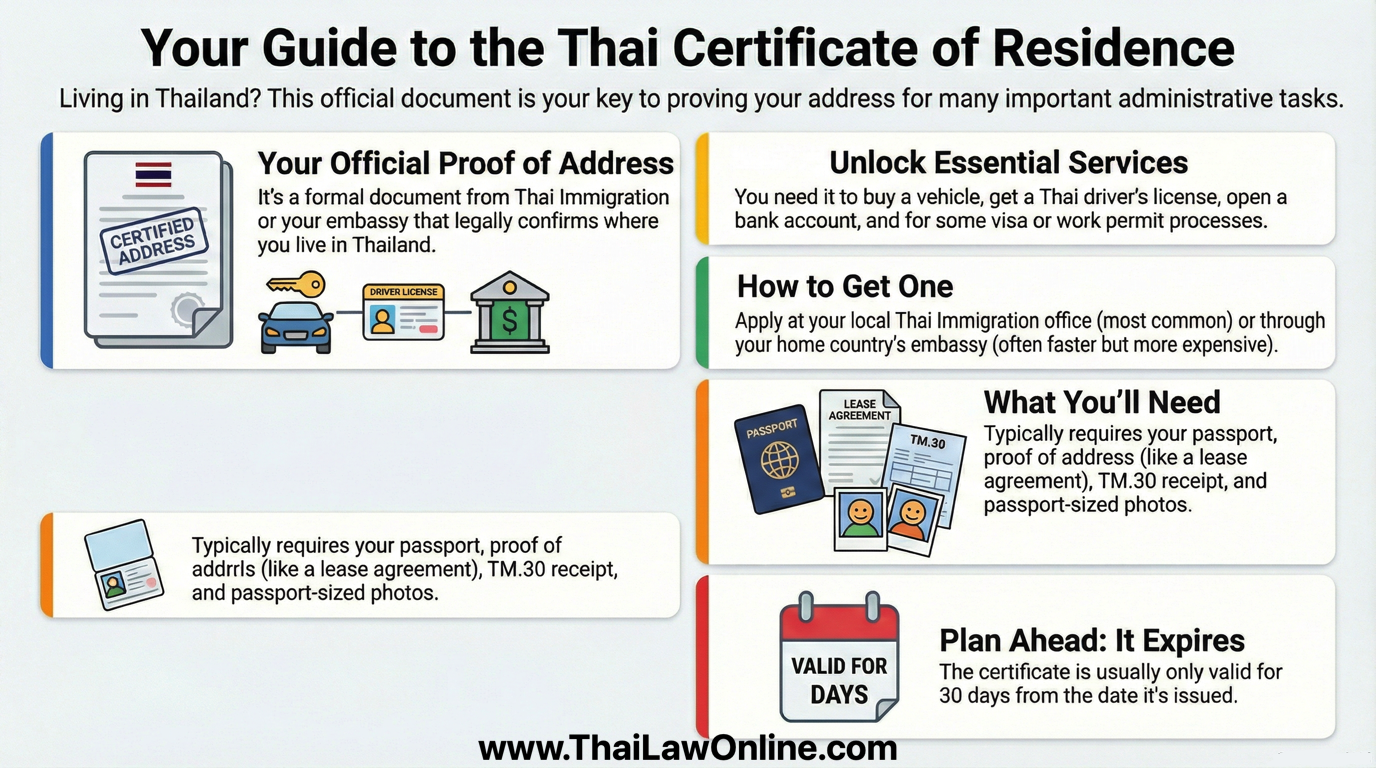
If you want to buy a motorbike, open a bank account, or get a local driving license, you need this paper. However, getting it creates a classic “chicken and egg” problem. You need proof of address to get the certificate. Yet, the certificate is often the only proof of address that authorities will accept.
This guide covers what you need to know about the Certificate of Residence in Thailand for 2026. It includes the requirements for Bangkok and Chiang Mai. It also explains the important 90-day report rule. Lastly, it discusses how the new Thailand Digital Arrival Card (TDAC) affects your application.
If you want to skip immigration lines, we can send your certificate of residence in Thailand. It costs 1,900 baht and we will mail it to your address anywhere in Thailand. See the information at the end of this article for that service.
Key Takeaways related to Certificate of Residence in Thailand
- What it is: Proof of address for foreigners in Thailand, often needed when you don’t have a house registration book.
- Where to get it: You can get it from Thai Immigration if you have a long-term visa. If you are on a tourist visa, go to your embassy.
- Why you need it: Essential for opening bank accounts, getting a driver’s license, registering vehicles, and some visa processes.
- Documents required: Passport, 90-day report receipt, TM.30 notification, lease contract, and photos.
- Cost & timing: Around 200 THB; processing can take from 1 day to 2 weeks.
Table of Contents
What is a Certificate of Residence in Thailand?
What is a Certificate of Residence? (vs. TM.30 vs. Tabien Baan)
Before diving into the application process, it is crucial to distinguish this document from other similar-sounding immigration papers. The Certificate of Residence is an official letter issued by the Immigration Bureau or, for some nationalities, a diplomatic mission. Some websites call it form TM.16, but that is not correct. In the Immigration Bureau’s own procedures, TM.15 and TM.16 are the two applications for the permanent-residence certificate, and they are priced differently: Immigration Division 1 publishes TM.15 at 19,000 baht and TM.16 at 191,400 baht, or 95,700 baht where the applicant is the spouse or the minor child of a resident alien or of a Thai national. TM.17 is the substitute for a lost or full booklet at 1,900 baht, and TM.18 is the application form used in the TM.15 and TM.16 procedures. The Act’s own Schedule of Fees caps a residence certificate under section 47 or section 51 at 200,000 baht, and at 100,000 baht in the spouse or minor-child case. The proof of address letter described in this guide has no TM form number: you simply complete the short request form that each immigration office provides at the counter. It verifies a foreign national’s current residential address in Thailand for legal and administrative purposes.
Official references: the Immigration Bureau lists the TM.15, TM.16, TM.17 and TM.18 forms and their fees on its residence certificate page, and Immigration Division 1 explains the TM.16 application. If you hold or want that status instead, see our guide to permanent residency in Thailand.
It is important to understand what this certificate is not:
• It is NOT a Visa: It does not grant permission to stay in the country.
• It is NOT the TM.30: The TM.30 is a notification by your landlord that you have arrived. While you need the TM.30 receipt to apply for the Certificate of Residence, they are different documents.
• This is NOT a Yellow Tabien Baan. The Yellow House Book (Tabien Baan) is a permanent house registration document for foreigners. A Yellow Book can eventually replace the need for a Certificate of Residence. However, getting the book is a separate and more complex process. It often requires a Certificate of Residence to start.
The Certificate of Residence is a “snapshot” document. It confirms where you live right now and is typically valid for only 30 days from the date of issue.
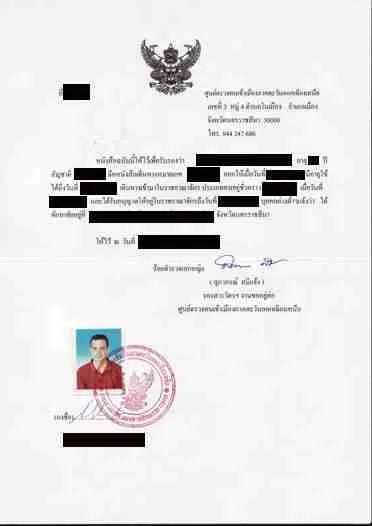
This is my own certificate of residence that I got around 2014.
Why You Need a Certificate of Residence in Thailand
You cannot navigate the Thai administrative system with just your passport. The Certificate of Residence is important. It allows you to access services at the Department of Land Transport (DLT), banks, and other government offices.
Banking and Financial Services
To open a bank account in Thailand, you usually need proof of residence. Many banks accept the Certificate of Residence as valid proof. Some banks may accept documents like work permits or lease agreements. However, the certificate gives standard proof that everyone recognizes. Since the crackdown on mule accounts that began in 2024 and 2025, most banks also require a long stay visa, a work permit or Thai family ties before opening an account for a foreigner. On its own the certificate is rarely enough anymore, and applicants on tourist entries are widely refused at the branch.
Vehicle-Related Transactions
The certificate is mandatory for purchasing vehicles, whether cars or motorcycles, in Thailand. You also need this when applying for a Thai driving license. The Department of Land Transport requires proof of your home address. Remember the “Two Certificates” rule. This means that if a resident wants both a car license and a motorbike license, they need two separate original certificates. The DLT generally requires an original for each application
Employment and Legal Processes
The Department of Employment does not normally ask for this certificate in a standard work permit application; the Department of Land Transport is where most certificates end up. Note that newer digital work permits often do not display the holder’s address, and a work permit without an address is not accepted as proof of residence for a driving licence, so even employees increasingly need the certificate. The document is also requested in some other administrative processes.
Government Services
Obtaining a Yellow Tabien Baan (foreign house registration book) requires a Certificate of Residence . This yellow house book provides foreigners with additional benefits and simplifies future bureaucratic processes.
The “Two Certificates” Rule
Here’s an important tip for expats. The Department of Land Transport (DLT) requires an original certificate for every application
If you want to apply for a car and a motorbike license on the same day, you cannot use one certificate for both. You must apply for and obtain two separate original Certificate of Residence documents from Immigration. Photocopies are usually not accepted by the DLT. You must present the original certificate but many offices will also keep a photocopy. Practice varies by office: Bangkok will not accept a certificate issued for a motorcycle licence when you apply for a car licence, while at Jomtien officers commonly accept one original listing both licences together with a photocopy. State every purpose when you apply and ask how many originals the receiving office wants.
Prerequisites: The Documents You Must Have Before Applying
You cannot simply walk into Immigration with a rental contract and expect a certificate. You must first ensure you are “in the system” through a specific chain of compliance.
The TM.30 Notification of Residence
The TM.30 is the foundation of the Thai residential tracking system. The house master, the owner or possessor of the dwelling, or the hotel manager must notify immigration that you have taken up residence, within 24 hours of your doing so. The duty is theirs, not yours. It is set out in section 38 of the Immigration Act B.E. 2522: the notification goes to the immigration office covering the address, to the local police station where there is no immigration office in that locality, and to the Immigration Division where the address is in Bangkok.
• The Trap: If your landlord has not filed this, Immigration will refuse to issue your Certificate of Residence.
The Solution: Look for the TM.30 receipt in your passport. If you can’t find it, ask your landlord for a screenshot of the digital confirmation. If it’s missing, it must be filed immediately (often settled with a fine of 800 to 1,600 baht; the statutory maximum under Section 77 of the Immigration Act is 2,000 baht, or 2,000 to 10,000 baht for hotel managers) before you can proceed. If your landlord will not cooperate, you can file the TM30 yourself as the occupant of the dwelling, online or at the office.
Benefits of Having a Certificate of Residence in Thailand
Obtaining a Certificate of Residence in Thailand offers several benefits, particularly for expatriates and long-term visitors:
- Legal Compliance: A Certificate of Residence can help you get a driver’s license in Thailand. It can also help you buy a car or motorcycle. This certificate serves as proof of your address.
- Establishing a Physical Residency: For those who plan to stay in Thailand for an extended period, the certificate helps establish your residency and integrates you into the local community. You can use it abroad to show your address or proof of residence in Thailand. The residence certificate is valid for these purposes. A yellow house book is a good proof of address when available. However, many expats use the Certificate of Residence. This document is practical for banks, DLT, and other purposes. The Ta bian baan is normally the real legal way to prove an address in Thailand.
Fees and processing times by office, which vary between offices and change without notice
| Location/Office | Service/Form Type | Requirements & Documents | Cost (THB) | Processing Time | Validity Period | Eligibility/Visa Restrictions |
|---|---|---|---|---|---|---|
| Bangkok (Chaeng Watthana) | Certificate of Residence | Passport (original + all copies), current visa page, entry stamp, TDAC confirmation, TM.30 receipt, completed 90-day report receipt, proof of address (rental contract/utility bill/house book), 2 photos (4×6 cm white background), blue ink signatures. | 200 | 1-14 days | 30 days | Non-immigrant visa status required; must have completed at least one 90-day report. Not available for 30-day visa exempt or 60-day tourist visas. |
| Bangkok (One-Stop Service Center, OSSC) | Certificate of Residence | Passport, visa, proof of address, work permit (if BOI company). | 200 | 0 days | 30 days | Primarily for BOI company employees or Thailand Privilege (Elite) visa holders. |
| Chiang Mai (Airport Road Office) | Certificate of Residence | Original passport + signed copies (photo, visa, entry stamp), TDAC confirmation, TM.30 slip, proof of address (minimum 3-month lease/house book/title deed), 1 passport photo (4×6 cm white background), TM.47 90-day receipt (for 1-year visa), application form. | 60 | 14-21 days | 30 days | Available for residents of Chiang Mai. Requires at least 30 days left on current visa. Allows tourist visa holders with lease/TM.30. |
| Pattaya (Chonburi, Jomtien Soi 5) | Certificate of Residence | Passport, TM.30 receipt, residential contract/proof of address. | 300 | 1 day | 30 days | Known to be more lenient regarding tourist visa holders. |
| Phuket (Phuket Town Office) | Certificate of Residence | Passport copy, visa copy, photo, TM.30 slip, proof of address, application form. | 500 | 1 hour | 30 days | Non-immigrant visa status or long-term address verification. |
| Phuket | Certificate of Residence | Passport copy, visa copy, photo, TM.30 slip, application form. | 0 | 1 day | Varies | Standard service; reported to take until the next day for free processing. |
| Hua Hin | Certificate of Residence | Passport, copy of visa/extension, copy of entry stamp, proof of address (lease or TM.30 receipt), 2 photos per certificate, application form. | 0 | 2-8 days | 30 days | Standard long-term resident requirements. Issued at main office; Bluport branch does not issue. |
| Samut Prakan (Sutthi Phirom) | Certificate of Residence | Passport, copy photo page, copy visa, TM.30 receipt, copy lease/house book, 2 photos, TM.47 receipt. | 0 | 7-14 days | 30 days | Requires proof of residence within Samut Prakan jurisdiction. |
| Thailand Immigration (General) | 90-Day Reporting (TM.47) | Passport, TM.47 form, current visa, TM.30 receipt, previous report slip, TDAC confirmation. | 0 | 0 days | 90 days | Mandatory for all foreigners staying in Thailand over 90 days continuously. |
| Thailand (General/Online) | TM.30 Residence Notification | Passport copy, entry stamp, visa, owner’s Thai ID/passport, Tabien Baan or rental contract, completed TM.30 form. | 0 | 0 days | Varies | The duty is the house master’s, the owner’s or possessor’s, or the hotel manager’s, not the visitor’s (Immigration Act B.E. 2522 s.38). Due within 24 hours of the foreigner taking up residence at that address, not within 24 hours of arrival in Thailand. Valid until you leave and re-enter. |
| Foreign Embassies (General) | Residence Affidavit / Consular Affirmation | Passport, potentially proof of address in Thailand (lease/utility bill), specific embassy forms. | 1500 | 1-2 hours | Varies | Available to citizens of the issuing country. Often accepts tourist visa holders. |
| British Embassy | Residency Affirmation / Certificate of Residence | Passport, proof of address if mandated by local authority, varies by specific document requested. | 2200 | 0 days | Varies | British citizens only. Required for those on 30/60 day visas who cannot use Thai Immigration. Fee listed as £50. |
| Australian Embassy | Address Verification Letter | Passport, written statement, by appointment only via Setmore portal. | 1830 | Varies | Varies | Australian citizens only. Note: Embassy cannot issue certificates for general address verification, only specific letters. |
| U.S. Embassy/Consulate | Residence Affidavit (Limited) | Passport, $50 USD fee, online booking. | 1650 | Varies | Varies | Services discontinued for DLT/driving licenses and vehicle transactions as of March 2023. |
Required Documents and Prerequisites
Begin by gathering all required documents and making the necessary photocopies. Ensure your passport photos meet the specific requirements: 4×6 centimeters, taken within six months, with a white background, and no Polaroid photos accepted. Sign all copied documents in blue ink as required by most immigration offices. You will normally need:
- Passport: A valid passport with a non-immigrant visa and your latest entry stamp into Thailand.
- TDAC (used to be TM.6 Departure Card) This was a small card you fill out when you arrived in Thailand. Today, it is a new document called the Thailand Digital Arrival Card. Starting on May 1, 2025, this digital card is required for every entry. Immigration will check these digital records with residency certificate applications more often.
- Rental Agreement or Proof of Address: You need to provide a copy of your rental agreement. You can also use your house registration. A letter from your landlord confirming your address is also acceptable. In some cases, a utility bill with your name and address can be used to get a certificate of residence. Your TM 30 can be a proof of address.
- Photos: Passport-sized photos (usually two) as specified by the Immigration Office.
- Application Form: Completed application form for the Certificate of Residence, which can usually be obtained at the Immigration Office.
Additional Documentation Requirements
You may need to provide extra paperwork based on your situation to get the certificate. If you’re renting, copies of your landlord’s identification documents and property ownership papers may be required. For those staying with family or friends, additional witness statements and property documentation might be necessary.
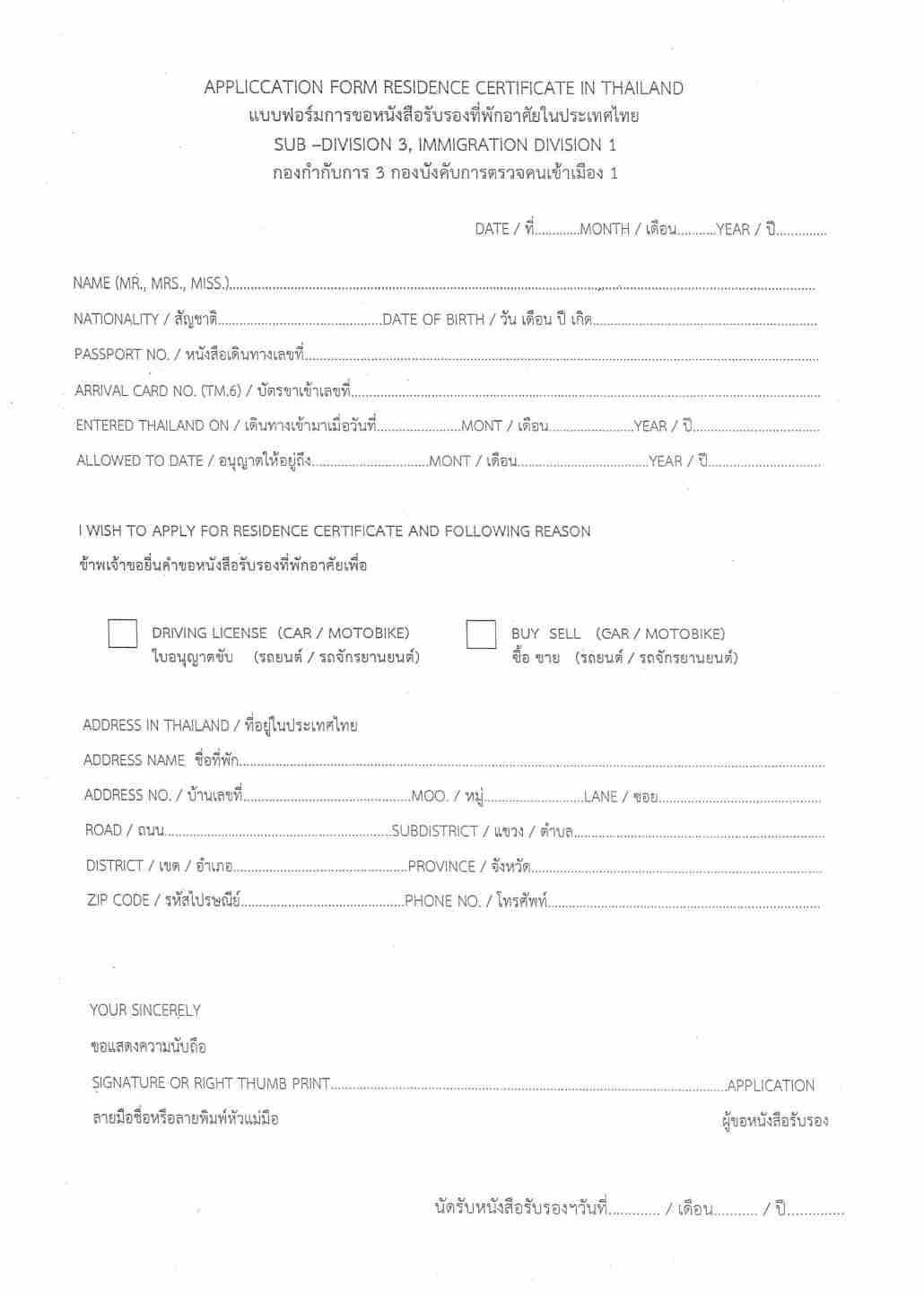
You can download the current application form for Bangkok here.
Submission and Processing
Visit your local immigration office during open hours. These are usually Monday to Friday from 8:30 AM to 12:00 PM and 1:00 PM to 4:30 PM. Take a queue number and wait for your turn to submit documents. The immigration officer will review your paperwork, verify your information, and collect the application fee.
Upon successful submission, you’ll receive a receipt that must be presented when collecting your certificate. Processing times differ by location. Some offices offer same-day service, while others may take up to 15 working days for official procedures.
The process of applying for a Certificate of Residence in Thailand typically involves the following steps:
- Gather Required Documents: Ensure you have all the necessary documents prepared and copies made as required.
- Visit the Local Immigration Office: Go to the Immigration Office in the area where you reside. It’s recommended to go early to avoid long wait times.
- Submit Application: Submit your application form along with the required documents. An officer will check your application and may ask questions about your residence. Some immigration offices have their forms and there used to be a TM
- Pay the Fee: Pay the required fee for processing your Certificate of Residence. Keep the receipt as proof of payment.
- Processing Time: The processing time can vary from office to office. In most cases, you will receive your certificate the same day.
- Collect Your Certificate: Once your application is approved, you will be notified to collect your Certificate of Residence.
Collection and Validity
Return to the immigration office at the specified time to collect your Certificate of Residence. Most offices see a certificate as ‘recent’ if it was issued within 30 days. However, the exact time frame can vary. It depends on the office that issued it and the agency that uses it. If you need the certificate for multiple purposes, you must apply for separate originals.
Fees and Processing Times by Location
The cost and processing time for a Certificate of Residence can vary a lot. This depends on the immigration office and the service level you choose. Unlike standardized visa fees, immigration offices have discretion over certificate fees, which can be around 200 baht.
Bangkok and Major Cities
In Bangkok, the main immigration office at Chaengwattana typically charges 200 THB with processing times of 1 to 5 working days, though you should allow up to two weeks in busy periods. This represents the most commonly reported fee structure for the capital city. In Bangkok, all signatures on application forms and photocopies must be in blue ink. Black ink is a primary cause for summary rejection.

Chang Watthana immigration in Bangkok.
✅ True Story Alert: Sometimes, real life writes the funniest scripts.
I remember a story from Nakhon Ratchasima that stuck with me. Around 2008 to 2010, a foreigner went to complain about the price of the Certificate of Residence. Well, that complaint didn’t go the way he probably hoped. After that, the immigration office in Korat completely stopped offering the service for several months. People were frustrated. However, the truth is that the law did not require immigration to provide these certificates. Eventually, they started offering the service again, but the price had gone up a lot. This shows you that I work with certificate of residence for more 20 years and it has not changed a lot.
Moral of the story: Sometimes it’s better to pick your battles and keep your mouth shut. I’m not a fan of corruption, but I do appreciate efficiency. When life teaches, you’d better listen.
Regional Variations
Outside Bangkok, fees and processing times can differ substantially. Pattaya’s Chonburi office charges 300 THB but offers same-day service, while Chiang Mai runs a standard service for about 50 baht postage, with the certificate mailed out in 3 to 5 weeks, and a 500 THB express service with next-day pickup. Some offices, like Hua Hin, Samut Prakan and Krabi, offer free standard processing, and Hua Hin and Krabi also sell a 500 baht same-day express. However, this may take longer. You can also choose expedited service for extra fees, which may include costs for the certificate.
Alternative Methods: Embassy Route
If you cannot get a certificate from immigration offices or need it quickly, your home country’s embassy can help. This option is particularly valuable for tourists or those who haven’t completed the 90-day reporting requirement. Do note that not all embassies offer this service and you must verify with your own embassy.
Embassy Advantages and Costs
Embassy-issued certificates typically take 1-2 hours to process, making them ideal for urgent needs. However, this convenience costs more. Fees range from 1,500 to over 3,000 THB. The amount depends on your nationality and the embassy you use. The British Embassy, for example, offers 45-minute service but charges premium rates. The U.S. Embassy stopped issuing residency affidavits in March 2023, and the Australian Embassy states on its notarial services page that it will not witness a statutory declaration or issue any document verifying an address in Thailand. This change forced citizens of those countries to use the Thai Immigration system. Before paying any embassy, also confirm that your Department of Land Transport office still accepts embassy letters, because some now insist on the immigration certificate
Embassy Requirements
Embassy requirements often differ from immigration office requirements, potentially accepting tourist visa holders or those without 90-day reporting history. However, embassies may have their own specific document needs. It is best to contact your embassy for exact details.
Important Considerations and Alternatives
When deciding to apply for a Certificate of Residence, consider several important factors. Think about which route to take.
Alternative Documents
If you have a work permit or Yellow Tabien Baan with your name, you might not need a separate Certificate of Residence. These documents can serve as proof of address for most purposes, potentially saving time and money. Banks and other institutions often accept these alternatives as valid residence verification.
Many years ago, I had a client who wishes to purchase a car. It could have been around 2007-2010 but I can’t remember. The dealership in Udon Thani wanted a document to show his address. We went to the police station, made a police report. The police report stated that this person was living at an address X. They didn’t ask any lease, no document.
That police report was ACCEPTED by the dealership as a proof of address. This shows that you must be sometimes creative in Thailand and the law is often not respected. The police could have refused to give us a police report, but they accepted. The dealership of course would take seriously a document from the police: Why not!
Timing and Planning
Given the 30-day validity period, timing your application is crucial. Only apply for the certificate when you need it right away. You cannot store the document for later use. Plan your applications accordingly if you need certificates for multiple purposes.
Regional Office Differences
Immigration offices operate with varying interpretations of requirements and procedures. What works in one office might not work in another. It is important to check the specific requirements with your local office before applying. Some offices are more accommodating to tourists, while others strictly require long-term visa status.
Relationship with Other Immigration Documents
Understanding how the Certificate of Residence relates to other Thai immigration documents helps provide context for the application process.
TM.30 Foundation
The TM.30 address notification serves as the foundation for most immigration services, including the Certificate of Residence. It must be filed within 24 hours of the foreigner taking up residence at the address, which is not the same moment as arrival in Thailand, and the duty falls on the house master, the owner or possessor of the dwelling, or the hotel manager. It sets the legal basis for checking their residence. Without a proper TM.30 filing, obtaining a Certificate of Residence becomes impossible.
90-Day Reporting Connection
The 90-day reporting requirement demonstrates ongoing compliance with Thai immigration law. Many immigration offices view completed 90-day reports as evidence of established residence, making this a practical prerequisite for certificate applications. Section 37(5) applies to any foreigner granted temporary stay who remains in the Kingdom more than 90 days, not only to non-immigrant visa holders. Anyone whose permitted stay has been extended past the ninety day mark owes the report, whatever category it started in.
Your Own Reporting Duties Under Section 37
The TM.30 is somebody else’s duty. Section 37 of the Immigration Act B.E. 2522 puts four separate duties on the foreigner personally, and most guides cover only the last of them. They apply to anyone granted temporary stay, which is nearly everyone reading this page.
- Live where you said you would. Section 37(2): you must reside at the address notified to the officer. Where for good reason you cannot, you must notify the change within 24 hours of taking up the new residence.
- Tell the police when you move. Section 37(3): on changing residence you must notify the police station for the district you have left, within 24 hours of moving. Where the new address falls in a different police district, you must also notify the station covering the new address, within 24 hours of arriving there.
- Tell the police if you stay overnight in another province. Section 37(4): if you travel to any province and remain there more than 24 hours, you must notify the local police station within 48 hours of arriving. In practice a hotel’s own TM.30 filing is what immigration works from, and 37(4) is rarely enforced against a visitor, but it sits on the statute book and it is your duty, not the hotel’s.
- Report every 90 days. Section 37(5): if you remain in the Kingdom more than 90 days you must notify your address in writing to the immigration officer without delay on completing 90 days, and again every 90 days after that. This is the TM.47.
The penalty almost nobody quotes. Section 76 punishes a failure under section 37(2), (3), (4) or (5) with a fine not exceeding 5,000 baht and a further fine not exceeding 200 baht for each day until you put it right. The daily element is what turns a forgotten 90-day report into a real number, and it is why a late report is worth filing the moment you notice rather than waiting for the next one to fall due.
Set that against the TM.30 route and the difference is clean. Section 38 is the duty of the house master, the owner or possessor of the dwelling, or the hotel manager, and section 77 punishes a breach with a fine not exceeding 2,000 baht, or 2,000 to 10,000 baht where the person in breach is a hotel manager. Two duties, two duty holders, two penalties, and a Certificate of Residence application can be refused because of either one.
FAQs: Certificate of Residence in Thailand
What is a Certificate of Residence and why is it important?
A Certificate of Residence in Thailand (also called a Residency Certificate) is an official document. It is issued by the Thai Immigration Bureau or a foreign embassy. Some embassies provide their own proof-of-address letters. These embassy letters are different from the certificate issued by Thai Immigration. Some Thai agencies require the immigration version. This certificate confirms a foreign national’s current address in Thailand. It is not an immigration status. It is the standard legal proof of address needed by government agencies and private institutions to handle administrative tasks.
What are the most common uses for this certificate of residence in Thailand?
You will likely need this document for the following activities:
• Department of Land Transport (DLT): Applying for or renewing a Thai driving license and registering or transferring vehicle ownership.
• Banking: Opening a new savings or current account at most Thai banks.
• Legal & Civil Affairs: Registering for marriage, obtaining a Yellow House Book (Tabien Baan), or applying for parental/custodial powers.
• Employment: Some instances of applying for or renewing a work permit.
Who is eligible to apply for the certificate of Residence in Thailand?
Foreign nationals who are legally in Thailand can apply. This usually includes those on a non-immigrant visa or extension. They must also have a verifiable address in the country. Applicants are generally required to be “in the system,” meaning their TM.30 address notification must be up to date.
What are the standard documentation requirements?
While requirements can vary by office, you should generally prepare the following:
• Original Passport plus signed photocopies of the bio-data page, current visa/extension, latest entry stamp, and TDAC (Digital Arrival Card) confirmation.
• Two Passport Photos: Typically 4cm x 6cm with a white background, taken within the last six months.
• TM.30 Receipt: The notification slip filed by your landlord confirming your address.
• Proof of Address: A valid lease agreement, property title deed, or a yellow house registration book.
• 90-Day Report Receipt: Many offices, particularly in Bangkok, will only issue the certificate once you have been in the system for some time (often evidenced by at least one 90-day report), but this is not an officially uniform rule.
Where must I apply for the certificate?
You must apply at the provincial Immigration Office that has jurisdiction over your residential area. For residents in Bangkok, this is the Chaeng Watthana Immigration Office.
What is the cost and processing time?
• Fees: The official service is sometimes free, but most offices charge an administrative fee between 200 and 500 THB. Some provincial offices offer expedited same-day service for approximately 1,000 THB.
• Processing Time: It usually takes 1 to 5 business days in Bangkok. However, immigration allows up to 15 working days.
How long is the certificate valid?
A Certificate of Residence is generally valid for 30 days from the date of issue. Due to this short validity, you should plan your application carefully. This will help ensure it is still valid for your bank or DLT appointment.
Can tourist visa holders obtain a residence certificate?
The policy for tourists varies by location:
• Bangkok: Chaeng Watthana typically does not issue certificates to tourists, but the obstacle is the length of the stay, not the visa category: most Bangkok offices want a completed 90-day report, and a visa exemption or a 60-day tourist entry never runs long enough to produce one.
• Provincial Offices: Some offices outside Bangkok, like Pattaya (Chonburi), can give them to tourists. Tourists need to show a TM.30 and proof of address.
• Embassy Option: Tourists unable to use Immigration should check if their home country’s embassy provides a proof of address letter, which many Thai institutions accept.
Are there alternatives to this certificate?
If you have a Work Permit or a Yellow House Book (Tabien Baan), you may not need a residence certificate. These documents can often serve as a substitute. You can use them for transactions with the DLT or banks.
What are the common reasons for application rejection?
• Missing TM.30 Notification: Rejection is immediate if the address in the system does not match your application.
• Black Ink Signatures: At the Chaeng Watthana office, all signatures must be in blue ink.
• Incomplete Copies: Photocopies must include all relevant passport pages, including the latest entry stamp and visa page.
• Address Discrepancies: The address on your lease, the TM.30, and your application form must be identical
Can I get a Certificate of Residence on a Tourist Visa?
Generally, no. Most Bangkok offices ask for a completed 90-day report, and a stay short enough to be a visa exemption or a 60 day tourist entry never reaches ninety days, so there is nothing to show. The obstacle is the length of the stay, not the visa category. Provinces: Yes, often. Offices in Pattaya, Phuket, and Samui are used to tourists buying motorbikes. They will often give you the certificate if you have a TM.30 and a rental contract. ThaiLawOnline can offer you that service for 1,900 baht. See at the end of our article.
Can I use a rental contract instead of the certificate?
For opening a bank account, some branches might accept a rental contract + TM.30 receipt. However, for the Department of Land Transport (Driving License/Vehicle Registration), a rental contract is not accepted. You must have the official government-issued Certificate of Residence.
What if my landlord hasn’t filed a TM.30?
You cannot apply. The officer will check the system, see no record of you at that address, and reject the application. You need to make the landlord file it online. Alternatively, you can hire a visa agent to help with the filing. This often means paying the landlord’s fine.
Can I use a digital copy?
No. For official purposes, like the DLT or transferring a car title, you need to show the original document. This document must have a wet signature and an official stamp. Photocopies are rejected.
Conclusion
Obtaining a Certificate of Residence in Thailand requires careful preparation, proper documentation, and understanding of local procedures. The process may seem complicated. However, if you follow the steps and meet all requirements, you will successfully apply. The document’s importance for various life activities in Thailand makes it a worthwhile investment for most foreign residents.
Getting a Certificate of Residence in Thailand requires meeting some important steps. You need to complete the TM.30 notification and the 90-day report. This certificate is your “golden ticket” to living in Thailand. Without it, you cannot legally drive, own a vehicle, or easily access banking services.
To ensure success in 2026:
1. Verify your landlord has filed the TM.30.
2. Wait until you have done your first 90-day report (if in Bangkok).
3. Prepare two sets of documents if you need licenses for both a car and a motorbike.
4. Use blue ink for all signatures.
ThaiLawOnline is offering a NEW SERVICE should you wish a Certificate of Residence. We will need a copy of your passport and other information and our full fees in advance. It will be posted to you in 5 working days. Please write to info@thailawonline.com for any request about certificate of residence in Thailand.
- The current website of Thailand immigration does not explain this service anymore (September 2024)
- Complete Guide on Certificate of Residence in Thailand that you can download (PDF).
Thai Law Updates, free by email
Plain-English updates on Thai law changes that affect foreigners: property, visas, marriage, business and wills. One short email a month from a firm practicing since 2006. No spam, unsubscribe anytime.