


Reviewed by ThaiLawOnline, a licensed Thai law firm practising in Thailand since 2006. Thai lawyer of record: Wichuda Atthamethakon, LL.M., Thai Bar Licence 3149/2556.
Last updated on
In the past, a man could marry a woman by sneaking into her room at night and announcing it in the morning. In Thailand, there are two types of marriages: civil and traditional/pseudo-religious. A Buddhist marriage in Thailand is not a legal marriage. Dowries are given to the women’s families, not the men’s. The wedding party usually starts early in the morning so guests can rest in the afternoon.
Thai weddings are filled with tradition, fun, and sometimes confusion. This article looks at Buddhist marriages in Thailand. These Buddhist marriages in Thailand are not legally recognized. However, many couples also have a legal marriage.
A ceremony and a legal marriage are two separate things in Thailand, which we explain in our guide to family law in Thailand.
Last reviewed: 8 September 2026. This page was telling readers that a same-sex couple could not yet marry in Thailand and that this would change during 2025. Same-sex couples have been able to marry here since 23 January 2025, and that passage has been corrected. The legal statements on this page were read against the Thai text in our own annotated Civil and Commercial Code: sections 1435 and 1437 on betrothal, khong man and sin sod, 1448 and 1458 on who may marry and on consent, 1457 on registration being what creates a marriage, and 1466 on prenuptial agreements. What this review did NOT check, said rather than implied: none of the money amounts on this page comes from a source we hold, including the photography, gift and dowry figures, and the gold weight in the engagement section was corrected as arithmetic only, because how much gold the custom calls for is not something we can verify. The ceremony, procession and reception sections are cultural description rather than law and were not part of this review.
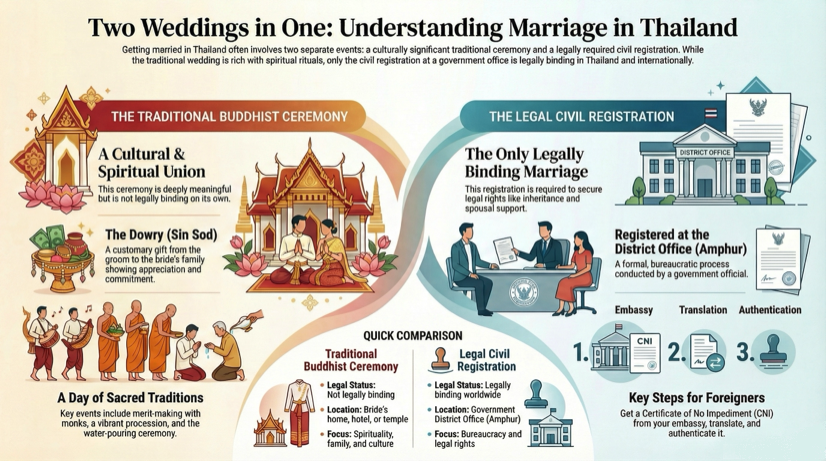
Table of Contents
Technical Matters about Buddhist Marriage in Thailand
1. Engagements
As marriage leads to babies, so does marriage spring forth from engagements, which are also a part of Thai tradition. In Thailand, couples do not use engagement or promise rings like in the West. Instead, they have a thong mun ceremony. During this ceremony, the groom promises to marry his sweetheart. He does this by offering gold, usually weighing 2 baht, which is about 30.4 grams: one baht of gold weighs about 15.2 grams.
A Buddhist marriage in Thailand is very important. It often shows the couple’s commitment to cultural traditions and family values. Each part of the ceremony honors the families of both the bride and groom. It shows how important community is in a Buddhist marriage in Thailand.
In many cases, a Buddhist marriage in Thailand includes rituals. These rituals show the couple’s love for each other, their families, and the community. This deep-rooted respect for tradition is what makes a Buddhist marriage in Thailand unique and meaningful.
In practice, the parents of the bride and groom would meet before the ceremony. They would discuss the couple’s suitability and start planning the dowry and wedding. Nowadays, this formal engagement is often skipped. Couples may simply ask for their parents’ blessings. Prenuptial Agreements are not necessary if the marriage is a buddhist marriage as it is not a legal marriage.
Divorce rates are rising in Asia. More money is also flowing into Thai households. Many couples now choose prenups. These prenups are binding under Thai law. They can outline rights and ownership in case of divorce. It’s just like lawyers to spoil the romance! Prenups are still rare among most people. However, they are becoming a new tradition for Thai-foreigner couples. This change is likely due to worries about differences in money and language barriers. A Buddhist marriage is not a legal marriage in Thailand. Prenuptial agreements are only for the legal registration, which is the legal marriage.
Traditional Buddhist Marriage in Thailand vs Civil Marriage
In Thailand, there are two types of marriage. Only one type is legally binding. The other type is enforced by social norms. The state requires couples to register their marriage to have it recognized by Thai courts. This is very important for finances and child custody. You can register easily by bringing the right paperwork to the local district office. This is called Amphoe or Khet in Bangkok. An officer will help you create a marriage certificate. These civil marriages are respected around the world. They may be enough for the local community to recognize the couple’s union.
In every part of the world, marriage is a traditional act. It gives couples social status and acceptance in their community. This status aligns with the values of that community. In Thailand, it is common to have a traditional wedding ceremony along with a civil marriage. Sometimes, people have the traditional ceremony instead of the legal one.
Same-sex marriage is widely accepted in Thailand, and since 23 January 2025 it has also been lawful. The Civil and Commercial Code Amendment Act (No. 24) B.E. 2567 replaced the Code’s references to a man and a woman with two persons, so section 1458 now reads that a marriage may be made when two persons consent to be spouses of each other, and any couple may register at a district office on the same terms as any other. Traditional ceremonies for these unions are common, and, exactly as for an opposite-sex couple, the ceremony is not the marriage: only the registration is. Another quirk is that monks cannot marry. However, many events in a man’s life may lead him to become a monk for a short time. These events include the death of a parent, atonement for sins, or fulfilling promises to spirits. Here’s an article that goes deeper into same-sex marriage in Thailand.
In these cases, a man’s marriage is seen as ended when he becomes ordained. Many Thai couples choose to re-marry in a small ceremony after the man returns to lay life. This does not affect the legal standing of the marriage, however. Confusing!
The rest of this article will deal with the traditional Thai wedding: we’ll leave the civil unions to the bureaucrats!
Understanding the nuances between a civil marriage and a Buddhist marriage in Thailand can help couples navigate their options effectively. While civil marriages are legally binding, a Buddhist marriage in Thailand is more focused on spiritual and cultural significance.
In Advance
Preparations for weddings in Thailand are in some ways similar to those in the rest of the globe. Who to invite, what food to prepare, times, locations, and the other standard questions unite couples worldwide. However, Thais have some unique differences. The most obvious is a trip to a fortune teller, or maw doo. They go to find the best (lucky) date for the ceremony. Generally couples will decide to marry and then ask for dates within a few months, so that things get over and done with quickly.
Another oddity is wedding photography, with studios currently cropping up like weeds across the country. Wedding pictures are not new. However, many couples now pose in their full wedding outfits for portraits before the big day. These pictures are often shown on invitations and at the wedding hall. They are like movie posters that advertise upcoming films. Portraits usually cost between $3,000 and $5,000. So, it might be a good idea to buy a nice camera and some online Photoshop tutorials!
2. The dowry in Thailand (it is not a legal obligation but a custom)
Dowry is perhaps the biggest part of preparation, for the groom at least, is never taken lightly. In a Buddhist marriage in Thailand, the couple’s parents decide the amount of dowry. This amount shows the woman’s worth and the man’s commitment to the Buddhist marriage in Thailand.
Many families see the dowry as an important part of a successful Buddhist marriage in Thailand. It helps strengthen the bonds between the families. No Thai law requires a dowry and no court will order anyone to pay one, but the Civil and Commercial Code does regulate what becomes of it: section 1437 defines sin sod as property given to the parents, adoptive parent or guardian of the betrothed person in return for that person agreeing to marry, and it can be reclaimed only where the marriage does not take place for an important cause attributable to that person, or because of circumstances that side is responsible for. Our page on sin sod in Thailand sets out when it can and cannot be recovered.
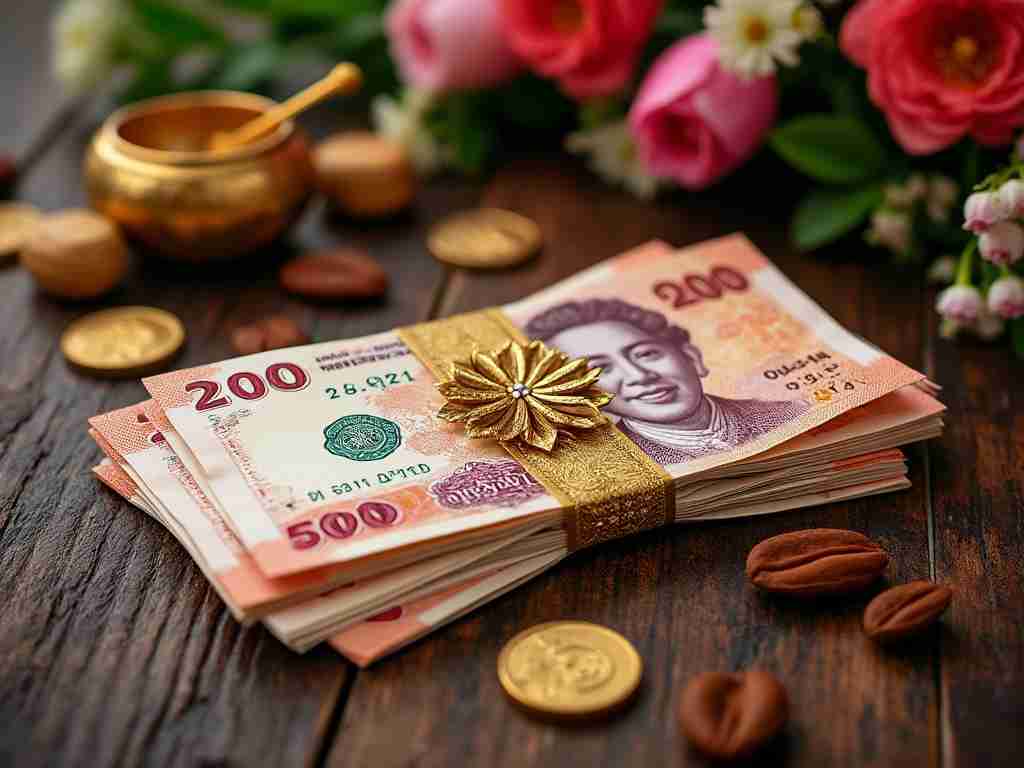
Do not worry, this is not real money. Be sure it will be real at your Buddhist marriage in Thailand!
The reason for this tradition is that the dowry shows appreciation to the bride’s family for raising her. This likely comes from a time when working sons were seen as their parents’ retirement plans. Daughters had few other ways to thank and support their parents. In modern times, it’s becoming very common for the bride’s family to keep a piece of gold jewellery. They will often return the rest of the dowry to the young couple to help them start off their married life.
Finally, costume, one of the highlights of the Thai wedding. Thai bridal dresses usually range from white to gold and are beautifully flattering 1-shoulder dresses down to the ankle. The groom usually wears a lightly embroidered Thai-style jacket and trousers that match the bride’s color. The best part is that they often rent the outfits together from the same shop! The practical Thais know you won’t wear the costume again. This is true even if you marry again. They have thrown out the “dress in a box in the attic” sadness!
The Standard Traditional Buddhist Marriage in Thailand
Traditional Thai weddings usually follow a general pattern. However, each village has its own unique customs. This means you won’t get bored at your first dozen ceremonies!
3. Get Up Early to Feed the Monks
Bride and groom to be will make merit by feeding a lavish meal to monks on the morning of their wedding day. The bride usually wakes up early to get her hair and makeup done. The groom, on the other hand, often gets out of bed feeling a bit hung-over. He quickly puts on his suit. Then, he takes on the main job of feeding the monks. This is because women cannot touch monks or hand things to them directly.
Male relatives also help with setting out the meal. Monks are invited in odd numbers, usually between 3 and 9. Before they eat, the monks pray and chant with a male village elder. They then offer blessings to the couple.
Monks also give symbols of beauty. They draw designs on the couple’s foreheads with white paste. They drape flower garlands around their necks. They place crowns made of white cotton string on their heads.
Following the blessings, the monks eat their meal in silence, bringing merit to the couple for their donation. Monks also receive money in envelopes (as they’re not supposed to touch money directly) as thanks for their role.
Here Comes the Groom in a Buddhist Marriage in Thailand
Traditionally, Thai weddings take place at the bride’s family home. Whether she still lives with her parents or not, this shows her family and where she comes from. The groom’s family comes to take her away to a new life. Today, many Thais, especially in cities, are choosing to have their weddings at hotels. They like the good prices, convenience, and organization. In the case of the hotel, the hall is first for the bride’s family. The groom’s family has to enter later.
And parade in they do! The kabun mak, or betel nut procession, is a fun part of the wedding. The groom is danced to the bride’s location. His friends and family sometimes carry him on their shoulders or even on an elephant’s back! The procession includes drummers and wailers (Oh-e-oh-e-oh-e-oh-e-ohhhhhhhhhh! Whew!), and possibly a whole band.
Family and friends bring gifts of fruit, candy, liquor, and always banana trees and sugar cane cuttings. These will be planted at the couple’s new home. In the past, fancy betel nut processing sets were the centerpiece gifts, giving the procession its common name. Be careful, the procession can take a while if people are enjoying themselves. Thais often call this party train “walking forward 2 steps and back 3”!
When the groom arrives at the bride’s family home, he will meet her family. They will hold thin chains to block his way. He will pay them to let him pass. He usually has envelopes of money, often 100 baht, in his jacket. Depending on local traditions there may be a lot of bribing to do for the determined groom.
Inside the bride’s room
Once inside the bride’s home, the gifts are set up in front of her family. Everyone gathers, and the fun begins. The Actual Ceremony
We call it confusion because no two weddings are ever the same. The only person who knows what to do is the male elder. He is invited to run the show. The bride and groom also each have a family member to be their helpers. They are told to hurry this way and that. They help the couple with many Buddhist prayers. They also do spirit-pleasing rituals. They bow and scrape to parents and grandparents. There are many more confusing activities. This part usually has the couple kneeling for up to 30 minutes. They kneel in front of parents and elders. The parents and elders may sit on the floor or in chairs.
The part that everyone watches carefully though is the presentation of the dowry, sin sot, which the groom pays to the bride’s family. This is laid out nicely with a fan of stacks of cash and velvety bags of gold jewellery. The bride’s mother makes big show of accepting the dowry and then carrying it away hunching under such a heavy burden.
Blessings are given and respects paid, and somewhere along the way the couple become married, though no one seems to know when exactly
4. Into the Bedroom!
If the wedding is at the bride’s home, a special bridal chamber is set up and decorated. Near the end of the ceremony, the couple is guided to the bed. There, they receive advice from older women. On how spouses should behave in the union. Nothing too racy though!
The couple lies down and closes their eyes. The man goes first, while the woman stays up to care for the home. Money is hidden in the bed, including coins and a 1000-baht bill. When told to open their eyes, the couple rushes to grab the money. The partner who finds the biggest bill is likely to control the finances in the future.
The wedding ceremony ends with giving gifts and thanking guests. Special thanks go to the elders for joining the celebration.
5. The Party
A typical Thai reception begins in the early morning. It continues through the ceremony and into the afternoon. Recently, a separate evening reception has become more common. However, it is still usual for guests to arrive around 8 AM. They often sit at tables under the house and in the yard. Then, they start drinking whisky and beer.
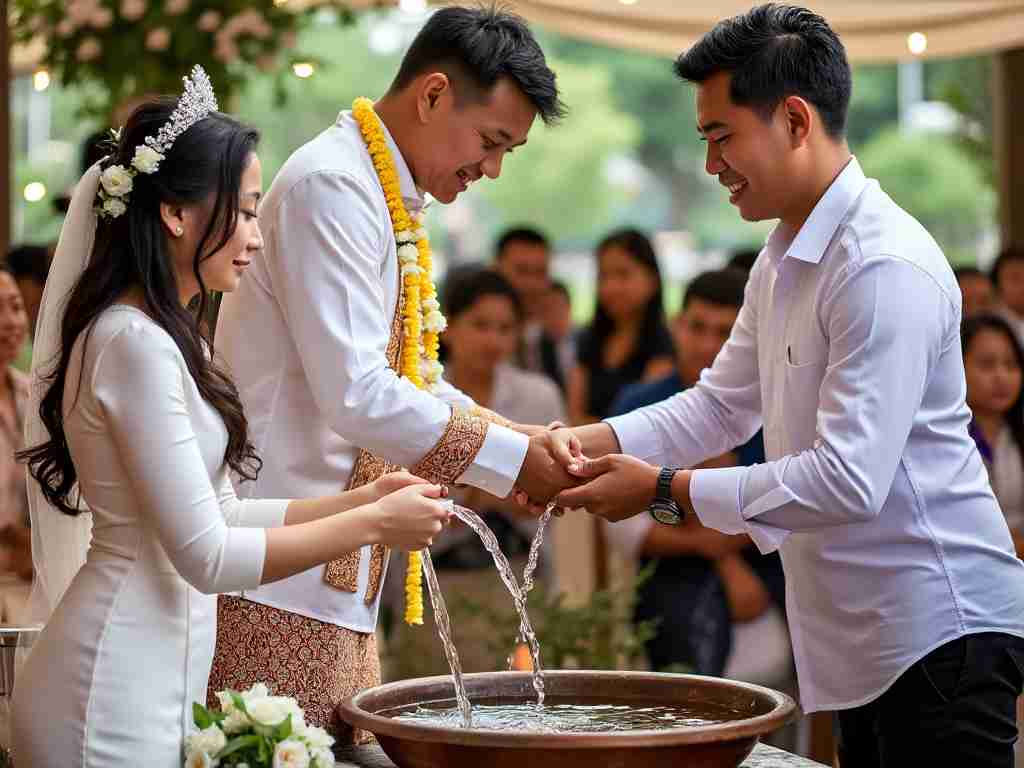
To connect these guests to the ceremony, which family and close friends usually attend, we do several extra activities. Speeches are often given to everyone after the ceremony. Guests can tie lucky cotton strings around the couple’s wrists. They can also pour water over their hands while they wai and offer blessings. During this time, the couple’s cotton string crowns are tied together to show their bond. Afterward, the couple will visit each table to greet guests and take photos together.
Lots of food and karaoke are the characteristic party closers, and guests will tend to drift off home in the mid-afternoon.
The rest of the day is for cleaning up. However, the married couple can sneak away to enjoy time together and relax.
As a Guest, Your Presence and Appearance
The best way to learn about Thai weddings is to attend one. If you don’t have your own wedding soon, consider accepting the many invitations you will likely receive. This is especially true during the dry season from October to May.
In fact it’s poor form to turn down an invitation unless you really have a good excuse, like out of town business. This doesn’t mean that you have to go for very long however. Even if you pop in and show your face, this counts as having attended. You can stay longer if you want. You can join the guests who are partying, eating, and drinking. You don’t have to watch the ceremonial parts if you don’t want to.
As a guest, you’re expected not to outshine the bride and groom, and what you wear is determined by where the wedding is. Hotels usually mean you have to dress up a bit, while at a home wedding you can get away with jeans and a clean shirt. Older guests still wear their finest, usually Thai silk shirts for men and dress suits for women, plus gold jewellery.
Presents and how does a Buddhist Marriage in Thailand works
It’s common to give a gift at weddings around the world. In Thailand, many guests now choose to sai song. This means they put money in an envelope for the new couple. In small towns neighbours will toss in 20-100THB while more ‘high-so’ guests, especially at hotel weddings, will give 500-1000THB. This is a common practice. Most weddings have a large, heart-shaped paper box for envelopes. The presents table is often empty.
If being entertained, wined, and dined isn’t enough for you, guests receive a small thank you gift when they leave. These are normally small and useless collectables to be kept in a showcase memorial to all those good times.
So that’s the Thai wedding in a nutshell! Unless you are a hurt ex, weddings are happy events. They are full of joy and fun. In a Buddhist marriage in Thailand, there is a small ceremony. This ceremony reminds everyone how important the new bond is. Wish your friends a happy and healthy life together. You can also try marriage yourself. Just make sure you know what you are getting into!
If you want to get married in Thailand, ThailawOnline.com can help. They offer reasonable fees and explain the whole process.
- Other information about Buddhist marriage in Thailand
Frequently Asked Questions
Is a Buddhist marriage ceremony legally binding in Thailand?
No. A Buddhist or religious ceremony is not legally binding on its own; only registration at the district office (Amphur) creates a legal marriage.
How do foreigners legally register a marriage in Thailand?
You obtain an affirmation of freedom to marry from your embassy, have it translated and legalised, and then register the marriage at a district office.
Can we have both a Buddhist ceremony and a legal marriage?
Yes. Many couples hold the Buddhist ceremony for tradition and separately register the marriage at the Amphur to make it legally valid.
Is a marriage registered in Thailand recognised abroad?
A marriage properly registered in Thailand is generally recognised internationally, though you may need legalised translations of the marriage certificate.
Do we need a prenuptial agreement before marrying in Thailand?
It is optional but advisable. To be enforceable, a Thai prenuptial agreement must be registered together with the marriage at the district office.
Thai Law Updates, free by email
Plain-English updates on Thai law changes that affect foreigners: property, visas, marriage, business and wills. One short email a month from a firm practicing since 2006. No spam, unsubscribe anytime.