


Reviewed by ThaiLawOnline, a licensed Thai law firm practising in Thailand since 2006. Thai lawyer of record: Wichuda Atthamethakon, LL.M., Thai Bar Licence 3149/2556.
Last updated on
Foreign Business Act offences and deportation
The 2026 deportation regulation was published on 27 August and took effect on 28 August 2026. Deportation is a separate decision from the criminal sentence. Clause 5 includes immigration offences, unlawful work and Foreign Business Act offences; its separate five-year category concerns an offence’s statutory imprisonment threshold, not a requirement for every foreign defendant to receive a five-year sentence. Prison authorities must give at least 15 days’ notice before the relevant release. Suspended sentences and fine-only outcomes are also referred for consideration. Referral does not itself mean an automatic deportation order.
A nominee arrangement therefore creates immigration exposure as well as corporate and criminal exposure. Clause 5(3) expressly covers offences under the law governing foreign business. A company filing or later restructuring does not erase an earlier offence or guarantee continued permission to stay.
Thai authorities have dramatically intensified their pursuit of business crimes, particularly targeting nominee structures used to circumvent foreign ownership restrictions. From September 2024 to May 2025, enforcement agencies handled 861 nominee business cases. These cases caused economic damages over 15.3 billion baht (which is approximately $450 million USD). The enforcement covers more than just nominee companies. It includes a wider range of business crimes. Authorities are pursuing 57,739 cases of illegal goods. They are also investigating 46,918 high-risk companies that may use nominee structures. This increase in enforcement highlights ongoing issues with recent actions against nominees in Thailand. These issues involve the law and court cases.
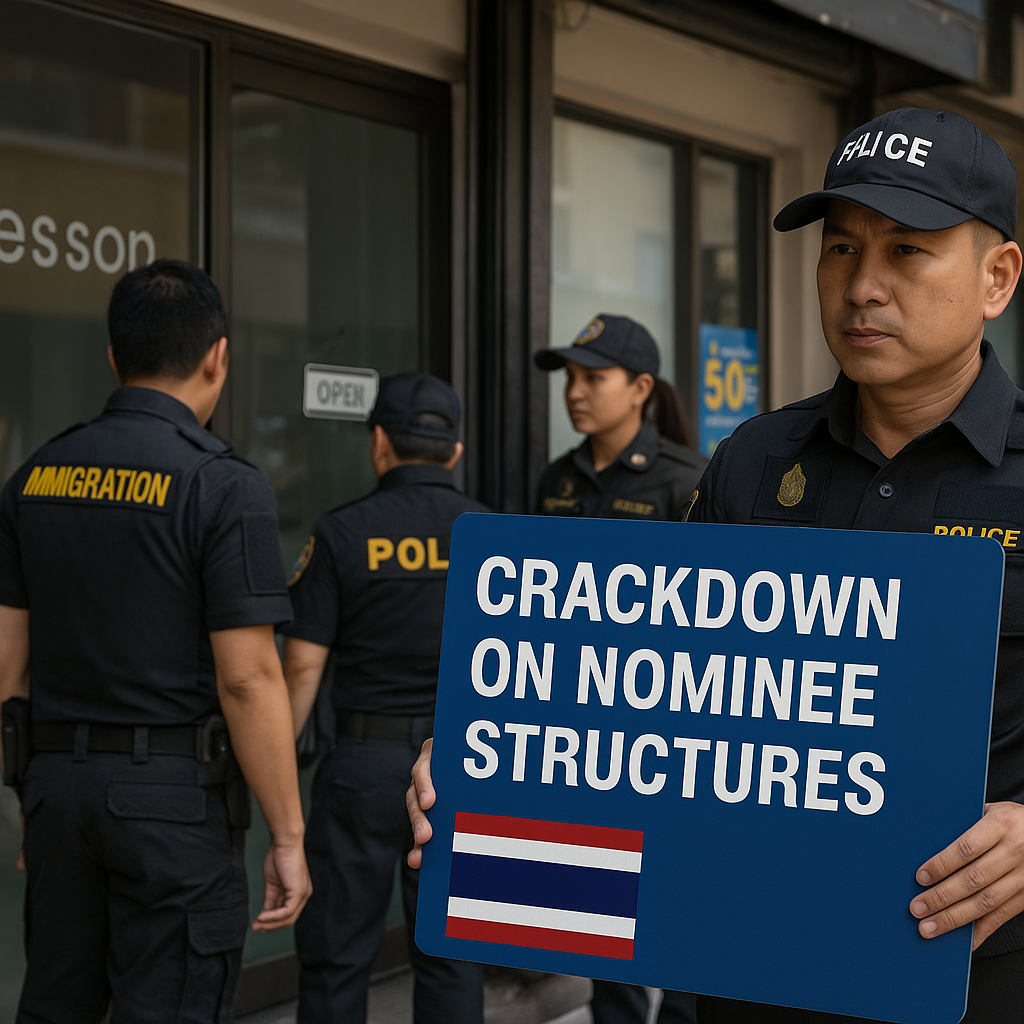
The crackdown has been particularly intensive in Thailand’s key tourist destinations. In Phuket, authorities arrested 231 suspects. This group includes 98 foreign nationals, mostly from Russia. They also seized assets worth over 1.5 billion baht. The investigation found a complex network. Individual foreign nationals controlled many companies using Thai nominees. One Russian woman was an executive and shareholder in nine companies. These companies had a total registered capital of 38 million baht.
This enforcement effort represents more than isolated cases, it reflects Thailand’s systematic approach to protecting its economy from illegal foreign business operations. Commerce Minister Pichai Naripthaphan has made this a national priority. He has told agencies to act quickly against what they see as a threat to Thai small and medium businesses.
Disclaimer: This article is for general information. Consult a licensed Thai lawyer for your situation.
Table of Contents
Recent Court Decisions and Legal Precedents
Landmark Criminal Court Ruling: Case A.2812/2567
The most important recent event happened on September 11, 2024. The Criminal Court made a key decision in Case No. A.2812/2567. This case involved 23 defendants who were part of nominee arrangements in Phuket. This case, investigated by the Department of Special Investigation (DSI), involved a law and accounting firm that orchestrated nominee arrangements for approximately 60 companies.
The court gave 10-year prison sentences to all 23 defendants. However, they reduced the sentences to 5 years because of confessions and clean records. The sentences were then suspended for 2 years with 1-year probation and 200,000 baht fines for each defendant. The court ordered the companies involved to dissolve right away. They will face daily fines of 10,000 baht if they do not comply.
The Recent Crackdowns on Nominees in Thailand: the Law and Court Cases have raised significant awareness about the legal ramifications for foreign investors and the operations of nominee structures.
This important case shows that Thai courts are giving big penalties. They are also being a bit lenient with first-time offenders who help the authorities. The case involved law firms and accounting firms. They acted as middlemen, providing Thai nationals as nominee directors and shareholders. This allowed foreign nationals to run restricted businesses and own real estate.
Supreme Court Legal Doctrine
Thai Supreme Court practice looks at substance rather than form when a shareholding is challenged: who actually paid for the shares, who takes the profits and who makes the decisions. The test in the statute itself is section 36 of the Foreign Business Act, which reaches a Thai who holds shares on behalf of an alien, or who presents an alien’s business as his own, so that the alien can operate a restricted business.
An agreement whose object is to evade a statutory prohibition is void under section 150 of the Civil and Commercial Code, so a side agreement with a nominee gives the foreigner no enforceable rights. Investigators apply strict scrutiny to see if Thai shareholders have made real investments or are just helping foreign control. This legal approach makes it hard for businesses to defend nominee structures. Courts look at financial capacity, fund sources, and real business participation instead of just formal documents.
Legal Framework and Penalties
Foreign Business Act Violations
The Foreign Business Act B.E. 2542 (1999) serves as the primary legal framework prohibiting nominee arrangements. Section 36 specifically criminalizes both Thai nationals who act as nominees and foreigners who use nominee structures. The penalties are severe:
- Imprisonment up to 3 years
- Fines ranging from 100,000 to 1,000,000 baht
- Daily fines of 10,000 to 50,000 baht for continued violations
- Forced business closure and dissolution
- Asset seizure under proposed Anti-Money Laundering Act amendments
Section 37 talks about foreigners who run businesses against the law. It sets penalties like jail time, large fines, and stopping business operations. The Act also includes daily penalty provisions that can result in massive accumulated fines for ongoing violations.
Enhanced Enforcement Through Anti-Money Laundering Amendments
Thai authorities have drafted changes to the Anti-Money Laundering Act B.E. 2542 (1999) that would classify nominee arrangements as predicate offenses for money laundering. The Anti-Money Laundering Office put that draft out for public comment on the government’s central legal system at law.go.th from 26 March to 24 April 2025. Its stated reason names Thai nationals who assist, support or hold shares for foreigners in breach of the Foreign Business Act, alongside beneficial ownership, court jurisdiction and penalties. The draft has not been enacted. On the sources open to us in September 2026, the consolidated Act that the Anti-Money Laundering Office itself publishes still runs only to Amendment No. 6 B.E. 2565 (2022), and its section 3 does not list Foreign Business Act offences among the predicate offences. If the draft becomes law, it would grant authorities expanded powers to:
- Seize and freeze assets of both Thai nominees and foreign beneficiaries
- Confiscate assets permanently for the state
- Investigate complex financial networks supporting nominee structures
- Impose money laundering charges carrying heavier penalties than Foreign Business Act violations alone
The amendments define acting as a nominee. This includes “helping, supporting, or engaging in business operations of foreign nationals who cannot operate such businesses.” It also includes “holding shares for foreign nationals in partnerships, limited companies, or other legal entities.” Public consultation on the draft closed on 24 April 2025; as noted above, it had not been enacted by September 2026.
Advanced Detection Systems and Enforcement Technology
Intelligence Business Analytics System (IBAS)
Thailand is using new technology to find nominee structures. This will be done through the Intelligence Business Analytics System (IBAS), a big-data screening tool which the Commerce Ministry said in 2025 was expected to be operational from August 2025 (Bangkok Post). The ministry’s committee urged fast integration of data from these agencies:
- Revenue Department (tax records and financial data)
- Customs Department (import/export activities)
- Land Department (property ownership records)
- Royal Thai Police (criminal investigation data)
- Anti-Money Laundering Office (suspicious transaction reports)
The IBAS system can find nominee structures by looking at financial problems. This includes Thai shareholders who do not get their fair share of dividend income or hidden management fees paid to foreigners. The system flags companies where individual nominees hold shares in multiple entities without demonstrable financial capacity to support such investments.
Targeted Enforcement Sectors
Two overlapping lists of high-risk sectors were published in 2025, one by the Commerce Ministry for the flagged companies and one by the Department of Business Development for its inspections. Together they cover:
- Tourism and related businesses
- Real estate and land trading
- Hotels and resorts
- Transportation and logistics
- Construction
- Agricultural land trading
- E-commerce and warehousing
The Commerce Ministry’s committee flagged 46,918 potentially risky companies with foreign ownership between 0.001% and 49.99% (Bangkok Post, May 2025), and the Department of Business Development set itself 26,830 companies to inspect in 2025. That ownership range captures companies kept just below the 50% mark. Being below this mark keeps them from being classified as foreign under the Foreign Business Act.

Recent High-Profile Prosecutions and Convictions
Phuket Real Estate Network
In February 2025 Phuket police arrested two Chinese nationals accused of using Thai nominees. They operated restaurants, international schools, hotels, car rental businesses, condominiums, and luxury villa developments. The total value of these businesses was about 1 billion baht. Police seized 4.1 million baht in cash and raided accounting offices involved in document falsification.
The case, reported by The Thaiger on 26 February 2025, shows the pattern investigators look for: an accounting office producing the paperwork, and the same Thai nominee shareholders appearing across companies in unrelated business lines.
POSCO Engineering Case
In a big corporate case, the DSI sent a South Korean executive of POSCO Engineering (Thailand) Company Limited to prosecutors on 22 August 2024 (DSI announcement). The company was accused of using Thai employees as nominee shareholders. The South Korean-affiliated construction company generated over 9 billion baht in revenue while allegedly avoiding proper Thai ownership requirements through nominee arrangements.
This case shows that enforcement applies to both small businesses and large international companies. It sends a clear message that size or ties to foreign governments do not protect anyone from prosecution.
Russian Business Networks
After complaints to Prime Minister Srettha Thavisin, authorities looked into foreign nationals, especially Russians. They were buying businesses and property at very high prices in southern Thailand. The crackdown showed that 59,717 Russian nationals came to Phuket since the Russia-Ukraine conflict started. This happened along with 1,603 new business registrations that looked suspicious.
These investigations led to the arrests of foreign nationals from many countries. This includes Russians, Iranians, Australians, and Chinese. This shows that enforcement targets nominee structures, no matter the nationality of the foreigners.
Case Studies: Lessons from Real Enforcement Actions
Enforcement has spread beyond Phuket. In July 2026 more than 250 officers raided 18 locations in Chiang Mai against a suspected foreign nominee network, with assets put at about 633 million baht, as reported by The Pattaya News on 20 July 2026.
Key lesson: digital footprints, like emails and bank transfers, are now key to investigations. Always make sure your compliance documents are strong. These cases highlight the need for proactive legal audits. At ThaiLawOnline, we’ve assisted clients in restructuring similar setups into compliant joint ventures, avoiding enforcement altogether. Where the asset is land held through a 51/49 company, the available routes are set out in restructuring a Thai property company.
Legal Consequences for Different Parties
Thai Nationals Acting as Nominees
Thai citizens who serve as nominees face severe personal and financial consequences under both current law and proposed amendments:
- Criminal prosecution under Section 36 of the Foreign Business Act
- Asset seizure under proposed Anti-Money Laundering amendments
- Personal liability for company debts and obligations
- Reputational damage affecting future business opportunities
- No deportation, but other consequences: a Thai national cannot be deported, although a person who acquired Thai nationality by naturalisation can in some cases have it revoked under the Nationality Act
The government has given strong warnings to Thai citizens. They say that nominee arrangements hurt Thailand’s business reputation and help money laundering. Deputy Government Spokesman Anukul Pruksanusak stressed that many people become nominees “unknowingly or willingly,” but both circumstances result in identical legal consequences.
Foreign Investors and Business Operators
Foreign nationals using nominee structures face comprehensive penalties designed to eliminate any business advantages gained through illegal arrangements:
- Imprisonment up to 3 years under the Foreign Business Act
- Deportation and potential entry bans
- Complete asset forfeiture under money laundering provisions
- Business dissolution with no compensation for investments
- Criminal records affecting future business activities in Thailand and other jurisdictions
The enforcement approach focuses on beneficial owners, not just nominees. This ensures that foreigners cannot avoid consequences by claiming they did not know what their Thai partners did.
Professional Service Providers
Law firms, accounting firms, and other service providers that help with nominee structures face serious penalties. They are seen as the “key enablers” of illegal business networks. Recent prosecutions have specifically targeted:
- Legal advisors who structure nominee arrangements
- Accounting firms that manage financial aspects of nominee companies
- Business registration services that provide nominee directors and shareholders
- Tax advisors who help optimize nominee structures
Professional service providers can face criminal charges. They may also suffer lasting harm to their business reputations. Additionally, they could face regulatory penalties from their professional organizations.
Defensive Strategies and Legal Compliance
Legitimate Business Structures
Foreign investors seeking to operate legally in Thailand have several alternatives to nominee arrangements:
Foreign Business Licenses (FBL): The Department of Business Development can give licenses for List 2 and List 3 businesses. This allows majority foreign ownership with the right government approval. While the application process is complex and lengthy, it provides complete legal protection for foreign business operations.
Board of Investment (BOI) Promotion: Companies promoted by the BOI can have 100% foreign ownership. They also enjoy big tax benefits and easier work permit processes. For a List 2 or List 3 activity, promotion entitles the company to a certificate under section 12 of the Foreign Business Act, which exempts it from most of the Act only while the activity stays promoted.
Genuine Joint Ventures: Partnerships with legitimate Thai investors who make actual financial contributions and participate in business management remain legal and protected. The main difference is that Thai partners should have real economic interests and the power to make decisions. They should not just be passive nominees.
Treaty Rights: Foreign investors from countries with investment treaties with Thailand may have enhanced rights to operate certain businesses. These treaty provisions can provide additional legal avenues for foreign business participation.
For expatriates navigating these changes, partnering with experienced legal professionals is crucial. Since 2006, ThaiLawOnline has helped more than probably a thousand clients set up legal structures. These include BOI-promoted companies and usufruct agreements for property. Our team has licensed Thai lawyers. We do careful checks to make sure your investments follow the changing rules. This helps reduce risks and increase opportunities in Thailand’s active market.
Due Diligence and Compliance Measures
Companies seeking to ensure compliance should implement comprehensive review procedures:
Financial Documentation: Maintain complete records demonstrating that all Thai shareholders have made actual financial contributions proportionate to their shareholding. Bank records, fund transfer documentation, and source of funds evidence are critical for defending against nominee allegations.
Operational Involvement: Ensure Thai shareholders participate meaningfully in business decisions, attend board meetings, and receive appropriate dividends. Documentary evidence of genuine participation in corporate governance provides crucial protection against nominee allegations.
Legal Structure Review: Regular legal audits of corporate structures can identify potential vulnerabilities before they result in enforcement action. Professional legal review should examine not only formal shareholding arrangements but also operational control and financial flows.
Future Enforcement Trends and Legislative Developments
Proposed Foreign Business Act Reforms
On 22 April 2025, Thailand’s Cabinet instructed the Ministry of Commerce to revise the Foreign Business Act, shifting its guiding principle from protecting domestic businesses to competitiveness. That was a policy decision, not an amendment. The first concrete change since is Ministerial Regulation (No. 5) B.E. 2569, published on 28 August 2026, which exempts eight services from the licence requirement. These reforms represent a significant shift from protecting domestic businesses to building long-term economic competitiveness.
The proposed amendments may modify the three-list system that currently governs foreign business restrictions, potentially allowing greater foreign participation in previously restricted sectors. However, legal experts caution that past amendments have often transferred restrictions to other regulatory frameworks rather than eliminating them entirely.
Enhanced Penalty Provisions
The one concrete proposal is the draft amendment to the Anti-Money Laundering Act announced in May 2025, which would make acting as a nominee a predicate offence and so allow the assets of nominee businesses to be seized. It had not been enacted by September 2026. Heavier penalties beyond that have been discussed in the press but not put in a bill we have seen.
In May 2025 Deputy Commerce Minister Napintorn Srisunpang said he was confident the amendment would allow the authorities to eradicate the use of Thai nominees within a year; by September 2026 it had not been enacted. The government’s commitment to aggressive enforcement suggests that penalties will become more severe rather than more lenient.
Technology-Driven Enforcement
The IBAS system represents just the beginning of Thailand’s technological approach to business crime detection. Our own expectation, not an announced plan, is that it will be followed by:
- Artificial intelligence analysis of complex corporate networks
- Blockchain tracking of cryptocurrency transactions used to obscure ownership
- Automated red-flag systems for new business registrations
- International data sharing with foreign tax and law enforcement agencies
Last reviewed: 30 September 2026. Legal provisions (FBA sections 36 and 37, CCC section 150) were checked by an earlier review on 27 September 2026. In this review the enforcement figures were traced to their press or agency sources: Khaosod and Bangkok Post (May 2025) for the 861 cases, 15.3 billion baht, 57,739 cases and 46,918 flagged companies; Bangkok Post, Nation and Thaiger (May 2024) for the Phuket arrests; Thaiger (26 February 2025) for the Chinese network; the DSI announcement of 22 August 2024 for POSCO. Corrected: the 0.001% to 49.99% band belongs to the 46,918 flagged companies, not the 26,830 inspections; POSCO was one executive; IBAS was expected, not confirmed, operational. Removed: an unsourced “30,000 to 50,000 baht per company” nominee fee and an unsourced list of future penalties. Figures are as reported and were not checked against government statistics.
FAQS about the nominees in Thailand
What is the crackdown on nominees in Thailand?
The crackdown on nominees in Thailand means the government is working harder to control their use. This is especially true for foreign ownership of businesses and real estate. This initiative aims to stop illegal nominee structures. These structures let foreigners avoid rules on land ownership and other investments meant for Thai citizens.
How does the nominee crackdown affect foreigners using Thai nominees?
Foreigners using Thai nominees may face significant legal risks due to the crackdown. The Thai government is paying more attention to these arrangements. Those who use illegal nominee practices may face serious penalties. This makes it very important for foreign investors to understand the legal risks of using nominees.
What are the risks of using nominees in Thailand?
The risks of using nominees in Thailand include potential legal repercussions, loss of investment, and challenges in ownership claims. The authorities have announced progress in enforcing corporate laws. Strict enforcement of these rules can lead to penalties for those using illegal nominee structures.
Who is Auramon Supthaweethum and what role does she play?
Auramon Supthaweethum is an important person in the Thai government’s efforts against nominees. She was Director-General of the Department of Business Development (DBD) during the 2024 to 2025 crackdown; the cabinet has appointed Kittiwat Patchimanan to the post from 1 October 2026. Her job is to oversee the enforcement of laws about nominee structures. She also ensures that businesses in Thailand follow these laws.
What is the authority of Thailand’s Ministry of Commerce regarding nominees?
The Ministry of Commerce has significant authority in regulating the use of nominees in Thailand. It collaborates with other agencies. These include the Industrial Estate Authority of Thailand (IEAT) and the Anti-Money Laundering Office (AMLO). This helps make sure that businesses follow corporate laws and do not take part in illegal nominee practices.
How does the crackdown impact the tourism and real estate sectors?
The crackdown on nominees is expected to impact the tourism and real estate sectors significantly. The Thai government is working on clear rules for investment. Foreign-owned businesses may need to rethink their strategies. They must follow the strict rules about using nominees.
What are the implications of the enforcement of existing land codes?
The enforcement of existing land codes in Thailand has serious implications for foreign investors. Land Code section 86 lets a foreigner acquire land only under a treaty that grants that right, and no such treaty is in force; the other routes are narrow, such as section 96 bis (1 rai for a 40-million-baht investment) and BOI or industrial-estate permission. The increased focus on nominee arrangements shows the risks of bypassing these laws with local nominees.
What does the term ‘juristic person’ mean in the context of nominees?
A juristic person refers to a legal entity, such as a corporation, that can own property and enter contracts. In the case of nominees, we may check the use of a legal entity. This is to make sure it follows rules about foreign ownership. We want to ensure it does not hide illegal nominee setups. Section 1012 of the Civil and Commercial Code only defines a partnership; the control test comes from sections 4 and 36 of the Foreign Business Act.
International Perspectives: How Thailand’s Crackdown Aligns with Global Trends
How Thailand’s Crackdown Aligns with Global Trends
Thailand’s nominee enforcement isn’t isolated, it’s part of a global push against illicit financial flows. Thai authorities are working to follow FATF (Financial Action Task Force) standards. This is similar to Singapore’s strict ownership registries and the EU’s AML directives. They aim to fight money laundering. For Canadian investors like me, this reminds me of Canada’s nominee crackdowns. These actions are part of the Proceeds of Crime (Money Laundering) and Terrorist Financing Act. Understanding these parallels can help expatriates adapt strategies, such as using treaty protections
Conclusion
Thailand is taking strong action against nominee companies and violations of the Foreign Business Act. This shows a significant change in how they enforce the law. They are moving from occasional prosecutions to a steady effort to remove illegal business structures. The combination of severe criminal penalties, advanced detection technology, and enhanced asset seizure powers creates an enforcement environment. This is where nominee arrangements face virtually certain detection and punishment.
The recent court decisions, especially Case A.2812/2567, show that Thai courts can give heavy penalties. They also allow some flexibility for defendants who cooperate. The trend of stronger enforcement shows that future cases will have tougher consequences. Authorities are gaining experience and confidence in their legal system.
For foreign investors and their advisors, the message is clear: nominee structures pose serious legal and financial risks. These risks can lead to total loss of investment, criminal charges, and permanent exclusion from business in Thailand. The best way to succeed is to use real business structures that follow Thai law. These structures may take more time, money, and effort to set up and keep running.
Thailand’s business crime enforcement has changed. It has moved from a manageable risk to a serious threat. This is especially true for businesses using nominee arrangements. The question is no longer if authorities will find and punish nominee structures. It is now about how quickly they will act and how serious the consequences will be for everyone involved.
Thai Law Updates, free by email
Plain-English updates on Thai law changes that affect foreigners: property, visas, marriage, business and wills. One short email a month from a firm practicing since 2006. No spam, unsubscribe anytime.