


Reviewed by ThaiLawOnline, a licensed Thai law firm practising in Thailand since 2006. Thai lawyer of record: Wichuda Atthamethakon, LL.M., Thai Bar Licence 3149/2556.
Last updated on
The Evolution of Cryptocurrency Laws in Thailand: A Timeline of Regulatory Changes and Future Implications. This is not an exhaustive list and just some of the evolution in that field.
Table of Contents
1. Introduction to the Timeline of Cryptocurrency Laws in Thailand
Last reviewed: 25 September 2026, adding the 2025 extraterritorial licensing amendment (section 26/1) below. This page is a timeline, and its narrative entries run to 2024. The tax position was re-checked against primary sources for this review: royal decrees Nos. 744 of B.E. 2565, 779 of B.E. 2566, and 788 and 789 of B.E. 2567, each read from its Royal Gazette PDF, and the Revenue Department royal decree register enumerated end to end to confirm that nothing later than No. 789 touches digital assets. The foreign-income paragraph was checked against Revenue Departmental Instructions Por. 161/2566 and Por. 162/2566. Not verified in this review: SEC and Ministry of Finance notifications made after B.E. 2563, which are not held in the sources available to us, so licensing and exchange-conduct rules stated above should be confirmed with the SEC before you rely on them. Re-checked on 5 October 2026: the Revenue Department’s ministerial regulation register was searched as well as its royal decree register, and Ministerial Regulation No. 399 (B.E. 2568) was read from its Royal Gazette image (vol. 142, part 56 Kor, 5 September 2025); the tax section and the tax FAQ now carry its 2025 to 2029 exemption for individuals’ gains through Thai-licensed operators, which the earlier statement that nothing had changed after No. 789 missed. The regulator FAQ no longer names the Bank of Thailand as a regulator under the Decree.
Cryptocurrency has changed finance, bringing new ideas and growth. But governments face challenges like protecting consumers and stopping illegal money activities. Thailand, with a growing crypto market, has made many rules over time. This article looks at the history of cryptocurrency laws in Thailand, showing important events and what might happen next. Let’s look at how the cryptocurrencies in Thailand have evolved.
2. The Early Stages: Recognizing the Potential (2014-2017)
In these early years, Thailand recognized the potential of cryptocurrencies and blockchain technology to spur economic growth. However, the absence of clear regulations created a degree of uncertainty and risk. Let’s explore Cryptocurrency Laws in Thailand per year:
2014: The Bank of Thailand issues a statement. It warns that bitcoin is not a currency and that its use carries risks. You can find an article of Coindesk about it :
2017: The UNODC Regional Office for Southeast Asia and the Pacific makes a meeting in Thailand in July. Thailand wants to Thailand strengthens capacity to trace and investigate cryptocurrencies
https://www.unodc.org/roseap/en/2017/07/cryptocurrencies/story.html
The Thai government initiates discussions to regulate and legitimize cryptocurrency exchanges, acknowledging the need for investor protection and anti-money laundering measures.
3. Establishing Regulatory Frameworks of Cryptocurrency Laws in Thailand(2018)
In 2018, Thailand took significant steps to establish comprehensive regulatory frameworks, bringing clarity and legitimacy to the cryptocurrency market. In May 2018, the Thai Ministry of Finance introduces the Emergency Decree on Digital Asset Businesses, marking the first legislation to regulate digital assets and initial coin offerings (ICOs).
Bitcoin was still seen mainly as a way for criminals to launder money. We now know that cash and conventional banking are used far more in criminal networks.
June 2018: The Securities and Exchange Commission (SEC) issues regulations for ICOs, defining required licenses and thresholds for fundraising activities. Satang was one of the first exchanges in Thailand.
https://www.sec.or.th/EN/Pages/News_Detail.aspx?SECID=8285
4. Building Trust and Security (2019-2020)
With initial regulations in place, Thailand focused on strengthening the security and trustworthiness of its cryptocurrency ecosystem. The government implemented measures to protect investors and combat illegal activities.
March 2019: The SEC approves the first four cryptocurrency exchanges, providing a much-needed framework for their operations. Exchanges are required to comply with anti-money laundering (AML) and know-your-customer (KYC) regulations. They also approved some cryptocurrencies to be traded
July 2019: The SEC grants an additional license to a cryptocurrency brokerage firm, demonstrating the government’s commitment to fostering a regulated crypto market.
5. Recent Developments and Future Implications in the Timeline of Cryptocurrency Laws in Thailand
Thailand has continued to evolve its cryptocurrency regulations, considering the global landscape and emerging technologies to ensure its policies remain effective and in line with international standards.
October 2020: The Thailand Securities and Exchange Commission proposes new regulations requiring cryptocurrency exchanges to have a minimum registered capital of ฿50 million ($1.6 million) and minimum $1 million digital asset operation fund.
January 2021: Thailand’s SEC enforces mandatory identification verification for cryptocurrency trading accounts, further strengthening AML efforts. This was really when the digital asset regulations in Thailand started.
June 2021: After the collapse of the market in May 2021, the SEC of Thailand prohibited :
- Meme token
- Fan token
- Non-fungible token (NFT)
- Digital tokens which are utilized in a blockchain transaction and issued by digital asset exchanges or related persons.
6. Foreigners can’t do KYC in Thailand parts of 2023-2024
Between July 2023 and February 2024, foreigners had trouble with crypto exchanges in Thailand refusing to let them deposit or withdraw money. We were told it was because of a new system from the anti-laundering money office.
7. Crypto hub in 2024?
In February 2024 the government announced it would change the taxes on cryptocurrencies to make Thailand a hub for crypto. A separate change, and one that is often stated too broadly: Revenue Departmental Instruction Por. 161/2566 of 15 September 2023, as qualified by Por. 162/2566 of 20 November 2023, does not tax all foreign earnings of anyone resident here. It applies to a person who is in Thailand for 180 days or more in the tax year, and it bites on foreign-source income brought into Thailand, in the year it is brought in rather than the year it is earned. Por. 162 then carves out income that arose before 1 January 2024 entirely. Money earned abroad and left abroad is not caught by it.
April 2025: the extraterritorial amendment and who now needs a Thai license
On 12 April 2025 the government published the Emergency Decree on Digital Asset Businesses (No. 2) B.E. 2568 in the Royal Gazette, and it took effect the next day. Several English-language summaries of this amendment call it a “Royal Decree.” The SEC’s own English translation of the instrument names it an Emergency Decree, the same type as the 2018 Decree it amends, so that is the title used on this page.
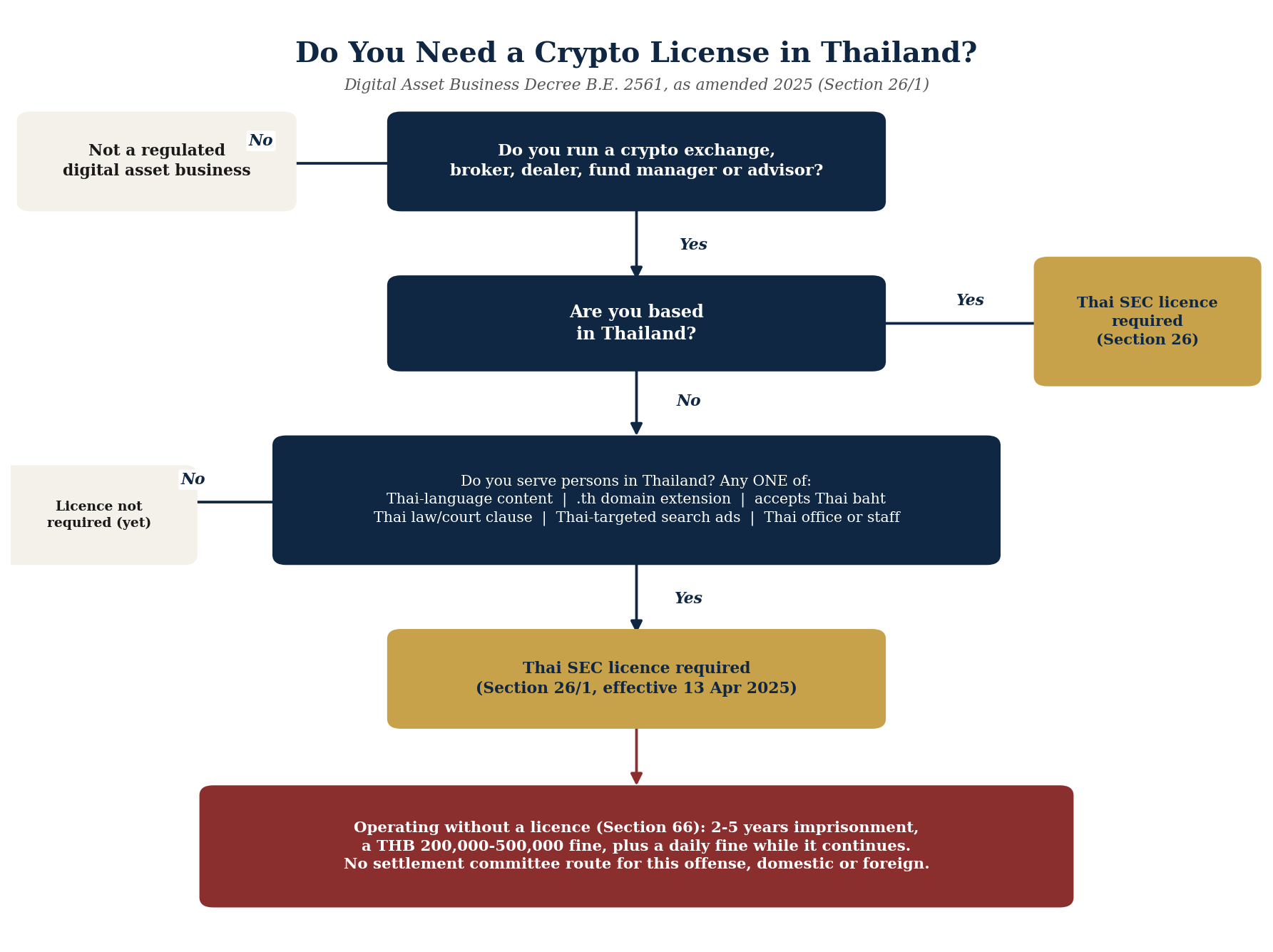
The amendment adds a third paragraph to section 26 of the Decree, which brings an operator based outside Thailand within the licensing requirement if it serves persons in Thailand, unless the service is one the SEC has exempted by notification. It also adds a new section 26/1, which deems an operator to be serving persons in Thailand if it has any ONE of the following features:
- Displays content in the Thai language
- Uses a .th domain, or a name that signals Thailand
- Accepts Thai baht, or a Thai bank or e-money account
- States that Thai law or a Thai court governs the service
- Pays for search engine placement aimed at users in Thailand
- Has an office, unit or staff, wherever located, set up to support or assist users in Thailand
- Meets any other characteristic the SEC announces
A foreign exchange with no Thai office can still be caught. An exchange that takes Thai baht deposits, shows Thai-language pages, or buys search ads that target Thailand is deemed under section 26/1 to serve persons in Thailand, and so needs a licence under section 26, the same as a Thai-based operator.
Which digital asset licence applies to you
The 2018 Decree sets out four categories of digital asset business at section 3: an exchange, a broker, a dealer, and any other business the Minister prescribes. A 2020 Ministry of Finance notification used that fourth category to add two more: a digital asset fund manager, who manages digital assets for someone else’s benefit, and a digital asset advisor, who advises on digital asset value or investment decisions outside SEC-licensed securities advice. An operator already running in these two categories in 2020 had 90 days to apply; that window closed in February 2021, so a new fund manager or advisor needs the licence before it starts, not a grace period.
Minimum paid-up capital is set by SEC Notification No. Kor Thor. 28/2567, published in the Royal Gazette (volume 141, special part 297 Ngor, pages 71 to 73) and in force since 1 November 2024. It replaced the 50 million baht figure set in 2020. An exchange that holds client assets needs 100 million baht. An exchange that does not hold client assets, a broker or dealer that does, and a custodial wallet provider need 50 million baht. A fund manager needs 25 million baht, or 10 million baht if it holds no client assets and serves institutional investors only. A broker or dealer that holds no client assets needs 10 million baht, and an advisor 1 million baht. An operator licensed in several categories needs the highest figure that applies. Operators licensed before November 2024 had to reach half of the new figure by 1 May 2025 and all of it by 1 November 2025. The 1 million US dollar operation fund in the October 2020 entry above was a proposal and is not part of this notification.
Operating without a licence: penalties and enforcement
Section 66 sets the penalty for running a digital asset business without a licence at imprisonment of 2 to 5 years and a fine of 200,000 to 500,000 baht, plus a further daily fine of up to 10,000 baht for every day the violation continues. This penalty applies equally to a domestic operator caught under section 26 and a foreign operator caught under the new section 26/1.
Some summaries describe the extraterritorial case as harsher because it cannot be settled by paying a fine. The Decree’s own settlement provision tells a simpler story: section 95 lists the specific offenses its settlement committee may compound, and section 66, unlicensed operation, has never been on that list, for a domestic operator or a foreign one. The 2025 amendment does not create a new, harsher track for foreign platforms. It extends the same licence requirement, and the same criminal exposure that has always attached to unlicensed operation, to operators outside Thailand.
The government has already used this power. The Ministry of Digital Economy and Society, under a companion 2025 amendment to the cybercrime law, can block access to an unlicensed platform without going to court first. It exercised that power on 28 June 2025 against five platforms: Bybit, CoinEx, 1000X, OKX and XT.COM. Separately, the SEC has filed criminal complaints naming OKX and CoinEx for unlicensed digital asset exchange operation, and in 2026 filed complaints against five individuals over unlicensed Worldcoin (WLD) trading. These are SEC filings and ministry blocking orders, not court judgments; no Thai court has yet ruled on section 26/1 in a published decision.
Crypto profits carry their own tax rules, separate from the licensing question above. See our guide to cryptocurrency tax in Thailand for how gains are taxed and what the current VAT exemption covers.
The tax position, as the royal decrees actually leave it
The tax changes trailed in February 2024 were made, and they were made by royal decree under the Revenue Code. Four decrees touch digital assets, and it is worth knowing which of them is still doing any work, because the first one has expired.
- Decree No. 744 of B.E. 2565 exempted VAT on transfers of cryptocurrency or digital tokens made on a licensed digital asset exchange, but only for transfers between 1 April 2022 and 31 December 2023. It has expired and is of historical interest only.
- Decree No. 788 of B.E. 2567 is the one in force. It exempts VAT on transfers of cryptocurrency and utility tokens made on a digital asset exchange, through a digital asset broker, by a digital asset dealer or to a dealer, from 1 January 2024, with no end date written into it. It is both wider than the decree it replaced, which reached only transfers on an exchange, and open-ended where that one was not.
- Decree No. 789 of B.E. 2567 deals with income rather than VAT. Where a person receives a share of profit from holding an investment token, and 15 per cent has already been withheld at source under section 50(2) of the Revenue Code, that profit share need not be brought into the annual income tax computation at all, for amounts received from 1 January 2024. The condition is strict: it applies only if the recipient does not reclaim or credit any part of the tax withheld. In substance the 15 per cent becomes a final tax, at the recipient’s election.
- Decree No. 779 of B.E. 2566 is aimed at issuers rather than investors. It relieves a company or juristic partnership of corporate income tax and VAT on the transfer of investment tokens offered to the public, retroactively to 14 May 2018, which is the day the Emergency Decree itself came into force.
No later royal decree has changed any of this. The Revenue Department’s own royal decree register runs to No. 810 of B.E. 2569 (checked 19 October 2026), and reading it end to end, 682 decrees from No. 9 to No. 810, the last one whose subject touches digital assets is No. 789.
But the income tax on gains has changed, by ministerial regulation, which is a separate register. Ministerial Regulation No. 399 (B.E. 2568), signed on 27 August 2025 and published in the Royal Gazette on 5 September 2025 (volume 142, part 56 Kor), adds item (109) to clause 2 of Ministerial Regulation No. 126: the gain an individual makes on transferring cryptocurrency or a digital token is exempt from personal income tax where the transfer is made on a digital asset exchange, through a digital asset broker, or to a digital asset dealer licensed under the Thai digital asset law, for income received from 1 January 2025 to 31 December 2029. The exemption is limited in three ways: it is a personal income tax exemption, so it does not help a company; it covers only transfers through a Thai-licensed operator, so a gain made on a foreign platform remains assessable income; and it ends with 2029 unless extended.
Future Implications and Conclusion
Thailand is working on creating laws for cryptocurrency to make transactions safe. They want to protect investors and encourage growth and innovation. By following global standards, Thailand is becoming a good place for cryptocurrency businesses and investments. They recently made significant agreements that could see Thailand as a technological hub for the future. Crypto currency is a part of it. Microsoft announced in May 2024 a new data center in Thailand for AI and others.
It is clear that Thailand is keen to benefit from the potential of cryptocurrencies and blockchain technology while ensuring compliance with regulatory requirements. The precise future implications are yet to be seen, but with a forward-thinking approach and continuous adaptation, Thailand may well establish itself as a leading jurisdiction for the crypto industry.
Frequently Asked Questions
Is cryptocurrency legal in Thailand?
Yes. Cryptocurrency is legal to hold and trade through SEC-licensed Thai exchanges, but it is not legal tender and using it to pay for goods and services is restricted.
Who regulates cryptocurrency in Thailand?
The Securities and Exchange Commission (SEC) licenses and supervises digital asset businesses under the Emergency Decree on Digital Asset Businesses B.E. 2561 (2018), which the Minister of Finance administers. The Bank of Thailand’s role is separate and concerns payments, including the restrictions on using digital assets to pay for goods and services.
Do I have to pay tax on crypto profits in Thailand?
It depends on where you trade. Gains are assessable income in principle, but Ministerial Regulation No. 399 (B.E. 2568) exempts an individual from personal income tax on gains from transferring cryptocurrency or digital tokens on a Thai-licensed exchange, or through a licensed broker or to a licensed dealer, for income received from 1 January 2025 to 31 December 2029. Gains made on a foreign platform, and gains made by a company, are not covered.
Can I pay for goods with crypto in Thailand?
Using crypto as a means of payment is restricted and has been discouraged by regulators, so it is mainly treated as an investment asset rather than money.
Can foreign crypto exchanges serve customers in Thailand?
Only if it holds a Thai SEC licence. Since April 2025, a foreign exchange counts as serving Thai customers under section 26/1 if it uses Thai language, accepts Thai baht, or meets any of the other listed triggers, and the government has already blocked several platforms that operated without one.
Do I need a licence to trade crypto for myself?
No. Sections 26 and 26/1 regulate the businesses that run an exchange, brokerage, dealing, fund management or advisory service, not an individual who buys and holds digital assets through a licensed exchange.
What is the penalty for running an unlicensed crypto exchange in Thailand?
Section 66 sets imprisonment of 2 to 5 years and a fine of 200,000 to 500,000 baht, plus a daily fine while the violation continues. This offense cannot be settled by paying a fine through the Digital Asset Business settlement committee.
Thai Law Updates, free by email
Plain-English updates on Thai law changes that affect foreigners: property, visas, marriage, business and wills. One short email a month from a firm practicing since 2006. No spam, unsubscribe anytime.