


Reviewed by ThaiLawOnline, a licensed Thai law firm practising in Thailand since 2006. Thai lawyer of record: Wichuda Atthamethakon, LL.M., Thai Bar Licence 3149/2556.
Last updated on
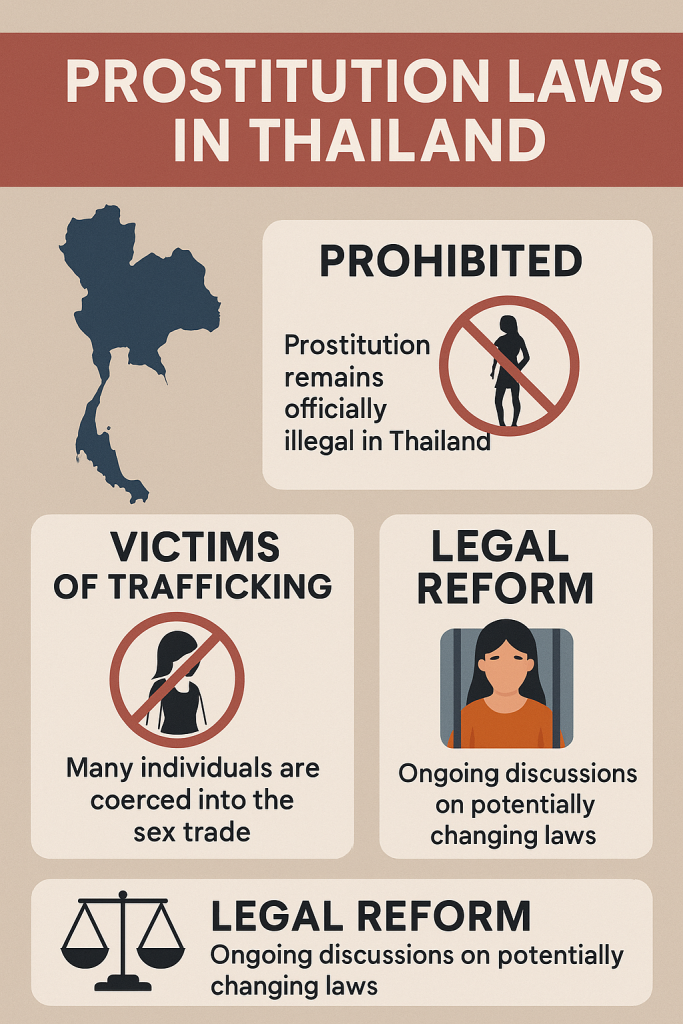
TL;DR Prostitution is illegal in Thailand on paper, but widely tolerated in practice. Laws target public solicitation and trafficking, while private consensual sex work often goes unpunished. A 2023 draft law aims to decriminalize and regulate the industry for adults over 20.


Key Takeaways to Get the Most Quickly
- Illegal but tolerated: Sex work thrives despite laws banning it, especially in bars and massage parlors.
- Strict laws on paper: Heavy penalties apply for pimping, brothels, trafficking, or involving minors.
- Private acts mostly ignored: Consensual sex work between adults is rarely prosecuted.
- Reform in progress: A 2023 bill proposes legalizing sex work for those 20 and older.
- Vulnerable workers: Current laws leave sex workers with little protection or legal support.
🎧 Listen to Our Prostitution Laws Guide for Thailand
Want to better understand how prostitution laws work in Thailand? Click below to listen to our short podcast explaining the key points.
In recent years, Thailand has gained notoriety as a major hub for sex trafficking. Prostitution laws in Thailand are still making it illicit but it might change soon. This illegal trade has harmed many victims, including Thai and foreign people. It has become a major human rights issue. The Thai government has implemented various measures to combat sex trafficking, but the issue remains prevalent in the country. Prostitution in Thailand is still illegal but widely spread.
Sex trafficking is when people are recruited, moved, or kept against their will. This is done using force, fraud, or pressure for sexual exploitation. Many victims are lured under false pretenses, promising job opportunities. They believe they will get better living conditions, only to find themselves trapped in the sex trade.
This is why there are laws to protect the victims. Is prostitution illegal in Thailand? How does this affect the legal status of sex workers?Well, this is not a black-and-white issue. An act can be illegal but still tolerated. The legality of an act can change from country to country and over time. For instance, cannabis was taken off Thailand’s narcotics list in 2022, and its rules have changed again since. And how are the prostitution laws in Thailand evolving to address the complexities of sex workers’ occupational rights?
Thailand’s location, economic gaps, and tourism industry attract sex trafficking networks. Vulnerable people like women, children, and migrants are often targeted by traffickers who take advantage of their difficult situations. Here is how Thailand’s prostitution laws work.
Table of Contents
Wording corrected: 3 October 2026, not a re-review. Two sentences still described soliciting as a fine and the 1996 Act as criminalising prostitution without the section 5 conversion to a civil penalty; three garbled sentences were rewritten.
Last reviewed: 3 September 2026. The Prevention and Suppression of Prostitution Act B.E. 2539 was read in Thai in full, from the Royal Gazette text (vol. 113 part 54 Kor page 1, 22 October 1996), and every penalty on this page for sections 5 to 13 was taken from it. The Act on Conversion of Fines to Civil Penalties B.E. 2565 (vol. 139 part 66 Kor page 22, 25 October 2022) was read for sections 7, 9, 10, 34, 39, 41, 46 and 47 and for its Schedule 1, in which this Act is listed without any section qualifier. Penal Code sections 277, 279, 282, 283, 285 and 286 were checked against our own annotated Code. Not verified here, and said rather than implied: the Entertainment Places Act B.E. 2509 (read since, see the re-check note below); the estimates of how many people sell sex in Thailand, which are estimates and not official figures; the enforcement practice described throughout, which is practice and not statute; and whether any bill to decriminalise adult sex work has advanced since the March 2023 reports. Re-checked on 6 October 2026: the Entertainment Places Act B.E. 2509 was read in Thai in its consolidated text on the government’s central law register (as amended to No. 5 B.E. 2560, with the 2022 conversion of fine-only offences to civil penalties), sections 3, 4, 6, 16, 16/1, 21, 22, 26, 27 and 28/3; the venue section now states what the Act itself provides instead of saying the text could not be obtained.
Is Prostitution Illegal in Thailand? What are the Prostitution Laws in Thailand?
Yes, it remains illegal, but it is widely tolerated and rarely punished between consenting adults. The current government wishes to amend the laws in collaboration with international organizations. The Thai government has implemented various laws and initiatives to address sex trafficking. The Prevention and Suppression of Prostitution Act of 1996, for instance, prohibits prostitution and punishes related activities, although soliciting under section 5 has carried only a civil penalty since 26 October 2023. It focuses mainly on abuse and sex trafficking of children. Section 8 punishes the buyer. Having sexual intercourse with, or committing any other act for sexual gratification on, a person over fifteen but not over eighteen inside a prostitution establishment carries one to three years and a fine of 20,000 to 60,000 baht, whether or not that person consented. Where the child is not over fifteen it is two to six years and a fine of 40,000 to 120,000 baht. Consent is no defence in either case.
| Legal Aspect | Explanation |
|---|---|
| Is prostitution legal? | Technically, the legal status of sex work in Thailand is complex and often debated. It is illegal under the Prevention and Suppression of Prostitution Act B.E. 2539 (1996). |
| Common enforcement issues | Enforcement is often inconsistent. Many venues operate under the radar, particularly those involved in prostitution in public places. |
| Penalty for selling sex | Soliciting in a street or public place, openly and shamefully or so as to be a nuisance: a civil pinai penalty of not more than 1,000 baht, not a criminal offence and not a criminal record, since 26 October 2023 (section 5, converted by the Act on Conversion of Fines to Civil Penalties B.E. 2565). Congregating in a prostitution establishment for the purposes of prostitution: up to 1 month, or up to 1,000 baht, or both (section 6), with no offence at all where the person acted under compulsion or under a power they could not escape. |
| Penalty for buying sex | The 1996 Act creates no general offence of buying sex from a consenting adult. Buying sex in a prostitution establishment from a person over 15 but not over 18 is 1 to 3 years and a fine of 20,000 to 60,000 baht; where the child is not over 15 it is 2 to 6 years and 40,000 to 120,000 baht (section 8). A client in a raided venue is otherwise reached through section 6. |
| Brothel owners or operators | Owner, supervisor or manager of a prostitution business or establishment, or controller of the people working in it: 3 to 15 years and a fine of 60,000 to 300,000 baht (section 11). 60,000 is the minimum fine, not the maximum, and imprisonment is not an alternative to it. Where someone over 15 but not over 18 works there it becomes 5 to 15 years and 100,000 to 300,000 baht; where a child not over 15 does, 10 to 20 years and 200,000 to 400,000 baht. |
| Human trafficking implications | Severe punishment under separate trafficking laws (Anti-Human Trafficking Act B.E. 2551). |
| Age of consent | Legal age of sexual consent is 15, but commercial sex must not involve anyone aged 18 or under. |
| Tourist implications | Foreigners may face deportation or blacklist if involved in underage sex or trafficking. |
| Real-world practice | Despite the law, sex work is widespread in places like Pattaya, Bangkok, Phuket, etc. |
| Reform efforts | There have been ongoing debates about decriminalisation and improved rights for sex workers, including sex trafficking concerns. |
The 1996 Act repealed the Prostitution Suppression Act of 1960 and is now the central statute on the subject. Its standing criticism is that it does not separate consensual adult sex work from trafficking. One statute carries a civil penalty of up to 1,000 baht for soliciting and ten to twenty years for coercing someone into prostitution, and the person selling sex can be processed as an offender under section 5 or section 6 before anyone has asked whether they were coerced.
Efforts have been made to strengthen law enforcement and improve victim protection. Specialized police units exist to combat human trafficking and the reliance on prostitution dating back through generations. There are victim-centered initiatives provide support and assistance to those rescued from the sex trade. Additionally, the government has implemented awareness campaigns and educational programs to raise public awareness about sex trafficking and its consequences. Despite the common cliche about this country, it is quite rare to see underage prostitution in Thailand. The authorities have taken a lot of precaution to lower sex trafficking in Thailand.
The Offences Most Guides Leave Out
The 1996 Act is usually summarised as three offences: selling, buying and keeping a venue. It contains several more, and the ones left out are the ones that carry the heaviest sentences. Every figure below is read from the Thai text of the Act.
Procuring: section 9, and consent is no answer to it
Section 9 is the provision that reaches agents, recruiters and anyone who arranges the supply of people. It punishes procuring, luring or taking away any person so that they engage in prostitution, and it says two things that matter more than the headline penalty. The person’s consent is not a defence: the section applies “even though that person consents”. And it has extraterritorial reach, applying whether the acts constituting the offence were done inside or outside the Kingdom.
The penalty is 1 to 10 years and a fine of 20,000 to 200,000 baht. Where the person procured is over fifteen but not over eighteen it rises to 5 to 15 years and 100,000 to 300,000 baht, and where the person is a child not over fifteen, to 10 to 20 years and 200,000 to 400,000 baht. Paragraph four then adds a further aggravation that is easy to trigger: where the act was done by deceit, threat, violence, undue influence or any form of coercion, the penalty is increased by one third.
Section 10 extends this to the family. A parent or guardian of a person aged eighteen or under who knows of a section 9 offence against the person in their charge and connives at it faces 4 to 20 years and 80,000 to 400,000 baht.
Coercion: section 12, the heaviest penalty in the Act
Section 12 covers detaining or confining another person, depriving them of liberty, causing them bodily harm, or threatening violence, in order to compel them into prostitution. The penalty is 10 to 20 years and 200,000 to 400,000 baht. If the victim suffers grievous bodily harm the penalty is life imprisonment; if the victim dies it is death or life imprisonment. A person who supports the offence is punished as the principal is.
The paragraph nobody quotes is the last one. Where the offender or the supporter is an administrative or police official, or an officer of a primary shelter or of a protection and occupational development centre under this Act, the sentence becomes 15 to 20 years and 300,000 to 400,000 baht. The statute anticipates that the people running the protective system may be the ones exploiting it, and punishes them more heavily for it.
Advertising: section 7
Section 7 punishes advertising or accepting advertising, and soliciting or introducing by document, printed matter or by making it public through any method, in a manner that can be seen to be a solicitation or contact for prostitution, one’s own or another person’s. The penalty is 6 months to 2 years, or a fine of 10,000 to 40,000 baht, or both. The words “by any method” are what carry it onto online listings and messaging apps, which is where this conduct now happens.
One consequence sits outside the penal scale entirely. Under section 13, where the parent or guardian of someone who commits a section 5, 6 or 7 offence has connived at their prostitution, the public prosecutor may apply, at the request of the Protection and Occupational Development Committee, for the removal of that parent’s or guardian’s parental power and the appointment of a replacement guardian, with the guardianship provisions of the Civil and Commercial Code applying to the appointment.
Penal Code and Prostitution Laws in Thailand
Living off the earnings of prostitution is dealt with by section 286 of the Penal Code. The whole section was repealed and replaced by the Criminal Code Amendment Act (No. 27) B.E. 2562, Royal Gazette volume 136 part 69 Kor, 27 May 2019, in force from 28 May 2019. It now lists seven separate ways of committing the offence, and the penalty for any of them is imprisonment not exceeding twenty years and a fine not exceeding four hundred thousand baht, or imprisonment for life.
The seven limbs are: assisting, facilitating or protecting the prostitution of another person; receiving a benefit in any form from another person’s prostitution or from a person who engages in prostitution; compelling, threatening, deceiving or unjustly influencing another person, or taking another person into employment, for the purpose of prostitution; arranging prostitution between a person who engages in prostitution and a client; concealing or disguising the source of income or property obtained from prostitution; habitually living or associating with one or more people who engage in prostitution while unable to show the source of the income one lives on; and obstructing an agency responsible for preventing or controlling prostitution or for assisting or educating the people caught up in it. The final paragraph excludes anyone receiving a benefit they are entitled to by law or by moral obligation, which is what keeps a sex worker’s dependent family outside the second limb
Two things about section 286 matter in practice. The fourth limb, arranging prostitution between a sex worker and a client, is what reaches an agent, a booker or a venue that puts the two in contact, and no money has to pass through that person’s hands for it to bite. And the old wording that punished a person over sixteen who lived off a prostitute’s earnings, together with the presumptions built around living with or habitually associating with a sex worker, has not been law since 28 May 2019. Any English summary still quoting a seven to twenty year term under section 286 is quoting a repealed provision.
The Penal Code has a wide rule against any indecent act with a child aged 15 or under. This rule includes child prostitution. Section 279 of the Penal Code states:
“Whoever commits an indecent act on a child not over fifteen years of age, whether or not such child consents, shall be punished with imprisonment not exceeding ten years, or fined not exceeding two hundred thousand Baht, or both.” Children are clearly protected by Thailand’s prostitution and sex trafficking laws.
Indecent Acts and the Age of Consent
The Penal Code in Thailand does not define what constitutes an “indecent act.”
Section 279 raises the penalty where the child is not over thirteen: imprisonment of one to ten years, or a fine of 20,000 to 200,000 baht, or both. A third paragraph of the same section raises it again, to one to fifteen years or a fine of 20,000 to 300,000 baht or both, where the act was committed by threat of any kind, by violence, while the child was in a state in which they could not resist, or by making the child mistake the offender for someone else
Section 277 of the Penal Code makes sexual intercourse with a child not over fifteen who is not the offender’s spouse an offence whether or not the child consents. The penalty is five to twenty years and a fine of 100,000 to 400,000 baht (Penal Code section 277). The provision has been gender neutral since the Criminal Code Amendment Act (No. 27) B.E. 2562, which also inserted the definition of sexual intercourse at section 1(18); English texts that still speak of a “girl” are quoting the pre-2019 wording.
Where the child is not over thirteen the penalty rises to seven to twenty years and a fine of 140,000 to 400,000 baht, or imprisonment for life. Two further paragraphs raise it again: ten to twenty years, or life, where the offender made the child believe he was carrying a firearm or an explosive, and life imprisonment where a weapon was carried or used, or where two or more offenders acted together.
The marriage exemption no longer exists. Until 2019 an offender could escape punishment under section 277 where the court permitted him to marry a child over thirteen but not over fifteen. The Criminal Code Amendment Act (No. 27) B.E. 2562 repealed that paragraph outright and replaced it with something different: where the offender is himself not over eighteen and the child was over thirteen but not over fifteen and consented, the Juvenile and Family Court may order welfare protection measures under the child protection law instead of imposing punishment, and if those measures fail the court may still sentence below the statutory minimum. Marriage is not a route out of a section 277 prosecution, and since 23 January 2025 it could not be one in any event, because section 1448 of the Civil and Commercial Code now requires both parties to have completed their eighteenth year.
In Thailand the age of consent is fifteen. The provision is section 277, not section 279: section 277 covers sexual intercourse and section 279 covers indecent acts, and both apply whether or not the child consented. Above fifteen, consent does not close the question. Sections 282 and 283 punish procuring, luring or taking away a person of any age for an indecent purpose to gratify someone else, with the penalty stepping up where the person is over fifteen but not over eighteen and again where they are not over fifteen. Section 285 adds one third to the sentence where the victim was an ascendant, a descendant, a pupil in the offender’s care, or anyone under the offender’s control, guardianship or power. And commercial sex with anyone aged eighteen or under is separately an offence under section 8 of the 1996 Act, whatever the age of consent may be.
It is important to know that the age of consent is 15. However, other laws may also apply. These laws help protect minors and prevent exploitation.
Here are some important articles from laws about sex workers, human trafficking, and prostitution in Thailand.
- Thai Penal Code, Section 279: indecent act on a child not over fifteen, whether or not the child consents. Section 279 is not the intercourse provision; that is section 277.
- Thai Penal Code, Section 277: sexual intercourse with a child not over fifteen. “Whoever has sexual intercourse with a child not over fifteen years of age, who is not his own wife or her own husband, whether or not the child consents, shall be liable to imprisonment from five to twenty years and a fine from one hundred thousand to four hundred thousand baht. Where the offence under paragraph one is committed against a child not over thirteen years of age, the offender shall be liable to imprisonment from seven to twenty years and a fine from one hundred and forty thousand to four hundred thousand baht, or to imprisonment for life.” Coercion against a person over fifteen is not section 277: it falls under section 276, or under sections 282 and 283 where the person was procured for another’s gratification.
- Child Protection Act (2003) section 4. “Child” means a person below 18 years of age, but does not include those who have attained majority through marriage.
- Anti-Trafficking in Persons Act B.E. 2551 (2008), section 4: “Child” means any person under eighteen years of age.”
- Civil Code of Thailand, specifies that majority is 20 years old (clause 19) while marriage requires both parties to have completed their eighteenth year (section 1448). A court may permit an earlier marriage where there is appropriate cause, and a minor who marries needs the consent of the persons listed in section 1436 (section 1454). The minimum age was seventeen until 23 January 2025.
Who Sells Sex in Thailand, and Under What Pressures
Prostitution laws in Thailand have not worked to reduce commercial sex work. This helps us understand the effects on sex workers. Many people choose this profession or do it because of money issues. They often work in public places and brothels. Sex workers in Thailand face many challenges. These challenges are social, economic, and legal. They affect how much these workers rely on prostitution. This issue has been around for many years. A lot of the population agree that prostitution laws in Thailand need to change. The current laws do not match what the public thinks.
Prostitution remains prevalent, disregarding the current prostitution laws in Thailand. Many people choose to engage in commercial sex work for economic reasons or personal choice. This often happens in places like Pattaya, where the reliance on prostitution dating back decades is evident. The complexities faced by sex workers in Thailand encompass a range of social, economic, and legal factors. Many Thai citizens support changing the prostitution laws in Thailand. They want the laws to match public views on sex work. This includes jobs like sex workers, escorts, and bar prostitutes.
Economic factors greatly influence individuals’ decision to enter the realm of commercial sex work. Poverty, few job options, and the need to support families often push people into the sex trade. The promise of higher pay compared to other jobs is a big reason many people choose sex work.
Social stigma around commercial sex work creates problems for those in the industry. It makes it hard for them to meet clients’ sexual needs safely. Sex workers in Thailand often face ostracism, discrimination, and limited access to healthcare and social services. The marginalization of sex workers exacerbates their vulnerability to exploitation, violence, and abuse. Remember that religion can shape the believes and the behavior of a country. Prostitution laws in Thailand can be very different from those in other countries. They can also change from year to year.
Policing, Reform and the Position of Sex Workers
Prostitution laws in Thailand is a complicated problem for sex workers. They work in a gray area of the law and often face harassment and corruption from the police. It can be hard to tell if someone is doing sex work by choice or being forced into it. Sex workers need help and support if they are being mistreated or taken advantage of.
Selling sex stopped being a crime in 2023, and almost nobody has noticed
Section 5 is no longer a criminal offence. The Act on Conversion of Fines to Civil Penalties B.E. 2565 (Royal Gazette vol. 139 part 66 Kor page 22, 25 October 2022) lists the 1996 Act in its Schedule 1, and section 39 of that Act converts every fine-only criminal offence in a Schedule 1 law into a pinai offence, a civil penalty, once 365 days from publication have elapsed. The conversion therefore took effect on 26 October 2023. The 1,000 baht ceiling is unchanged, because section 39 deems the old criminal fine rate to be the new civil rate, but almost everything else about it is different: a state official or the court sets the amount on the facts, including the person’s economic circumstances (section 9); state agencies are forbidden to enter it in a criminal record (section 34); there is no detention in lieu of payment; and someone who offended out of severe poverty or dire necessity may ask for a figure below the statutory one, for community service instead, or for a warning with no fine at all (section 10). Section 6 is not converted, because it carries a month’s imprisonment as an alternative and section 41(1) excludes any offence carrying imprisonment.
The change reaches backwards as well. Section 46 provides that a person under a final judgment for an offence converted by section 39 ceases to be an offender and is deemed never to have been convicted of it; any detention in lieu of the fine ends, and an unpaid fine lapses. Section 47 then cancels the criminal record itself: it may not be used against the person, and the agencies holding it were required to delete the entry within 365 days of the conversion. A Thai national carrying an old section 5 conviction is entitled to have it gone.
What this does not do is legalise sex work. The conduct in section 5 is still prohibited and still penalised, and every other offence in the Act keeps its criminal character, its prison terms and its fines. What changed is the machinery applied to the one offence the sex worker is actually charged with.
Prostitution has been prohibited since the Prostitution Suppression Act of 1960, replaced by the present Act in 1996. The “up to 20 years” figure that circulates online is not what a sex worker faces. Selling sex by soliciting in public carries a civil penalty of up to 1,000 baht and nothing more, and since 26 October 2023 it is not a criminal offence at all. The long sentences in the Act attach to procuring, to running the establishment and to coercion, which is to say to the people around the sex worker rather than to the sex worker. Estimates of the number of people selling sex in Thailand range from about 100,000 to 400,000, and no official count exists.
There are groups and activists who are trying to protect the rights of sex workers in Thailand. They want to end the stigma, improve working conditions, provide healthcare, and make sure sex workers are legally protected.
Even though the government is trying to stop sex trafficking, it is still a big problem in Thailand. It is important for the police to work with international groups to stop sex trafficking. Changes are needed to deal with the economic, social, and legal issues related to prostitution laws in Thailand.
Venue Licensing: Where Enforcement Actually Happens
Almost every English article on this subject stops at the 1996 Act and the Penal Code. That is not where a bar, a massage parlour or a karaoke venue actually gets into trouble. Proceeding against an individual sex worker produces a civil penalty of up to 1,000 baht and no criminal record. What closes a business is its licence.
An entertainment place, in Thai sathan borikan, is licensed under the Entertainment Places Act B.E. 2509 (1966), and ministerial regulations issued under it fix the categories of venue and the permitted opening hours. The most recent of those, the Ministerial Regulation Prescribing Opening and Closing Times of Entertainment Places (No. 2) B.E. 2566, signed on 21 August 2023 and published on 26 August 2023, lets venues inside the Eastern Aviation City promotion zone open twenty four hours.
Sitting on top of that licensing regime is Head of the National Council for Peace and Order Order No. 22/2558, dated 22 July 2015, Royal Gazette volume 132 special part 171 Ngor page 7, amended by Order No. 46/2559, Royal Gazette volume 133 special part 169 Ngor page 4. It is still in force. It is not among the orders repealed by the Act Repealing Certain Announcements and Orders of the National Council for Peace and Order B.E. 2568, whose schedule reaches orders 3, 4, 5, 23, 29 and 36 of 2558 but not order 22.
Clause 4 forbids the operator of an entertainment place, or of any premises operating in a manner similar to an entertainment place, from doing any of the following:
- allowing anyone under twenty years of age to use the premises;
- selling alcohol to anyone under twenty;
- opening beyond the hours the law allows;
- selling alcohol beyond the hours the law allows;
- allowing weapons, explosives or narcotics onto the premises;
- allowing an offence of human trafficking to be committed on the premises;
- allowing gambling on the premises.
The consequence is the part worth reading twice. Where any of those happens, the competent authority may revoke the licence, or order the premises closed and prohibit any entertainment place from operating at that address again for five years. A pending renewal is refused, and no new licence may be issued to that operator for five years. Where the venue stands near a school or a student dormitory the prohibition is permanent, and the liquor licence is revoked with it. Clause 4 then provides that the order is final, so there is no appeal against it. Reopening inside the five year ban is a separate offence under clause 6/1, punishable by up to one year, or a fine of up to 20,000 baht, or both.
Two things follow for anyone operating or investing in a venue. The phrase premises operating in a manner similar to an entertainment place is deliberate: not holding a licence does not put a bar outside the Order, it puts it outside the protection of one. And clause 4(1) uses twenty years of age, not eighteen and not the age of consent. A venue that admits a nineteen year old customer has committed the breach that carries the five year closure, whether or not anything sexual took place there.
Running in parallel, section 11 of the 1996 Act reaches the owner, supervisor or manager of a prostitution establishment personally, at three to fifteen years and a fine of 60,000 to 300,000 baht, and section 286(1) and (4) of the Penal Code reaches anyone who assists, facilitates or protects another person’s prostitution or arranges it between a sex worker and a client. Those are the provisions under which the management, rather than the premises, is prosecuted.
What the Entertainment Places Act B.E. 2509 itself says, read in its consolidated Thai text (as amended to No. 5 B.E. 2560, with the fine-only offences converted to civil penalties by the 2022 Act on Conversion of Fines to Civil Penalties). Section 3 defines an entertainment place: a dance hall; a venue selling food or drink with hostesses to attend customers; a bath, massage or sauna establishment with staff serving customers, other than a licensed medical or health establishment; a venue where singers, performers or staff sit with customers, karaoke with staff singing with customers, or dancing on stage or at the tables; a venue with music or shows that closes after midnight; and any other place a ministerial regulation adds. Opening one without a licence, operating it while the licence is suspended, or running it outside the licensed category is punishable by up to one year, a fine of up to 60,000 baht, or both (section 26). A licensee may not employ anyone under eighteen (section 16(1)), and may not let anyone under twenty who does not work there in during opening hours, which means checking photo identification at the door (section 16/1); each of those is now a civil penalty of up to 50,000 baht (section 27), and either can cost the licence, since the official may refuse renewal, suspend or revoke it for any breach of the Act (section 21). Allowing an obscene show is up to three years, a fine of up to 60,000 baht, or both (section 28/3). A suspension or revocation can be appealed within fifteen days, to the national police chief in Bangkok and to the Permanent Secretary of the Interior elsewhere, and that decision is final (section 22). Order 22/2558 sits on top of all this and is the heavier instrument for a venue.
FAQs about Prostitution Laws in Thailand
Is prostitution illegal in Thailand?
Yes, under the Prevention and Suppression of Prostitution Act B.E. 2539 (1996). What the Act actually punishes is narrower than most readers expect. Soliciting in public carries a civil penalty of up to 1,000 baht under section 5, which stopped being a criminal offence on 26 October 2023, and there is no general offence of buying sex from a consenting adult. The heavy penalties fall on procuring, on running the establishment, and on anything involving a person aged eighteen or under.
What penalty does a sex worker face?
Section 5, soliciting in a street or public place openly and shamefully or so as to be a nuisance to the public: a civil pinai penalty of not more than 1,000 baht. Since 26 October 2023 this is not a criminal offence, so it carries no criminal record and no imprisonment, and a person who cannot pay may ask to do community service instead. Section 6, congregating in a prostitution establishment for the purposes of prostitution: up to one month, or up to 1,000 baht, or both. Section 6 paragraph two provides that there is no offence at all where the person acted under compulsion or under a power they could not avoid or resist.
What penalty does a brothel owner face?
Section 11: three to fifteen years and a fine of 60,000 to 300,000 baht. The fine is a minimum, not a maximum, and the prison term is not an alternative to it. Where a person over fifteen but not over eighteen works there it becomes five to fifteen years and 100,000 to 300,000 baht, and where a child not over fifteen does, ten to twenty years and 200,000 to 400,000 baht.
Can a foreigner be prosecuted?
Yes. Nothing in the 1996 Act or in the Penal Code provisions on this page turns on nationality. A foreign customer in a raided venue is exposed under section 6, and under section 8 if the other person was eighteen or under. A conviction can carry immigration consequences as well, but those are decided under the Immigration Act and not under these provisions.
What is the age of consent, and does it settle commercial sex?
The age of consent is fifteen, under section 277 of the Penal Code, and it does not settle commercial sex. Section 8 of the 1996 Act makes it an offence to buy sex in a prostitution establishment from anyone aged eighteen or under: one to three years and 20,000 to 60,000 baht where the person is over fifteen, and two to six years and 40,000 to 120,000 baht where the child is not over fifteen. Separately, clause 4(1) of Order 22/2558 bars anyone under twenty from an entertainment place at all.
Has sex work been decriminalised?
No. A bill to repeal the 1996 Act and regulate adult sex work was reported in March 2023. It has not been enacted. The 1996 Act remains in force exactly as set out on this page.
Why does the law look unenforced?
Because most of the enforcement that happens is administrative rather than criminal. Order 22/2558 lets an authority revoke a venue’s licence and bar any entertainment place from that address for five years, with no appeal, which is faster and heavier than prosecuting individuals under the 1996 Act. A street that looks tolerated can sit in a district that is closing venues.
Sources and Further Reading
The sections quoted above are reproduced in full, with commentary, in our annotated Penal Code, and the Supreme Court has applied section 277 in the two judgments below.
- Penal Code section 277, sexual intercourse with a child not over fifteen
- Penal Code section 279, indecent act on a child not over fifteen
- Penal Code section 286, living off the earnings of prostitution
- Supreme Court Decision 6336/2557, on what counts as an act falling within section 277 paragraph two
- Supreme Court Decision 2417/2540, on distinguishing attempted rape from an indecent act by the offender’s intention from the outset
- Age of consent in Thailand, which sets out the age rules these sections turn on
- Human trafficking under Thai law, the offence most often charged alongside the ones on this page
- Criminal law in Thailand, for how a prosecution actually proceeds
- Draft law to decriminalise sex work, reported March 2023. It has not been enacted.
Thai Law Updates, free by email
Plain-English updates on Thai law changes that affect foreigners: property, visas, marriage, business and wills. One short email a month from a firm practicing since 2006. No spam, unsubscribe anytime.