


Reviewed by ThaiLawOnline, a licensed Thai law firm practising in Thailand since 2006. Thai lawyer of record: Wichuda Atthamethakon, LL.M., Thai Bar Licence 3149/2556.
Last updated on
Sap-Ing-Sith, introduced through Thailand’s 2019 legislation, represents a genuinely new property right. It was designed to bridge the gap between traditional ownership structures and modern investment needs. It offers foreigners enhanced property utilization rights while addressing the longstanding restrictions on foreign land ownership in Thailand. The potential of the Sap-Ing-Sith in Thailand is gaining attention. Many investors are starting to embrace this property right. Investors are increasingly looking at the Sap-Ing-Sith in Thailand as a viable alternative to traditional property ownership.
The following article is co-written by Mr. Sebastien H. Brousseau (LL.B., B.Sc.) and Khun Wichuda Atthamethakon (LL.M.). ThaiLawOnline is one of the rare law firms having registered more than fifteen of Sap-Ing-Sith in Thailand.
Table of Contents
What Is Sap-Ing-Sith in Thailand?
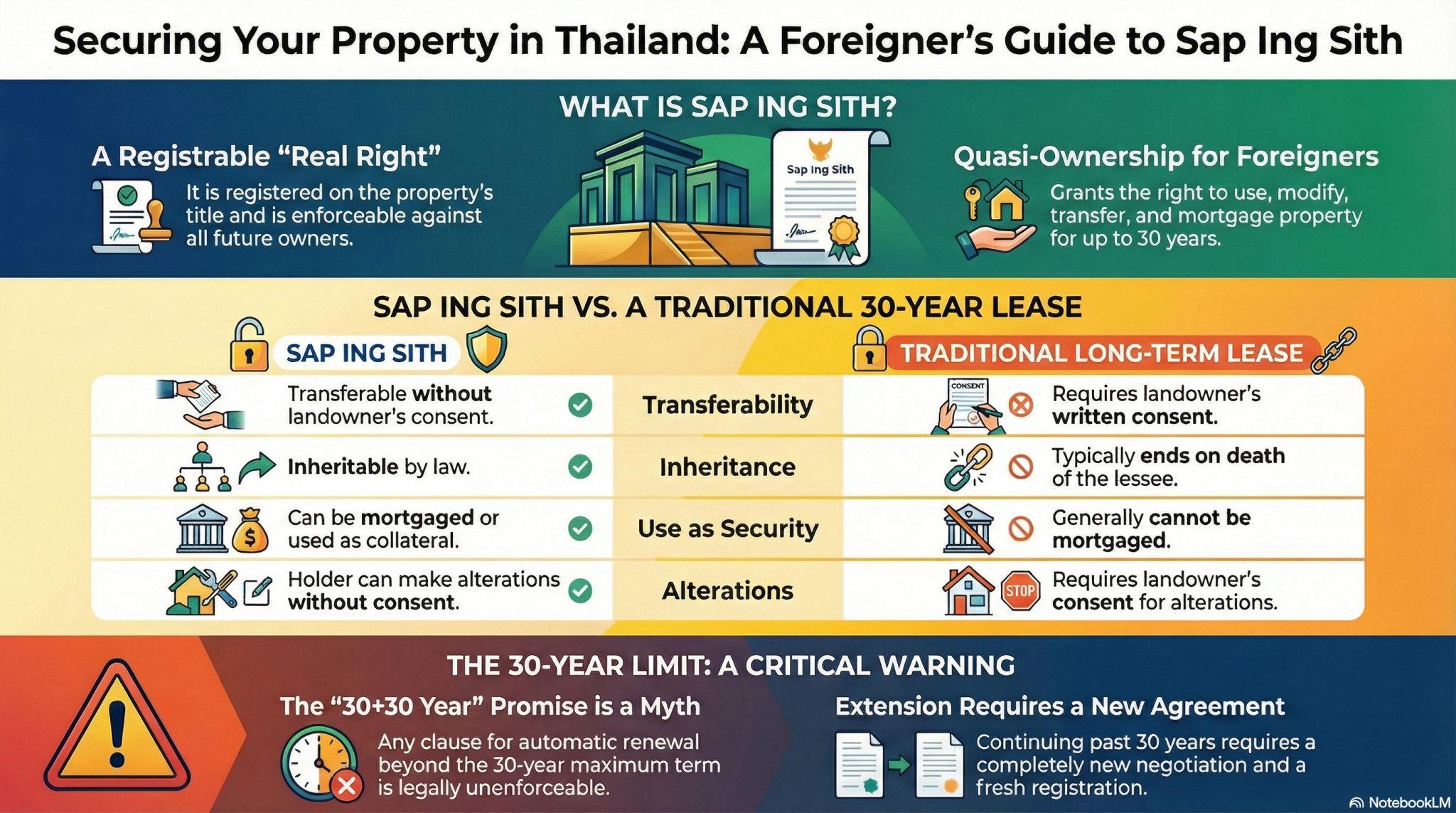
At its core, Sap-Ing-Sith is a new property right that some will call a “transferrable right”. It gives the holder the right to “use” or “own” land in Thailand. Section 4 of the law talks about “use.” A completely new title deed is created with a blue garuda. The holder of sap-ing-sith rights acts like the owner of the property. This right applies to land with a valid Chanote. It also applies to buildings on land with this title deed.
Additionally, condominium units as defined in the Condominium Act can also fall under this property right. The Sap-Ing-Sith can be registered for up to 30 years. The Act sets no renewal mechanism, so continuing beyond that term needs a fresh agreement with the owner and a fresh registration. See the renewal section below. It is important to have the agreement in writing, and every juristic act concerning a Sap-Ing-Sith must be in writing and registered with the competent official (Section 12). Two limits catch people out. Under Section 4 a Sap-Ing-Sith cannot be created over only part of the land or unit in a title deed: it covers the whole title or nothing. And where the property is already mortgaged, used as business collateral, or carries any other registered right, the right can only be created with the written consent of the mortgagee, the security holder or the holder of that right.
Historical Context
Thailand’s Land Code generally prohibits foreigners from owning land. The Thai National Legislative Assembly passed the Sap-Ing-Sith Act on February 8, 2019. This law aims to update the property market. It also seeks to attract foreign investment. The Act was published in the Royal Gazette on 30 April 2019 (volume 136, part 56 Kor, page 97). 26 April 2019 is the date of royal assent, not publication, and the difference matters: Section 2 brings the Act into force only when 180 days from publication have elapsed, so it took effect at the end of October 2019. It has become an important option for foreign investors. This law offers a simpler choice than traditional leasehold agreements and other complex legal structures.
Advantages of Sap-Ing-Sith for Foreigners
- Better Control: You can use the rights as collateral. You can change the property freely. You can also transfer or inherit the rights easily.
- Financial Security: Offers superior legal protection compared to typical lease agreements, making it suitable for business operations or commercial use.
- Practical Benefits: You can have a term of up to 30 years. Continuing beyond it depends on a new agreement with the owner, not on any automatic renewal. You will receive clear official documents through the blue Garuda certificate. This certificate is legally enforceable against new landowners.
- The right survives a sale: the owner may sell or transfer ownership of the land at any time and does not need your consent, but the registered Sap-Ing-Sith stays on the title deed and binds the new owner (Sap-Ing-Sith Act section 9 paragraph 2). What the owner cannot do is create any other real right over the property, such as a usufruct, servitude or superficies, without your written consent (section 9 paragraph 1). The owner also cannot cancel the right early where that would prejudice a third party who acquired for value, in good faith, and registered in good faith (section 14).
- Sap-Ing-Sith are transmissible to heirs. However, the court must appoint an estate administrator. This step is necessary before the right can be transferred to an heir at the Land Office.
Practical Considerations for Expatriates
For expatriates in Thailand, Sap Ing Sith offers a more flexible and legally robust alternative to traditional leasehold arrangements. It allows greater control over property modifications, easier transferability, and the ability to use the property as financial security. However, buyers should know that this is a registered right of use capped at 30 years. It is not a usufruct and it is not permanent ownership. They should plan for the end of the term.
Limitations and Considerations
- Legal Restrictions: No actual ownership of the land itself, limited duration without guaranteed automatic renewal, and mandatory registration for validity.
- Practical Challenges: Higher associated costs, complexity requiring professional legal assistance, and reliance on cooperation from the initial Thai landowner.
- Market Concerns: Some land offices are not very aware of this since it was introduced in 2019. This leads to fewer examples and possible legal uncertainties.
Real Case Studies Sap-Ing-Sith in Thailand done by ThaiLawOnline
Case Study 1: Villa Investment in Koh Phangan (2024)
We successfully registered a Sap-Ing-Sith for a foreign couple. They are investing about 10 million THB in a villa on Koh Phangan. Initially, the local land department was unfamiliar with this process, leading to significant delays. On our first two-day trip, we faced several problems. Officials said their computer systems could not issue the title deed.
Only after confirming with Bangkok authorities, and then relaying their instructions, did the local officials finally cooperate. This unexpected situation delayed the project by about two months. Another problem linked to servitude happened. However, we finished the registration without charging our clients extra fees. This experience taught us valuable lessons, prompting us to adjust our pricing for similar future cases. The first picture with the blue garuda is that case.
Case Study 2: American Lawyers’ Luxury Villa in Southern Thailand (2024)
Our clients, both experienced lawyers from the USA, purchased a luxury villa in Southern Thailand. They chose a Sap-Ing-Sith instead of a standard lease. This option gives better legal protections and allows them to mortgage the rights. The total investment was around 6 million THB, plus 150,000 THB for legal expenses, including government fees. Our clients could have said: “As lawyers, we saw that the Sap-Ing-Sith offered much better protection than a regular lease. Paying a little extra was definitely worth it for the added security.”
Case Study 3: Empty Land Plot in Chiang Mai (2025)
We had completed Sap-Ing-Sith registrations 4-5 times before in Chiang Mai. This made us confident in the process. A local lawyer had told us it couldn’t be done, but we were sure we could manage. This time, registration was done quickly in two days and in one trip. This was the local land department’s first time handling a case like this.
It’s important to know that the Hang Dong Land Department in Chiang Mai is very strict. Registering Sap-Ing-Sith there may not be possible. In this case, we got a fully working Sap-Ing-Sith with agreements in place. This could extend the rights for another 30 years, but we can’t guarantee those extensions. The registration picture below, June 2025 is that case.
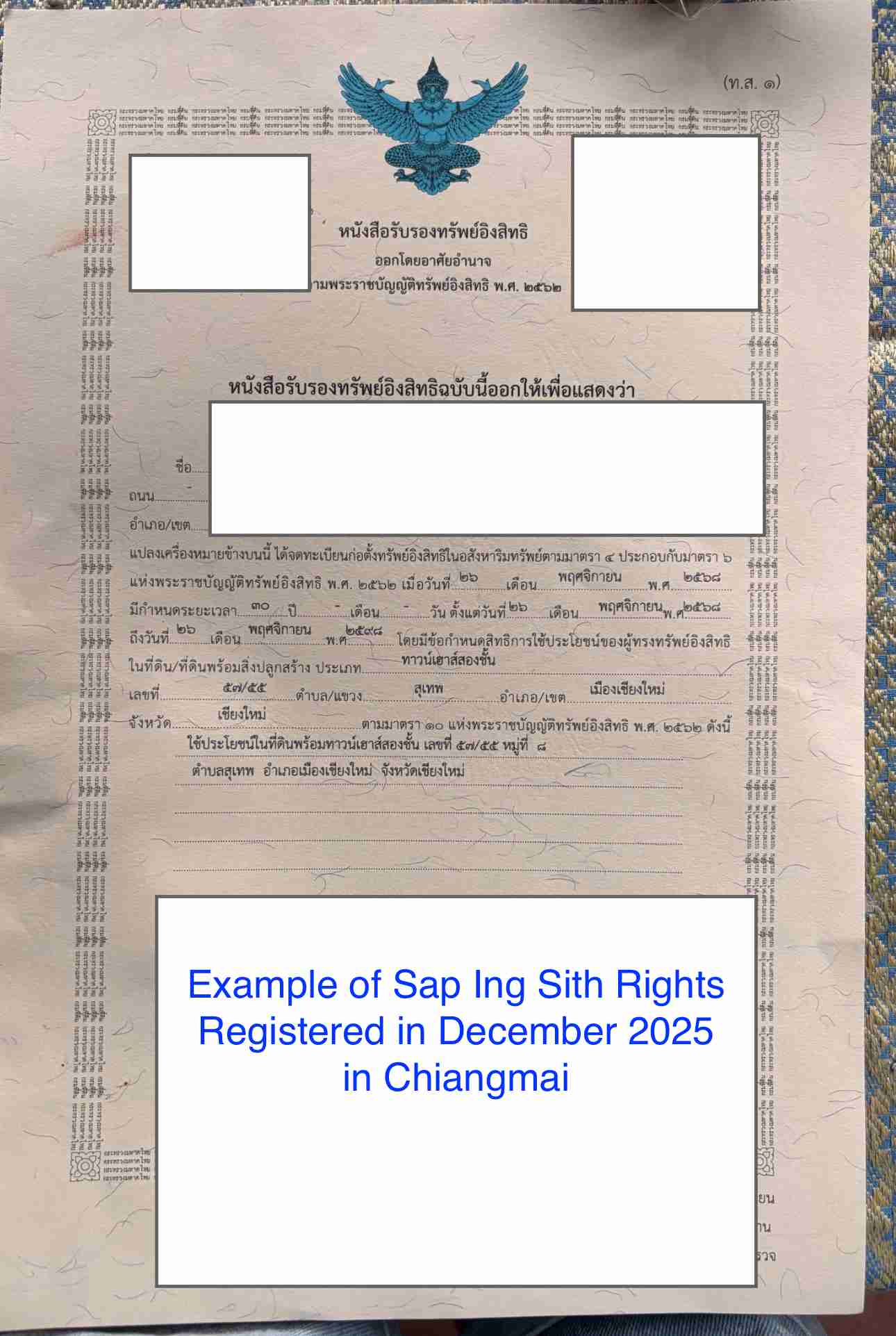
Registration of a Sap-Ing-Sith rights in Chiangmai in November/December 2025.
The process took about 10 days. The name of the foreigner appears on the back of the title deed.
Is a Sap-Ing-Sith in Thailand a personal or a real right?
The legal classification of Sap-Ing-Sith remains a subject of significant debate among Thai legal scholars. The lawmakers wanted to create a “special personal right” that is not like other rights. However, many experts say it has key features of real rights. This is because it involves control over property, affects third parties, has registration needs, and can be transferred. This classification controversy has practical implications. If they are seen as personal rights, they may not transfer automatically when property ownership changes. They could have limited protection against future buyers. If they are classified as real rights, they would provide stronger protections for third parties and better commercial value.
That might be a technical question for lawyers and jurists. However, it can have real effects in reality. The drafters (especially from the Fiscal Policy Office) did not aim to create a new kind of real right. They clearly defined Sap-Ing-Sith as a special personal right. This was done to avoid the legal issues of adding new real rights under Thai civil law. Under Section 1298 of the Civil and Commercial Code, a real right must be established by statute. Since Sap-Ing-Sith is not explicitly declared as such in the CCC, it defaults to being a personal right.
While it can be transferred, inherited, and mortgaged, the law limits some powers. Exclusion rights are part of the law. They are found in Section 11 of the Sap-Ing-Sith Act. These rights belong to the owner of the real estate. They do not belong to the holder. That supports its personal right nature. Real rights can be enforced against everyone. However, Sap-Ing-Sith does not always work that way. This is especially true when legal standing only allows for notifying the property owner.
In a thesis by Natthaphong Wongto submitted at Thamasat university in 2021. The author raises doubts where the practical effects blur the line between personal and real rights around pages 81-85:
Sap-Ing-Sith functions more like a real right in practice, because:
- It grants control over real estate similar to ownership.
- It allows for inheritance, mortgage, and transfer.
- It is registered at the land office.
- It limits the owner’s rights without their consent.
While the law says that Sap-Ing-Sith is a personal right, we believe it acts more like a real right. Its structure and legal effects support this view. This leads to confusion and legal uncertainty in practice.
The rules set by the Sap-Ing-Sith Act apply to land with valid Chanote title deeds. They also apply to buildings on that land and to condominium units as defined in the Condominium Act. Only property owners can create these rights for someone else. They must register at the local land office. The office will then issue a certificate that documents the arrangement. Importantly, land subject to registered Sap-Ing-Sith cannot be subdivided or consolidated, maintaining the integrity of the original property boundaries. Do note that a new title deed is made for the Sap-Ing-Sith holder having a blue garuda.

The Sap-Ing-Sith act in Thailand has a big impact. It opens the door for more foreigners to invest in real estate.
Understanding the advantages of Sap-Ing-Sith in Thailand is crucial for potential investors. It provides a new way to handle property rights. It also creates a legal framework for foreigners to invest in Thai real estate.
Historical Context in Thailand
The Sap-Ing-Sith Act was introduced on February 8th, 2019. It responded to limits set by the Thai Land Code. This code usually does not allow foreigners to own land in Thailand. The Thai National Legislative Assembly created this law to attract foreign investment in real estate. It took effect on October 27, 2019. This change in law shows a new attitude towards foreign investment in the Thai property market. It highlights a move towards more openness. Such reforms are essential for enhancing Thailand’s appeal as a destination for expatriates and foreign investors alike.
Using Sap-Ing-Sith in Thailand helps foreign investors gain an advantage in the real estate market. Foreigners can now enjoy the benefits of Sap-Ing-Sith in Thailand. This allows them to buy property without the limits of traditional ownership laws.
Legal Framework Surrounding Sap-Ing-Sith
The laws about the Sap-Ing-Sith are mainly found in the Sap-Ing-Sith Act. The Civil and Commercial Code matters here for one reason only: Section 1298 provides that real rights may be created only by virtue of the Code or another law, and the Sap-Ing-Sith Act is that other law. Sections 1383 to 1387 of the Code are sometimes cited for Sap Ing Sith and have nothing to do with it: 1383 to 1386 govern acquisitive prescription and 1387 opens the title on servitudes. This legal structure explains the rights of Sap-Ing-Sith holders. It ensures they can use their property effectively. The Act outlines the steps and rules for registration and transfer. It provides a clear guide for foreigners who want to buy property in Thailand.
When juxtaposed with traditional property rights, the Sap-Ing-Sith certificate presents several distinct advantages. The Sap-Ing-Sith is different from a standard lease. A standard lease usually restricts changes to the property. However, the Sap-Ing-Sith lets the holder make changes without needing the owner’s permission. It also lets you transfer rights to another party. This gives you more flexibility than regular lease agreements. This new property right can also be used as security for a mortgage. This makes it more appealing to foreign investors who want to invest in real estate in Thailand. We wrote an article about the differences of Sap-Ing-Sith, Lease and Usufruct in Thailand.
Rights and obligation of Sap-Ing-Sith holders
Rights and duties of the Sap-Ing-Sith Holder:
The Sap-Ing-Sith holder can use the property freely. They must follow the purpose stated in the Land Office certificate. They can also freely transfer or sell their rights to another party without needing approval from the property owner. The holder can also use these rights as collateral for a mortgage. Another significant benefit is the inheritance feature, allowing the rights to be passed down under statutory inheritance laws. The holder can also make alterations or renovations to the property without requiring consent from the landowner.
The holder must keep the property in its original condition. They must return it after the Sap-Ing-Sith period ends, unless another agreement says otherwise. The holder takes full responsibility for the property, just like an actual owner. This does not include recovering it from unauthorized third parties or protecting it from illegal interference.
Rights and duties of the Property Owner:
Section 9 paragraph 2 of the Sap-Ing-Sith Act is explicit on this point: the restriction in paragraph 1 does not affect the right of the property owner to transfer ownership to another person, or to use the property as security for a debt by mortgage or under the law on business collateral. So the landowner can sell, transfer or mortgage without the consent of the Sap-Ing-Sith holder. That is not a hole in your protection, because the Sap-Ing-Sith is registered on the title deed and runs with the property: a buyer takes the land subject to your right, for the rest of its term. Where a client wants more than the statute gives, we restrict the freedom to sell or mortgage by contract, in an addendum filed with the land office documents.
Proprietary Limitations on the Landowner
Once a Sap-Ing-Sith is registered, the owner cannot create any other real right over the property, such as a usufruct, servitude or superficies, unless the Sap-Ing-Sith holder gives written consent (section 9 paragraph 1). Selling and mortgaging remain open to the owner under section 9 paragraph 2. The owner cannot end the right early where that would prejudice a third party who acquired the interest for value, in good faith, and registered it in good faith (section 14). And for as long as the right runs, the land cannot be split into several plots or merged with another plot (section 8).
Procedural Realities of Inheritance and Legal Defense
While the Sap-Ing-Sith in Thailand is an inheritable interest, the transfer to an heir at the Land Office is not automatic. The process needs the registration of an estate administrator. This usually requires a Thai court order to appoint a manager for the estate. About the legal defense of the property, the holder has rights like an owner. The original owner still has the right to get back their property if someone has it unlawfully. They also have the right to stop any unlawful interference. The holder is statutorily obligated to immediately inform the owner of any such disturbances
How Does Sap-Ing-Sith in Thailand Compare to Usufruct and Leasehold Agreements?
Key Differences from Other Property Rights
Usufruct in Thailand lets a person use and enjoy property that belongs to someone else. This is similar to Sap-Ing-Sith. However, the key difference lies in the rights conferred. Usufruct gives the right to use a property for life or a set time. However, the holder cannot use it as security for a mortgage. Sap-Ing-Sith in Thailand offers extra financial benefits. This makes it a better choice for foreigners who want to improve their property rights and financial plans. The remainder of the Sap-Ing-Sith term can also be sold by the holder.
| Feature | Sap-Ing-Sith | Usufruct |
|---|---|---|
| Ownership Rights | No ownership, but strong real right | No ownership, use and benefit only |
| Transferability | The right itself can be sold, mortgaged and inherited (Act section 12) | The right itself cannot be sold and it ends when the usufructuary dies (CCC section 1418), but unless the deed says otherwise the usufructuary may transfer the exercise of the right to a third person (CCC section 1422) |
| Registration | Must be registered at the Land Office | Must be registered at the Land Office |
| Duration | Fixed term, 30 years maximum, with no life option and no statutory renewal (Act section 4) | For the life of the usufructuary, or a fixed term of up to 30 years (CCC section 1418 read with section 1403 paragraph 3) |
| Security | Stronger legal protection | Less secure but safe if registered |
| Typical Use Case | Long-term leases, investment protection | Family or personal use rights |
The comparative analysis of leasehold and Sap-Ing-Sith reveals distinct advantages and disadvantages. Leasehold agreements are often limited to shorter terms and may not offer the flexibility needed for long-term planning. Leaseholders have some rights under a standard leasehold. They can stop any illegal use of the property.
However, they cannot make major changes or improvements. On the other hand, Sap-Ing-Sith gives stronger rights. These rights are similar to those of a property owner. They include the right to make changes and use the land for loans. However, Sap-Ing-Sith in Thailand might involve more complex legal processes and registration requirements. The key is how contracts are written. Using a law firm is important. It gives you more rights and flexibility.
The acquisition of the Sap-Ing-Sith involves a two-stage registration process at the Land Department. Initially, the property owner must formally register the Sap-Ing-Sith for the property in question. Subsequently, the transfer of rights to the other party must be registered to solidify the transaction legally. If the land plot has a mortgage, you must get permission from the mortgage holder. This is important for finishing the registration process and following the Sap-Ing-Sith Act.
Statutory Registration Fees and Transactional Costs
Establishing a Sap-Ing-Sith involves specific flat fees and percentage-based duties paid to the Land Department. The registration fee to start is 20,000 THB for each application. The official Sap-Ing-Sith certificate costs 10,000 THB for each copy.
If the holder wants to use the right as security, they will need to pay a mortgage registration fee. This fee is 1% of the mortgaged amount. Transferring the right costs 2% of the declared value where the transfer is for consideration, or 1,000 baht per transaction where it is not, which includes a transfer on inheritance. Cancelling the right costs 20,000 baht. These rates are set by the Ministerial Regulation prescribing fees and expenses relating to Sap-Ing-Sith B.E. 2563, made under Sections 16 and 17 of the Act (Royal Gazette volume 137, part 96 Kor, page 18, 18 November 2020), and they are the same as the maximum rates in the schedule to the Act itself. Neither the Act nor that Regulation imposes any recurring or annual fee on the holder. Section 16 paragraph 3 does provide that the fees collected, after the Department of Lands retains 5%, become revenue of the municipality, sub-district administrative organisation, Bangkok, Pattaya City or other local authority for the area, but that governs where the one-off fees go and is not a charge on the holder. Annual property taxation is a separate matter under the Land and Building Tax Act and is not a Sap-Ing-Sith fee
Renewal Clause of Sap-Ing-Sith in Thailand
The 30-Year Cap and the “Renewal Myth”
Investors must distinguish between contractual promises and registered real rights. Under the Sap-Ing-Sith Act, the maximum duration is an absolute statutory cap of 30 years. The Act contains no provisions for automatic renewal or extensions. Supreme Court Decision 4655/2566 shows how the courts treat an attempt to go past a statutory 30-year limit: a promise to renew, made at the outset to get around the limit, is void, and the Court refused to save it as a personal obligation between the parties.
On that reasoning, such a clause should not be relied on against a later owner or against the original landowner. Any extension after the initial term requires a new agreement. You also need to register again at the Land Office when the original term ends. Contrary to a lease, the Sap-Ing-Sith Act, B.E. 2562 (2019) does not mention renewal. This means that to continue the right after the first 30 years, a new agreement with the landowner is needed.
Supreme Court Decision 4655/2566 is a lease case decided under Section 540 of the Civil and Commercial Code, and its reasoning is applied here to Sap-Ing-Sith by analogy. The landowner and the tenant registered a 30-year lease and, on the same day, the landowner promised to renew twice more for 30 years each, with the rent for all ninety years paid up front on the original terms. The Court held that this showed a plain intention to evade the 30-year limit, so the renewal promises were void, and it refused to treat them as a personal right enforceable between the two parties, because that would defeat Section 540. When the first 30 years ended the tenant was evicted and ordered to pay damages for staying on. In our view a renewal clause written into a Sap-Ing-Sith agreement at the outset would very likely meet the same outcome, and it should not be relied on.
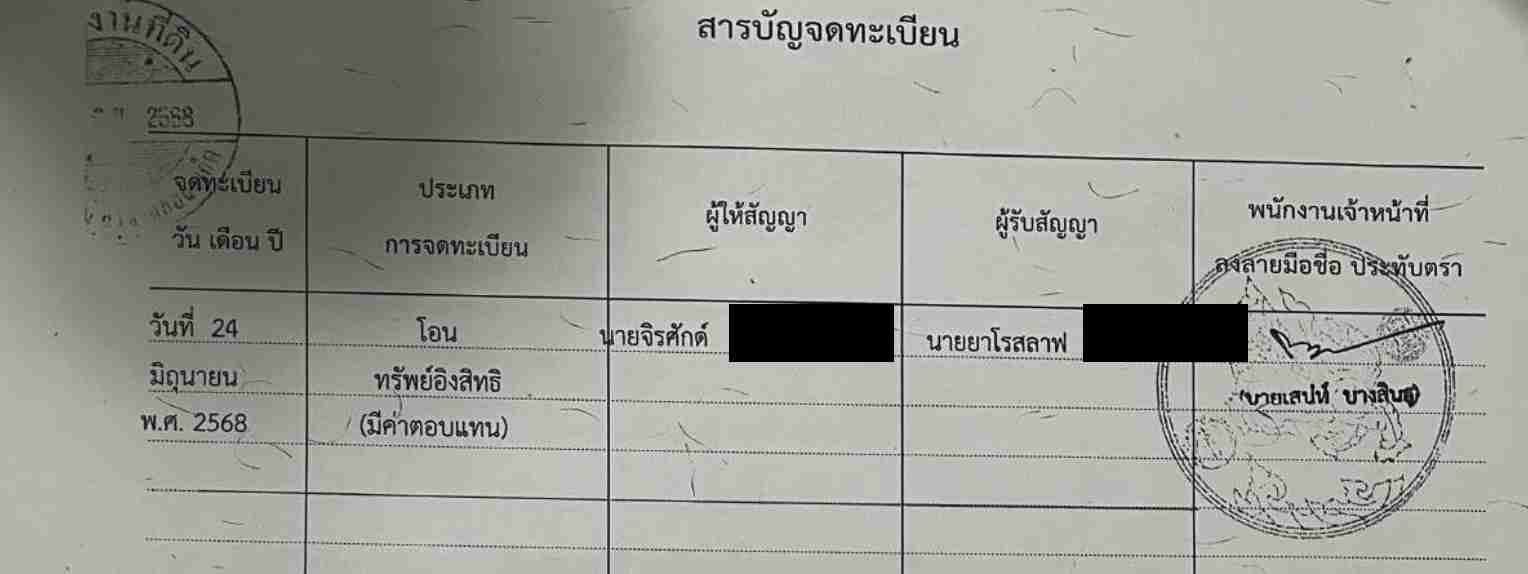
This is an example of Sap-Ing-Sith Registration done in June 2025 by ThaiLawOnline.
Contracts are very important when you are dealing with lease, usufruct, superficies or Sap-Ing-Sith in Thailand.
Practical Strategy:
They do not create a real right that affects others. However, they can still be contractual obligations between the original parties. One strategy is to add a “reciprocal benefit” clause. This clause requires the owner to negotiate in good faith. It applies if the holder has made significant improvements. This provides a way to fix damages, even if specific performance is not possible. This is complex in theory and we have an article about reciprocal agreements here.
Here are some key Supreme Court decisions that have helped shape the understanding of special reciprocal agreements:
- Supreme Court Decision 1135/2506 (1963): In this case, the tenant paid the landlord 10,000 baht towards the cost of building the shophouse unit, in return for a lease of six years and ten months. The court decided this is a special reciprocal contract, binding for its full term even without registration, so the landlord’s claim to evict the tenant once three years had passed failed. This decision established that a significant, value-adding contribution by the lessee could create a contract with special considerations.
- Supreme Court Decision 412/2511 (1968): This judgment involved a contract where the builder of a property was granted the right to lease it. The court saw this as a special agreement. It was different from a regular lease. This agreement did not need to be registered to be valid for a longer time, eleven years in that case. But the lease part still followed ordinary lease law: when the builder, as tenant, did not pay the rent, the landowner was entitled to terminate under Section 560, and the builder lost.
- Supreme Court Decision 2759/2534 (1991): A lease agreement required the lessee to build a car park. The lessee had to give ownership to the lessor. This was seen as a reciprocal agreement. But it protected the tenant only for the term the parties had actually agreed, one year and then month to month, so the landlord’s written notice ended it and the tenant had to pay damages for staying on. A special reciprocal lease does not lengthen the agreed term.
- Supreme Court Decision 8534/2542 (1999): An agreement to build on leased land and give ownership to the landowner was seen as a binding agreement. This was true even though it was not registered and the term was longer than three years.
Alternative Property Rights in Thailand
Lease agreements in Thailand represent a common method for foreigners to access property rights. These agreements give the lessee the right to use a property for a set time in return for rent. However, it is crucial to note that lease agreements do not confer the same extensive rights as usufruct agreements. Leaseholders usually have limits on the changes they can make to the property. They may not be able to profit from it like a usufructuary holder can.
Usufruct agreements in Thailand present an appealing alternative for those seeking more comprehensive rights over property. A usufruct gives the holder the right to use and enjoy someone else’s property for a set time. This does not change who owns the property. This allows the usufructuary to use the property, keep the profits derived from it, and manage it effectively. The laws about usufruct in Thailand protect the rights of the holder. This makes it a good choice for foreigners who want to invest in real estate.
Comparative Analysis: Sap-Ing-Sith vs. Lease vs. Usufruct
When evaluating the Sap-Ing-Sith, lease agreements, and usufruct, notable distinctions arise. The Sap-Ing-Sith can be given to someone else without the owner’s permission. It can also be used as security for a mortgage. A usufruct, in contrast, cannot be mortgaged, and the right itself cannot be sold; the usufructuary may transfer the exercise of it to a third person under CCC section 1422, but it still ends when the original usufructuary dies. Lease agreements often have shorter terms and may lack the long-term flexibility required for strategic planning. The Sap-Ing-Sith provides a better framework. It helps foreign investors protect their interests in the Thai property market.
Future of Sap-Ing-Sith in Thailand
The Sap-Ing-Sith Act marks a big change in how Thailand welcomes foreign investors in real estate. This new property right is expected to boost foreign investment. It gives a legal framework that allows non-nationals to buy and sell property more easily. The chance for higher returns on investment in condos and other properties under the Sap-Ing-Sith is looking good. This shows a bright future for foreign investors in Thailand’s property market.
Economic changes can greatly affect how appealing the Sap-Ing-Sith is as a property right for foreign investors. Changes in Thailand’s economy may change how investors see things. This can affect the demand for real estate and the popularity of the Sap-Ing-Sith. A robust economy often leads to heightened interest in property, driving up prices and increasing competition for ownership rights. On the other hand, during economic downturns, the demand for property may decrease. This can lead investors to rethink their strategies in the Thai market.
The ongoing opening of the Thai property market, shown by the Sap-Ing-Sith Act, is good news for foreign investors. Thailand is making ongoing changes to simplify property ownership. These reforms also aim to improve rights for non-nationals. This shows Thailand’s commitment to attracting foreign investment. The government is trying to improve the economy by investing in real estate. The Sap-Ing-Sith will probably influence future policies. This group will also drive growth in the property sector.
Both Sap-Ing-Sith and lease agreements let non-Thai nationals use property in Thailand. However, there are important differences between them. A traditional lease of property gives rights like those of a tenant. The tenant has limited control over the property. The lease often requires negotiations for renewal. In contrast, Sap-Ing-Sith in Thailand gives more control. It lets the holder change or build on land plots they own. Also, Sap-Ing-Sith holders can use their rights as security for a mortgage. This gives them financial leverage that regular lease agreements do not provide.
Recent Developments and Reforms
Status as of August 2026: neither reform is law. In June 2024 the Ministry of Finance put two changes to the government of the day, and the Ministry of Interior was asked to study them. The first was extending long lease terms for foreigners from 30 years to 99 years. The second was raising the foreign ownership ceiling in a condominium building from 49% to 75%, with the share above 49% carrying no vote in the juristic person meeting, so that Thai owners keep control of management decisions.
Two years on, no amending bill has passed Parliament and nothing has been published in the Royal Gazette. The enforceable limits are unchanged: 30 years for a registered lease, 30 years for a Sap-Ing-Sith under section 4 of the Act, and 49% of the combined area of all the units in a condominium building for foreign owners under the Condominium Act. Treat any marketing that offers you a 99-year term today as a proposal being sold as a product. And note that if the 99-year extension is ever enacted it would most likely be drafted for leases: whether it would be carried across to Sap-Ing-Sith, which has its own 30-year cap in its own statute, is an open question and not something to plan a purchase around.
Faqs abour Sap-Ing-Sith in Thailand
What is Sap-Ing-Sith in the context of property rights in Thailand?
Sap-Ing-Sith is a new type of property right in Thailand. It lets foreigners invest in property and provides similar rights to ownership it. It grants the right to use immovable property as specified in a written and registered agreement. However, it is limited in time.
How does Sap-Ing-Sith encourage foreigners to invest in property in Thailand?
Sap-Ing-Sith offers a clear legal way for foreigners to invest in property. It allows them to use and benefit from immovable property. However, they cannot own land directly under the Thai Land Code.
What are the key features of a Sap-Ing-Sith agreement?
The main features of a Sap-Ing-Sith agreement include the right to use property for up to 30 years. It also grants several extra rights that are usually only for owners. It also allows for changes or additions. The agreement must be in writing and registered at the land department.
Can Sap-Ing-Sith be established on any type of land in Thailand?
Sap-Ing-Sith can be established on land with a valid chanote or land title deed. The property must be clearly defined and registered with the land department.
What rights does a Sap-Ing-Sith holder receive?
A Sap-Ing-Sith holder will have the right to use the property as stated in the agreement. They can also make changes or additions. They are responsible for the property much as an owner would be. Two owner rights do stay with the landowner under section 11 of the Act: the right to reclaim the property from someone holding it without right, and the right to stop unlawful interference by others. The holder must tell the owner immediately when either happens.
What happens to the property at the end of the Sap-Ing-Sith agreement?
At the end of the Sap-Ing-Sith agreement, the holder must return the property. It should be in the same condition as at the end of the term. This is true unless there are any agreed changes or additions made during the agreement.
Are there any restrictions on the types of structures that can be placed on land plots held under Sap-Ing-Sith in Thailand?
Buildings on leasehold land under Sap-Ing-Sith must follow the rules in the agreement. They also need to comply with the land department’s regulations.
Does Sap-Ing-Sith require consent from a Thai company or landowner?
You need consent from the landowner or the right authority. The agreement must be in writing and registered at the land department to be valid.
How does Sap-Ing-Sith differ from traditional ownership in Thailand?
Sap-Ing-Sith offers more flexible land use and management. It does this through leasing and investment partnerships. In contrast, traditional ownership usually requires full title transfer. This method allows for less flexibility in land use.
How does the registration of the Sap-Ing-Sith works?
Some land department do a process in two steps. First, they will make a document called Tor Kor 16. That documents explains the basic rights. And about 5 to 10 days later, the holder will receive his official blue garuda with his name written on the back. Additional contracts drafted by a law firm with experience in Thai property law would benefit you.
Testimonials about Sap-Ing-Sith
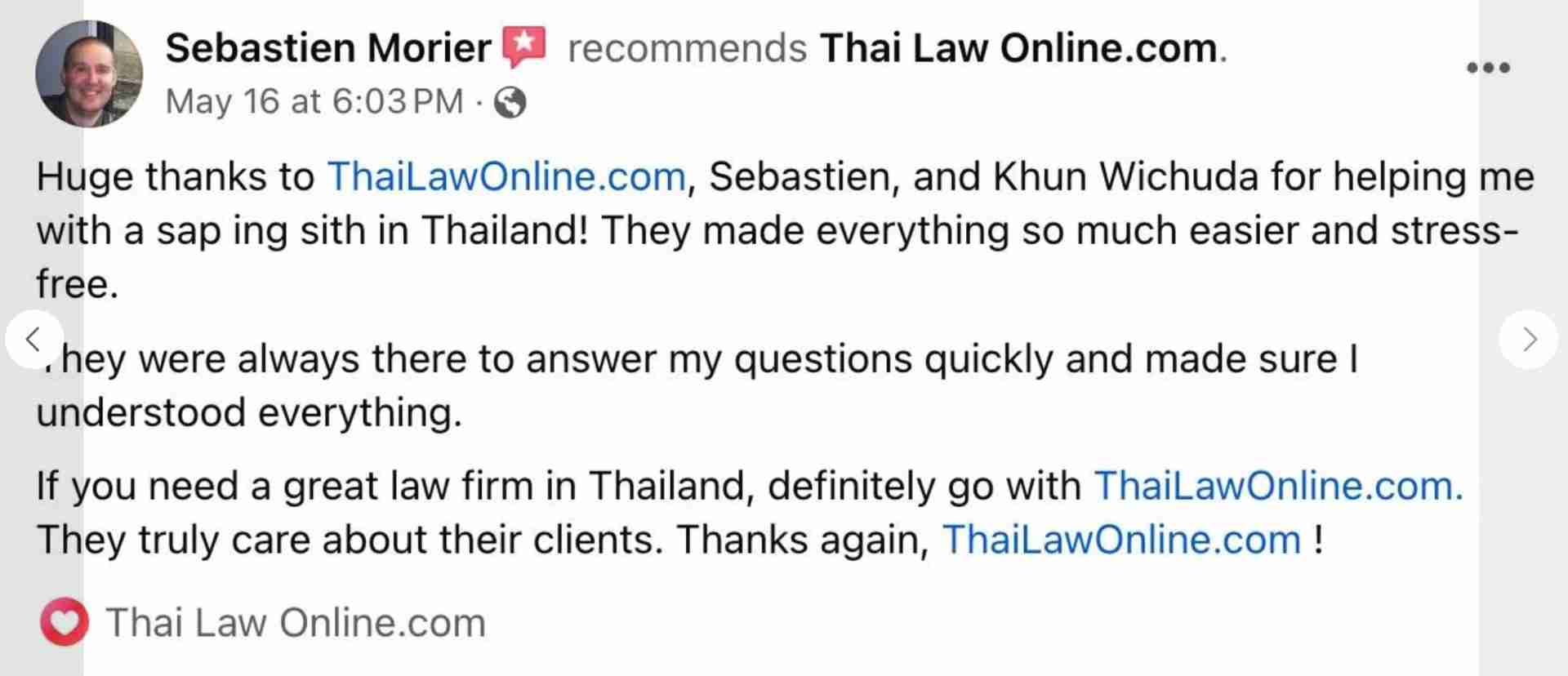
We have testimonials on Facebook, our website, emails, but this is a happy client who posted on Facebook. Done in 2024.
I truly appreciate the time, effort, and care you’ve put into guiding this process, it means a lot.
Hi Sebastien and Khun Wichuda,
I just wanted to send a quick note to thank you both for all your help and support with the land purchase. I should have written sooner, but things have been quite busy on my end.
I truly appreciate the time, effort, and care you’ve put into guiding this process, it means a lot.
2026 Legal Updates
Recent Changes:
- Digital Registration: Some land offices now accept online preliminary applications
- Increased Scrutiny: More thorough background checks on foreign applicants related to problems with nominees (This started around 2024)
ThaiLawOnline prepares agreement for you to ensure that you will get maximum rights for Sap-Ing Sith in Thailand. We have registered the first Sap-Ing-Sith in Chiang Mai, Koh Phang Ngan, Krabi, Prachuap Khiri Khan, and other provinces in Thailand. We are one of the only law firm in Thailand having registered more than a dozen Sap-Ing-Sith in more than 10 provinces.
Links :
Last reviewed: 5 September 2026. The Sap-Ing-Sith Act B.E. 2562 was read in Thai in full for this review, all seventeen sections and the fee schedule, together with the Ministerial Regulation prescribing fees and expenses relating to Sap-Ing-Sith B.E. 2563 (Royal Gazette volume 137, part 96 Kor, page 18, 18 November 2020). Three things were corrected. The fee section stated a percentage stamp duty and a recurring annual charge calculated on appraised value; neither appears in the Act or in that Regulation, which impose one-off fees only, and the section omitted the two charges that matter most, the transfer fee and the cancellation fee, both of which are now stated above. The publication date was given as 26 April 2019, which is the date of royal assent; publication was 30 April 2019 and Section 2 brings the Act into force 180 days later. And two limits in Section 4 were missing: the right cannot be created over part of a title, and where the property is mortgaged or carries another registered right the written consent of that holder is required. What this review does not cover, said rather than implied. The statement that the National Legislative Assembly passed the Act on 8 February 2019 is not in the text of the Act and was not verified. The Ministerial Regulation on applications, cancellation and juristic acts B.E. 2563 exists in our sources but was not read here. The testimonials, the case studies, the firm’s own registration record and the comparisons with lease and usufruct are commercial statements, not legal ones. The treatment of Supreme Court Decision 4655/2566 was not changed in that review; see the case review that follows.
Case citations reviewed: 17 September 2026. The Supreme Court decisions cited on this page were checked against the Thai text and five were read in full to their disposition. The account of Decision 4655/2566 had the holding the wrong way round on whether a renewal promise survives as a personal obligation between the parties; the Court held such promises void and refused to treat them that way, and the passage now says so, with its application to Sap-Ing-Sith kept as the firm’s analogy. Decisions 412/2511 and 2759/2534 are now described with their outcomes, both of which went against the tenant. One detail not found in Decision 1135/2506 was removed. A further lease decision was removed from the list because no copy of it could be found in any source we hold, and a case we cannot read is not cited. Decision 8534/2542 stood as published.
Thai Law Updates, free by email
Plain-English updates on Thai law changes that affect foreigners: property, visas, marriage, business and wills. One short email a month from a firm practicing since 2006. No spam, unsubscribe anytime.