


Reviewed by ThaiLawOnline, a licensed Thai law firm practising in Thailand since 2006. Thai lawyer of record: Wichuda Atthamethakon, LL.M., Thai Bar Licence 3149/2556.
Last updated on
A living will is separate from a last will, and both are placed in context in our guide to Thai inheritance law.
A Living Will in Thailand is an important legal document. It lets people state their wishes about life-sustaining treatments. Under Section 12 of the National Health Act B.E. 2550 (2007), these rules are legally binding. They make sure your wishes are followed if you are in a terminal or irreversible condition. This document helps with “passive euthanasia.” It means stopping or not starting treatment. This gives comfort to patients and their families. This guide offers a comprehensive look at the legalities and practical steps of establishing a Living Will Thailand.
🎧 Listen to Our Podcast about Living Wills in Thailand
Want to better understand how a Living Will works in Thailand? Click below to listen to our short podcast explaining the key points.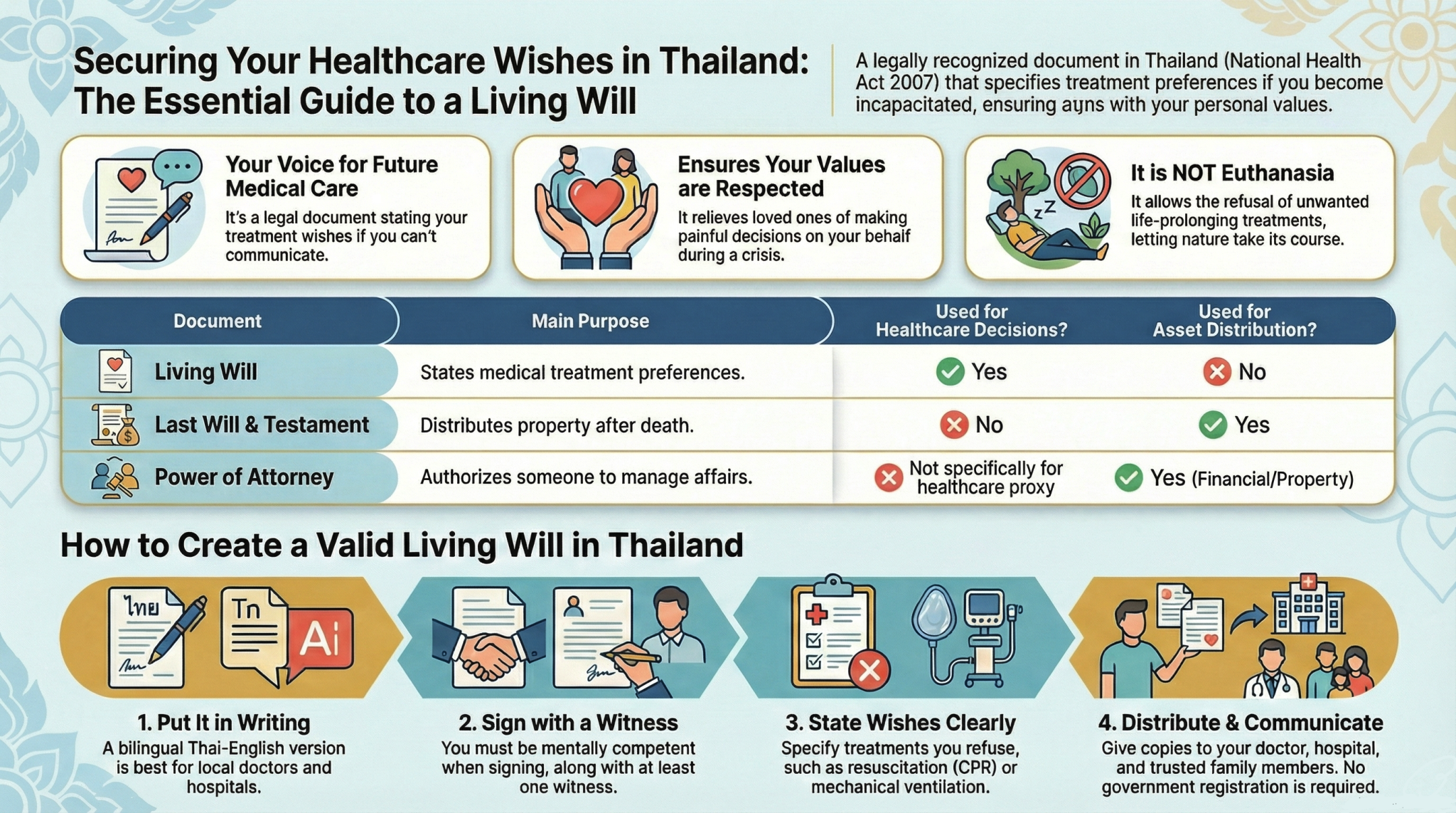
📋 EXPERT AUTHORS This guide is co-authored by:
- Sébastien Brousseau, LL.B., B.Sc., French-Canadian lawyer by training, 20+ years managing Thai law firms.
- Khun Wichuda Atthamethakon, LL.M., Licensed Thai Lawyer (Thai Bar Licence 3149/2556), also a Notarial Services Attorney (registration 576/2566).
Key Takeaways of Living Wills in Thailand
- Practical tips for foreigners: Major private hospitals accept advance directives, including Bumrungrad International and Bangkok Hospital in Bangkok, and Bangkok Hospital Siriroj in Phuket. These hospitals include this in their Patient Rights & Responsibilities policies. Patients must provide a copy of their advance directive, living will, and written choices for treatment options. Getting help from a Thai lawyer who speaks both languages is important. It reduces the risk of the document being overlooked in an emergency.
- Legal basis: Section 12 of the National Health Act gives everyone, including expats, the right to refuse treatment. This applies when treatment only prolongs dying or severe suffering. The refusal must be in a written living will.
- Minimum formalities: Write it in Thai, or in Thai and English, because Thai doctors rely on the Thai text. You should sign it when you are mentally competent. Have it witnessed by at least one person who has no interest in your estate. Notarization is not required.
- Scope & Limits: A valid living will lets you refuse life-prolonging treatment, like ventilators or feeding tubes. However, it does not allow active measures, such as lethal injections, which are still illegal.
- Add a proxy: Pairing a living will with a medical power of attorney or health-care proxy helps. This ensures that hospitals and family know who can speak for you if questions come up. ThaiLawOnline can help you with both at affordable costs.
Table of Contents
Understanding a Living Will in Thailand
What is a living Will?
A living will Thailand is a legal document. It is part of the National Health Act B.E. 2550 (2007) Section 12. This document lets you refuse certain medical treatments. These treatments include life support or resuscitation. You can refuse them if you are terminally ill or permanently unconscious. Thai hospitals must honor your written wishes when you cannot communicate.
Key features:
• Legal since 2007 • Applies only to end-of-life care • Does not permit active euthanasia • Must be signed; witnesses strongly recommended Understanding the importance of a Living Will Thailand can help ensure your healthcare preferences are honored. • Binding on healthcare providers under section 12
Living Will vs. Advance Directive in Thailand
The terms “living will,” “advance directive,” and “health care directive” are often used the same way. However, a living will Thailand is different. It focuses on your written instructions for medical treatment if you cannot make decisions. It’s a primary component of your broader advance care planning. Understanding the differences between an advance directive and a living will is important. In Thailand, the living will is the legal document for end-of-life medical decisions. This is stated in the National Health Act. A living will in Thailand is crucial for ensuring your healthcare wishes are followed. It clearly states your preferences for medical care if you cannot make decisions due to incapacity. A living will in Thailand lets you refuse some medical treatments ahead of time. It helps healthcare providers know your choices. This is especially important for expatriates in Thailand who may face unique medical situations. By having a living will in Thailand, you ensure peace of mind for yourself and your family.
This important document lets you make end-of-life or critical care choices now. This way, you will get care on your terms later. A living will does not support euthanasia or assisted suicide. Instead, it allows you to refuse extreme life-prolonging treatments and focuses on your comfort. It is a crucial part of planning for medical care. It helps you make end-of-life or critical care decisions now. This way, you will be cared for on your terms later. A living will is not about supporting euthanasia or assisted suicide. Instead, Thai law lets you refuse extreme measures to prolong life. It also allows you to stop treatments that only cause more suffering. Here’s a table about different tools that can be used for estate planning.
| Tool | Main Purpose | Applies When | Legal Use in Thailand | Registration Required | Can Be Used for Healthcare Decisions | Can Be Used for Asset Distribution |
|---|---|---|---|---|---|---|
| Living Will | States your medical treatment preferences if you become terminally ill or unconscious | When you’re alive but unable to communicate | Yes, recognized under the National Health Act B.E. 2550 | No (but should be signed and witnessed properly) | ✅ Yes | ❌ No |
| Last Will and Testament | Distributes your property after death | After your death | Yes, governed by the Civil and Commercial Code Sections 1646-1710 | No, but should be properly executed and kept securely | ❌ No | ✅ Yes |
| Power of Attorney (General) | Authorizes someone to act on your behalf | While you’re alive and competent (or until revoked) | Yes, widely used for property, banking, and legal matters | ❌ Not mandatory, but often notarized or certified | ❌ Not usually | ✅ Possibly (for property or financial matters). But most important assets must go through the Court after death. |
Creating a living will in Thailand is essential for any adult. It ensures that your medical preferences are known and respected, especially in critical situations. This document is your voice when you are unable to communicate. It can significantly ease the burden on your loved ones. Understanding how to create and use a living will in Thailand is vital for all expats and residents.
Valid Living Will in Thailand
- The document must be in writing. Be careful about what other law firms might say, there is a lot of misinformation on internet. A bilingual Thai-English version is best because doctors and hospitals will rely on the Thai text first. That is what we prepare for you.
- You, the declarant, must sign while still mentally competent.
- The regulation asks for the witnesses’ names, ID numbers and relationship to you, and for their signatures, but it sets no number, and the National Health Commission Office’s own guidance says a document without a witness is not thereby invalid. We still strongly suggest two witnesses who will not gain from your death, because they are your proof if the document is ever questioned.
- Clearly state which treatments you accept or refuse. This includes things like resuscitation, ventilators, and feeding tubes. Do this if you reach a terminal stage or an irreversible coma.
- You may name a trusted person in the document to explain your real wishes where the document is unclear (Ministerial Regulation of 2010, clause 3, paragraph 3: ผู้ทำหน้าที่อธิบายความประสงค์ที่แท้จริง). That person signs the document and gives their ID number. If you can no longer communicate, the treating doctor must explain your condition to that person or your relatives before acting on the document, and consult them if problems arise (clause 6). They explain your wishes; they do not decide in your place. For palliative care and other decisions the document does not cover, we recommend a separate power of attorney.
We include this with our Living Will package.
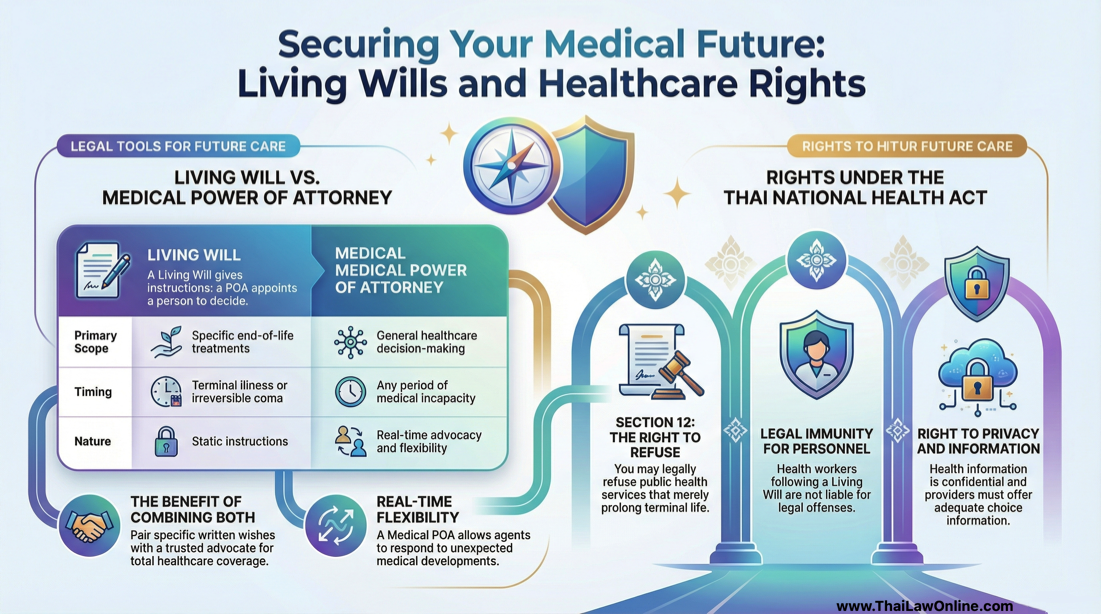
Why Create a Living Will?
Consider the example of an older expatriate couple in Thailand discussing their future healthcare and the
legal regulations of the ministerial regulation.By putting their wishes in writing, they relieve their loved ones of the burden of making painful decisions on their behalf. Instead of leaving family to wonder “What would mom or dad have wanted?” during a medical emergency, a living will provides clear instructions. It’s a kind choice that saves family from guilt or conflict. It also makes sure your values are respected. This includes whether you care more about quality of life, avoiding invasive procedures, or getting all possible treatments. Thinking about illness or incapacity (การไร้ความสามารถ (gaan rái kwaam săa-mâat)) is not easy. However, making a living will is a caring step. It helps both you and your family. In Thailand, the same laws and living will format apply everywhere. However, awareness and hospital practices can differ by district. This makes communication and proper documentation especially important, as we’ll discuss below. Remember that:
- Thai doctors do not like to talk about the possibility of death
- An accident or a sudden illness can leave you unconscious, or unable to direct your own treatment, for a long time and without warning
- The nature of Thai culture is to continue treatment until a person actually dies.
- The Living Will should be completed now or as soon as possible. This is to follow the regulations of the ministerial regulation. Under Thai Law, you can’t consent to a Living Will if you are considered incompetent. So do not wait, do it soon!
Legal Framework for Your Living Will Document in Thailand:
The National Health Act 2007 (พระราชบัญญัติสุขภาพแห่งชาติ (prá-râat-chá-ban-yàt sùk-kà-pâap hàeng châat)
Thailand formally recognized living wills in
Section 12 of the National Health Act B.E. 2550 (2007). This law gives everyone the right to create a written living will. This will refuse medical treatment that only extends the final phase of life or increases suffering. If you are terminally ill or in a hopeless condition, you can tell doctors not to use aggressive treatments. This includes things like CPR, mechanical ventilation, or tube feeding just to keep you alive. Section 12 also protects healthcare providers who follow a valid living will. They will not face criminal or civil liability for honoring your wishes. This assurance has been important in helping Thai doctors and hospitals follow advance directives without worrying about legal issues. In Thailand, a living will only focuses on refusing certain treatments. It does not allow for asking to end life actively. Thai law forbids euthanasia; medical professionals cannot take any action intended to cause death. They are, however, duty-bound to provide
palliative carefor comfort. The living will simply allows a patient to decline futile or unwanted life-sustaining treatment. If you are in a permanent coma and cannot recover, you may not want to be kept alive. This means you do not want to be on a respirator or feeding tube. If such conditions are met, doctors will let you pass naturally, focusing only on comfort care like pain relief. Patients have the right to refuse treatment. This right is based on their dignity and independence. It is the same across Thailand’s healthcare system, but some hospitals may have their own forms or processes.
Requirements for a Valid Thai Living Will:
In 2010, a
Ministerial Regulation was issued about Living Wills in Thailandto outline how living wills should be made. It took effect on May 20, 2011, and has since been an important aspect of legal advice in healthcare. Neither section 12 nor the regulation sets an age; the National Health Commission Office recommends 18, following the Declaration of Patients’ Rights, with parental consent below that age. Below are the key components your Thai living will should include for it to be legally sound:
| Component | Details |
|---|---|
| Declarant’s Information | Please provide your full name, date of birth or age, and identification number. This can be your Thai ID card number or passport number if you are a foreign national. Also, include your current address or contact details. |
| Date of Declaration | The date on which the living will is made. This confirms that you made the directive at a specific point in time while of sound mind. |
| Witness Information | Full name, ID number, and relationship to you of each witness (clause 3(3)); the regulation sets no number and we recommend two. Choosing adults who do not inherit from you avoids any conflict of interest. The witnesses sign the document. |
| Healthcare Instructions | Clear statements of the medical treatments or life-prolonging measures you do not want. For example, you can refuse resuscitation (CPR), mechanical ventilation, tube feeding, dialysis, or other interventions in specified circumstances. You could say, “I refuse any treatment just to extend my life when I cannot recover.” You can also add details, like “no intubation if I cannot breathe on my own.” |
| Optional: Person to Explain Your Wishes | You may name a person to explain your real wishes where the document is unclear (clause 3, paragraph 3). That person signs and gives their ID number, and the doctor must explain your condition to them and consult them before acting (clause 6). They explain; they do not decide for you. We still recommend a separate power of attorney for other decisions. |
| Signature(s) | Your signature (or thumbprint, if unable to sign, certified by two witnesses under the National Health Commission Office’s guidance) and the signature of the witness(es). If someone helped write or type the document for you, that person must sign too and provide their name/ID. All signatures should ideally be made in each other’s presence. |
Your living will should be written in Thai or in both Thai and English. This way, local medical staff can easily understand it. Many expats write the document in English first to make their intentions clear. Then, they work with a lawyer to create an official Thai version. The law in Thailand does not require living wills to be registered. However, it is a good idea to inform your doctor and close family that you have one. Provide copies to your primary physician or hospital and keep a copy with your important papers. In some cases, you can have a note added to your hospital file or even carry a card stating you have a living will. Implementation can vary. One hospital may know a lot about living wills, while a smaller hospital may not. Taking these steps makes sure your directive is known and easy to access when needed. The good news is that more people are aware of living wills. Thai courts and health authorities support this change. As a result, living wills are being respected more across the country.
Registration of Living Will Thailand
Can I Register My Living Will Online in Thailand?(e-Living Will) Thailand does not have a required central registry. However, the National Health Commission Office (NHCO) has created the e-Living Will system. This digital platform lets Thai citizens and residents record their advance directives on the Government Central Cloud (GDCC). This makes them easy to access for participating hospitals. •
Where to register:The NHCO e-Living Will portal. •
Limitations for Expats:The system currently relies on Thai ID verification. Foreign residents should keep a bilingual physical copy of their records at their main hospital’s medical records department. We always suggest clients to do at least 2 original and to renew them each three years.
How to Ensure Your Living Will is Honored
A Checklist for ExpatsMerely signing the document is not enough. Follow these practical steps to ensure enforceability:
Free download: our bilingual signing guide walks you through the whole signing session, the witness rules, and what to do with the document afterwards, in English and Thai. Download the signing guide for Last Wills and Living Wills (PDF, English then Thai). Every Last Will and Living Will we prepare comes with this guide.
Lodge with Medical Records
Take your bilingual document to your main hospital, like Bumrungrad, Siriraj, or Bangkok Hospital. Ask them to scan it into your electronic medical record. According to hospital protocols (e.g., like Bumrungrad), a doctor cannot simply activate your Living Will alone. They usually need a second opinion from a specialist. This is to confirm that your condition is terminal. This safeguard prevents stopping care too soon
The “3-Year” Rule
Many Thai hospitals prefer documents to be updated every 3 years. This helps ensure they show your current intent. It is not in the law but recommended to avoid future problems.
Visual Indicators
Place a sticker on your hospital membership card or carry a wallet card stating, “Living Will on File”.
Digital Backup
Keep a scanned PDF on your smartphone to show emergency room staff immediately
Court Support and Enforcement of Living Will Thailand
Thailand’s courts have affirmed the legitimacy of living wills. The case usually meant was decided by the Supreme Administrative Court, on a challenge to the ministerial regulation made under section 12, not by the Supreme Court on a living will itself. The challengers argued that respecting a patient’s refusal of life-prolonging treatment amounted to euthanasia. Following a valid direction under section 12 is not euthanasia, and the regulation stands (see the judgment below). This verdict confirmed that a living will made under the National Health Act must be honored. It shows the patient’s rights. The Court’s decision made things clear and gave confidence. Doctors who follow a valid living will are protected by law. Families should not blame them for respecting the patient’s wishes. It’s important to give copies of your living will to your doctor or hospital. Also, keep a copy with your important papers. In some cases, you can ask to add a note to your hospital file. You can also carry a card that says you have a living will. Implementation can vary; one hospital may understand living wills well, while a smaller one may not. Taking these steps ensures your directive is known and easy to access when needed. In short, on 18 June 2015 the Supreme Administrative Court handed down
Decision Red No. ฟ.11/2558 (Black No. ฟ.147/2554). Three doctors asked the Court to cancel
the 2010 Ministerial Regulation.They argued it allowed euthanasia and went against medical ethics. The Court dismissed the petition and upheld the Regulation in full. Government agencies have also supported the use of living wills through public policy. The Ministry of Public Health and the National Health Commission Office have released guidelines and materials. These aim to help people understand advance directives. For example, the National Health Commission has shared sample living will forms. They also provide lists of treatments that patients often refuse. These treatments include CPR, ventilators, and feeding tubes in end-of-life situations. These efforts aim to dissolve myths among healthcare workers and the public. Thanks to this outreach and the Supreme Administrative Court’s ruling, living wills are now seen as an important tool in Thai healthcare. Hospitals today are more familiar with handling them, especially in urban centers like Bangkok.
Active vs Passive Euthanasia in Thailand
Understanding the distinction between active and passive euthanasia is crucial for anyone considering a living will in Thailand. Section 12 of the National Health Act B.E. 2550 (2007) gives patients the legal right to refuse life-prolonging treatment, which is sometimes loosely called passive euthanasia; the Supreme Administrative Court held that following such a direction is not euthanasia. Patients have the legal right to refuse life-sustaining treatments. This includes mechanical ventilators, feeding tubes, dialysis, or resuscitation. This applies when they are in a terminal stage or irreversible condition. Passive euthanasia involves allowing a natural death by withholding or withdrawing treatment rather than actively causing death. Active euthanasia means taking specific steps to end a person’s life. This can include giving a lethal injection. Active euthanasia and mercy killing remain criminal offenses under Thai law, regardless of the patient’s wishes. A valid living will Thailand allows only passive measures. It stops treatments that only prolong dying and focuses on comfort care. It does not permit any action designed to hasten death. This important legal difference makes Thailand’s approach similar to many other countries. These countries allow people to refuse treatment but do not allow assisted suicide.
Common Misconceptions About Living Wills in Thailand
To ensure clarity and dispel common myths surrounding living wills in Thailand, let’s address some frequent misunderstandings:
1. Misconception: A Living Will Authorizes Euthanasia or Mercy Killing.In summary, a living will in Thailand is more than a document. It shows your values and choices about medical treatment. It’s essential for anyone living in Thailand to create a living will to safeguard their healthcare preferences.
- The Living Will allows Euthanasia
- Reality: This is incorrect. A living will in Thailand allows a person to refuse some medical treatments. This is based on the National Health Act B.E. 2550 (2007). These treatments only prolong the final stages of life or increase suffering. It does not permit any action to actively end a life. Thai law strictly prohibits euthanasia. The focus is on letting death happen naturally. We avoid extreme measures but still provide comfort through palliative care.
2.
Misconception: My Family Can Override My Living Will.- Reality: If a living will is properly made under Thai law, healthcare professionals must follow its instructions. It must be in writing, clearly state intentions, be signed by a person of sound mind, and have proper witnesses. Family input is often valued in care discussions. However, a clear living will shows your wishes. It usually takes priority over family opinions about the treatments you want to refuse.
3.
Misconception: Living Wills Are Only for the Elderly or Terminally Ill.- Reality: Many people think a living will is only for the elderly or seriously ill. However, it is a useful planning tool for all adults aged 18 and older in Thailand. Unexpected accidents or sudden illnesses can happen at any age. These events may leave you unable to share your healthcare wishes. Creating a living will proactively ensures your preferences are known, regardless of your current health status.
4.
Misconception: Once I Make a Living Will, It’s Set in Stone and Cannot Be Changed.- Reality: This is false. You can change or cancel your living will at any time. This is true as long as you can make and share your own decisions. If your wishes change or if new medical treatments change your views, you can make a new living will. It’s important to destroy all copies of the old document. Also, let your doctor and any relevant parties know about the updated or revoked document.
5.
Misconception: A Living Will Must Be Registered with a Government Agency to Be Valid.- Reality: Registration is not required for a living will to be valid in Thailand, although the National Health Commission Office offers an online service. Its validity comes from meeting the rules of the National Health Act and the related Ministerial Regulations. This includes having a clear intent, in writing, signed, and witnessed. The most important thing after creating it is to share it. Make sure to give copies to your healthcare providers and trusted people.
6.
Misconception: A Living Will Also Manages My Finances or Distributes My Assets.- Reality: A living will is strictly for healthcare decisions. It does not deal with financial matters or the distribution of your property after death. To achieve those goals, you need separate documents. You will need a Power of Attorney for financial matters and a Last Will and Testament.
Many Expats confuse DNR” and Living Wills
A Living Will is a broad legal document. However, when you go to a Thai hospital for surgery or critical care, doctors may ask you to sign a form. This form is called a ‘Do Not Resuscitate’ (DNR) order Your Living Will serves as the evidence needed to support signing that DNR.
Power of Attorney (หนังสือมอบอำนาจ (nǎngsěu mâwp am-nâat))and Living Will Thailand
One common question is if you can choose someone to make healthcare decisions for you in Thailand. This is like a medical
power of attorneyor healthcare proxy in other countries. Under current Thai law, a living will under Section 12 does
notitself assign a healthcare agent. The concept in Thailand is that you give
instructionsin advance, rather than naming a proxy to decide for you. This is an important point: if you sign a Thai living will and later cannot make decisions, doctors will follow your written wishes. They will also talk to your family to confirm what you want, instead of relying on one legal spokesperson. That said, you may still use a general
Power of Attorney (POA)in conjunction with your living will in Thailand. You can create a document that names your spouse, adult child, or a close friend. This document allows them to make medical and personal decisions for you if you cannot. Thailand’s laws do not have a specific “medical POA” form for healthcare. However, a well-written POA can give someone the power to make healthcare decisions. As you go through this process, remember that having a living will in Thailand helps protect your healthcare wishes. This document ensures that your preferences are honored, providing you with peace of mind regarding your future medical decisions. Hospitals in practice will often listen to close family members regarding an incapacitated patient’s care. If you have officially chosen someone with a POA and told your doctors, they will likely follow that person’s advice. This is true as long as it does not go against your written living will. For example, if your living will says “no ventilator in case of irreversible coma” and you’ve given your spouse POA, the doctors will not intubate you, and your spouse would be involved in other care discussions (like pain management or hospice arrangements) that you didn’t specifically cover in writing. Remember that the law does not clearly recognize a healthcare proxy. This means that a power of attorney (POA) in medical situations relies on general agency rules. It also depends on whether medical staff agree to follow it. It is wise to have both a living will and a trusted person. A living will states your treatment choices. The trusted person can be chosen informally or through a power of attorney. They help make sure your wishes are followed and can make other decisions if needed. Make sure your family or chosen proxy knows about your living will in Thailand and has a copy. Open communication is key. A Thai living will works like a
limited power of attorney. It serves as your voice on paper during important times. Thailand Law Online defines a living will as a type of advance directive. It is similar to a power of attorney for healthcare. A living will gives instructions for when you can no longer make decisions for yourself. Just remember that the written directive is the most important. In Thailand, a doctor or family member cannot change what you have clearly refused in a valid living will. They can only fill in the gaps for situations you didn’t address. In summary, you cannot officially name a binding “healthcare proxy” in a Thai living will. However, you can and should include someone you trust in the process. Many expats will talk to their spouse or a close friend and give them a broad power of attorney covering health decisions. While not an exact legal guarantee, this can be very helpful in practice. It ensures there’s an advocate by your side who understands your values. Combine that with a good living will in Thailand, and you have a strong plan. You have your own instructions and a proxy to help carry them out. If you need help preparing these documents in the right format and in both languages, a Thai lawyer can assist you. They will ensure that the living will and any power of attorney work well together.
Translation and Legalization of Living Wills in Thailand
Hospitals in Thailand usually accept bilingual Thai-English living will documents for healthcare. However, sometimes, extra legalization may be needed. Under Civil Procedure Code section 46, documents filed in a Thai court must be in Thai. If they are not, a certified Thai translation is required. If you need to use your living will in legal matters, you may have to get it legalized. This can be done through the Ministry of Foreign Affairs (MFA) or certified by a Notarial Services Attorney. In most medical cases at Thai hospitals, a good bilingual living will is usually sufficient. This document should be prepared by a Thai lawyer. If you need your advance directive to be legally valid for court or government use, consider getting it notarized. Thailand has no civil-law notary public; signatures are certified by a Notarial Services Attorney, or the document is legalised through the right channels. ThaiLawOnline prepares bilingual documents that are accepted by Thai hospitals, and we can advise on additional legalization if your specific situation requires it.
How to Create a Living Will in Thailand, Step-by-Step Guide
Creating a living will in Thailand is fairly simple. However, you should do it carefully. This ensures it meets all legal requirements and truly shows your wishes. Below is a step-by-step guide to help you through the process:
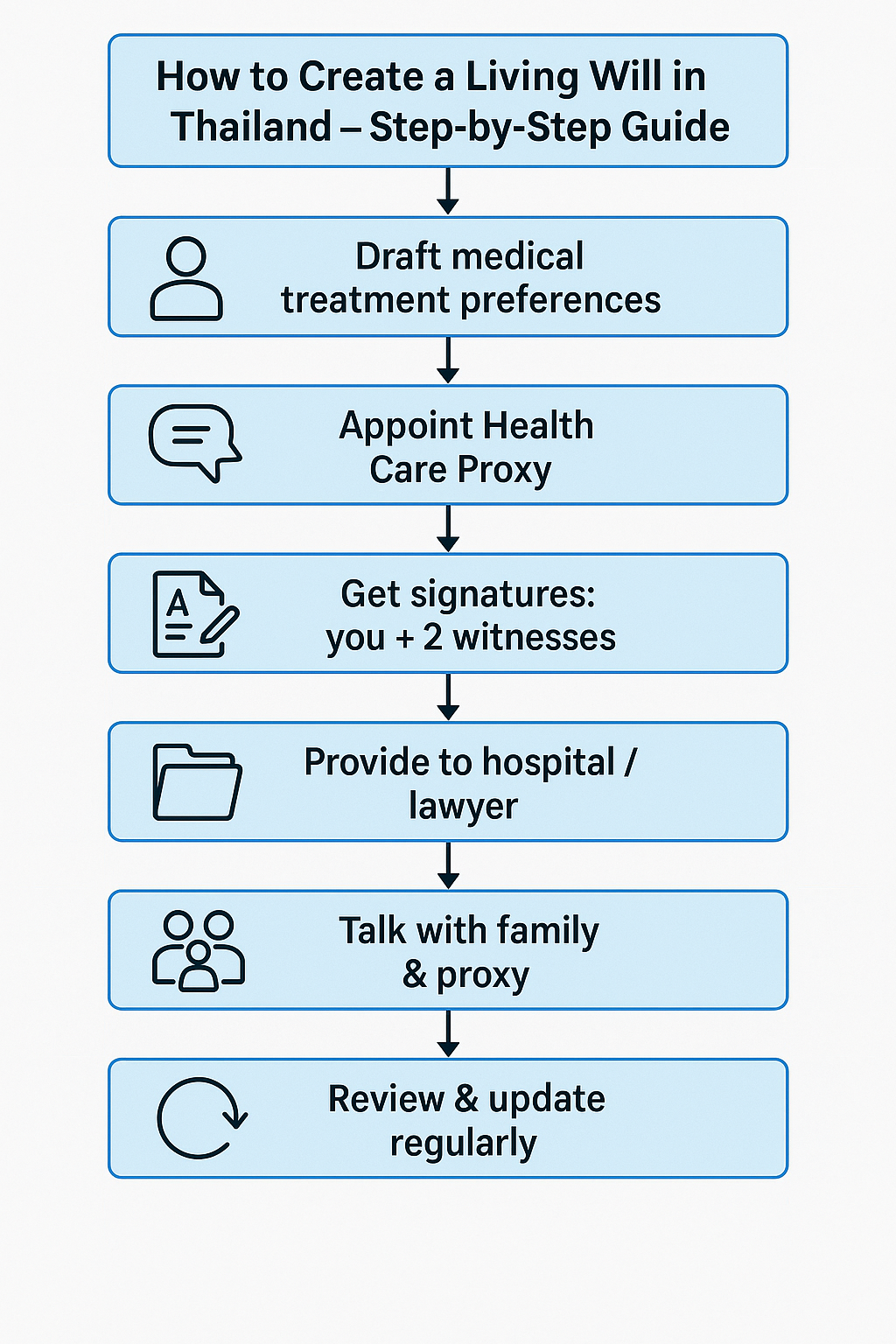
- Reflect on Your Wishes and Consult Professionals: Begin by thinking about the medical situations and interventions that concern you. Do you want CPR if your heart stops? Ventilator support if you cannot breathe on your own? Tube feeding if you can no longer eat? Consider your values and discuss with your doctor if needed, they can explain what these treatments entail. It’s also wise to consult a lawyer experienced in Thai health or family law. A lawyer can help with the right wording for Thai legal needs. They will make sure your living will is clear and not misinterpreted. You could say, “no life-sustaining treatment if I am terminally ill.” A lawyer can help explain terms like “terminally ill” according to Thai guidelines. This first planning step is very important. Take your time to learn more.
- Draft the Living Will Document: When you’re ready, draft your living will document*n writing. You can begin with a living will form or template. However, it is important to customize it to fit your wishes. Make sure it meets Thai legal standards, like those in the Ministerial Regulation. Make sure the document includes your name, ID or passport number, and address. It should be titled Living Will in Thailand or Advance Directive. In the content, write out the conditions under which you want to refuse treatment and list the specific treatments to be withheld. Be as clear as possible. For instance: “If two doctors agree that I am in a permanent vegetative state with no chance of recovery, I direct that no resuscitation, ventilator, or dialysis be given, and I only receive comfort care.” You can also express positive wishes (e.g. “I would prefer to be at home rather than in a hospital at end of life, if possible”). The draft should be in Thai or dual-language. A lawyer can translate your English draft to formal Thai phrasing. Make sure it follows the Ministerial Regulation’s format (see the table above). Also, add a section for witnesses and signatures.
- Sign the Document with Witnesses: After finalizing the content, print the living will. Sign it in front of at least 1 witness but preferably two. The witnesses should also sign and provide their names, IDs, and relationship to you. It’s best if your witnesses are not people who will inherit your estate. Choose friends, neighbors, or professionals instead of immediate family, if you can. By signing, witnesses affirm that you were of sound mind and signing voluntarily. You don’t need a notary or official registration. A living will in Thailand is valid if it is signed and witnessed correctly. However, you may choose to have it certified by a lawyer or have extra copies signed to distribute. Some people create several original copies (signed in wet ink). Each copy can be given to different people, like a doctor or family. After signing, each witness should also add the date and their contact information. Now your living will is officially executed.
- Distribute, Communicate, and Keep it Updated: A living will doesn’t help anyone if it’s locked away unknown. Notify your family and doctors that you have made a living will in Thailand. Provide a copy to your primary care physician or hospital, you can ask that it be placed in your medical record. It’s a good idea to give a copy to your closest relative or friend in Thailand. You should also share it with your decision-maker if you have one through a power of attorney. For practical lodging at Thai hospitals, follow these steps: Ask the hospital to put a sticker on your membership card. This sticker should show that you have a living will on file. Keep a digital copy of your living will on your smartphone. This makes it easy to access in emergencies. Be aware that some hospitals, like Siriraj Hospital and Bumrungrad, may want their own advance directive forms. They might also add a note to your medical record. It’s a good idea to contact your chosen hospital directly. This way, you can learn about their process and make sure your wishes are recorded correctly.
- In Thailand, you do not have to register living wills. However, the National Health Commission Office (NHCO) offers a voluntary e-Living Will Portal. This portal is available on the Government Digital Governance Cloud (GDCC). This digital advance directive service allows you to register your living will electronically, though it remains optional. But making your directive visible and known is key. Also, review your living will periodically. If your feelings about treatment change or medical advancements occur, you can update it. To revoke or change a living will, create a new document, destroy the old copies and inform everyone of the new version. If several versions are produced, the latest one given to the treating doctor prevails (Ministerial Regulation clause 5). If you are pregnant when the time comes, the document is carried out only after the pregnancy ends (clause 6(4)). Thai law allows you to revise your wishes anytime while you have capacity. Talking often with your loved ones and doctors about your advance care plans will help avoid surprises when the document is needed.
You will create a living will that is effective and honored in Thailand. It’s a good idea to keep a translated copy of Section 12 of the National Health Act. You can also include a letter from your lawyer with the document. This will help educate any healthcare provider who may not know about living wills. As more people learn about it, many Thai hospitals will accept and file your advance directive without any problems. Making a living will in Thailand is a helpful step for you and your family. It ensures that healthcare choices match your wishes and reduces stress for everyone.
✅ LIVING WILL CREATION CHECKLIST
□ You are an adult (the National Health Commission Office recommends 18+) □ You have mental capacity to make decisions □ You have identified at least 1 adult witness (2 recommended) (not beneficiaries) □ You have decided on specific medical treatments to refuse □ You have informed family members of your intentions □ You have stored copies with doctor, hospital, and family
Case Study: Mr. Smith’s Journey with a Living Will in Thailand
Background: The importance of a living will document in ensuring patient wishes are respected.Mr. Smith, a 65-year-old expatriate living in Bangkok. He wanted to make sure his medical care matched his values. He also wanted to refuse treatment if he could not communicate. He was mainly worried about life support in a serious condition. So, he chose to make a Living Will in Thailand and name a power of attorney.
Process:Mr. Smith consulted us. We created a Living Will that explains his wishes to stop life-sustaining treatments in some situations. We signed the document in front of two witnesses. He then told his main doctor and family about the living will he made to choose a power of attorney. Registration is optional, so the people around you should be ready to tell doctors about the document if he cannot.
Outcome:When Mr. Smith had a medical emergency, he knew it would happen. His Living Will helped the medical team. It provided palliative care in accordance with his wishes, avoiding unnecessary procedures and kept his dignity.
Takeaway:A good Living Will can make sure your medical care follows your wishes. This brings peace of mind for you and your loved ones.
🆕 GOVERNMENT E-LIVING WILL PLATFORM
Thailand’s National Health Commission Office offers an online living will registration system (e-livingwill.nationalhealth.or.th). This free platform makes it easier to access, but it only offers template forms. It does not include legal review, translation services, or checks to ensure your wishes meet medical-legal requirements. ThaiLawOnline’s lawyer-drafted living wills ensure legal validity, hospital compliance, and bilingual clarity that template systems cannot provide.”
Last reviewed: 27 September 2026. National Health Act B.E. 2550 section 12, the Ministerial Regulation on living wills under section 12 (B.E. 2553, in force 20 May 2011, clauses 1 to 7) and the National Health Commission Office’s guidance manual for health workers were read in Thai, as were Civil Procedure Code sections 46 and 94. The Supreme Administrative Court decision Red No. ฟ.11/2558 was read in the National Health Commission Office’s report of it. Hospital practices named on this page were not verified with the hospitals.
FAQs About Living Wills in Thailand
Is a Living Will legally binding in Thailand, and can it be used to refuse treatment at the terminal stage of life?
Yes, Living Wills are recognized under the National Health Act of 2007. They provide legal authority for your healthcare preferences, as long as they comply with the law.
Can foreigners create a Living Will in Thailand to ensure their wishes are followed while still alive?
Absolutely. Foreign residents can draft a Living Will in Thailand, provided it meets the local legal requirements. Don’t depend on your Home Country Will.A Living Will from the UK, USA, or Switzerland is often not valid in Thailand. This is because it does not mention_ Section 12 of the Thai National Health Act._
Thai doctors are legally protected only when following Thai law, so they will likely ignore a foreign document.
What treatments can I include in my Living Will in Thailand?
You can specify treatments like life support, resuscitation, palliative care, and any procedures you wish to decline.
How do I update or revoke my Living Will document?
You can revise or revoke your Living Will at any time. Inform your healthcare providers and family members about any changes to your living will document on your behalf.
What happens if I don’t have a Living Will?
Without a Living Will, family members or doctors make healthcare decisions for you. This may not match what you want.
How do I make a living will in Thailand?
To create a living will in Thailand, you must write the document. It should state your choices for medical treatment. It should state whether or not you want to be kept alive in certain medical conditions. You sign it, and it should be witnessed: the regulation asks for the witnesses’ details and signatures, though the National Health Commission Office says a missing witness does not by itself invalidate it.
Does a living will allow mercy killing or euthanasia in Thailand?
No, a living will in Thailand does not allow mercy killing or euthanasia. It allows people to refuse some medical treatments under the Thailand National Health Act. However, it does not support actions to end life. This is an important difference in advance health care directives.
Can I appoint someone to make decisions on my behalf in my living will?
Not as a decision-maker. A Thai living will sets out your own choices. You may name a person to explain your real wishes where the document is unclear, and the doctor must explain your condition to that person and consult them (Ministerial Regulation of 2010, clauses 3 and 6), but they do not decide for you. A separate power of attorney can cover other matters.
Is a living will mandatory for medical treatment in Thailand?
No, a living will is not mandatory. It is a helpful tool to make sure your medical treatment wishes are followed if you cannot speak for yourself. It is your right to make a living will, but it is not required.
How is a living will used in a medical situation?
In a medical situation where you cannot speak or make choices, doctors will look at your living will. This will help them know your treatment preferences. It helps them understand if you want to stay alive in certain situations. It also shows if you want to refuse public health services.
What is the difference between an advance directive and a living will in Thailand?
In Thailand, a living will is a type of advance directive. It lets you express your wishes about medical treatment. This applies if you are in a terminal state or an irreversible coma. This is according to the National Health Act B.E. 2550. An “advance directive” is a general term for any instructions about future healthcare. A “living will” is a specific document that formally states a person’s wish to refuse life-sustaining treatment.
Does a Living Will expire in Thailand?
No, a living will in Thailand does not have a legal expiration date. Many hospitals and healthcare providers prefer a document updated within the last 3 years. This helps ensure it shows your current wishes. Medical circumstances, treatments, and your own preferences may change over time, so it’s good practice to review and update your living will periodically. If your wishes are the same, just re-sign and re-date the document. This shows it still reflects your current intentions.
Can I choose to die at home in my Living Will?
Yes, you can specify a preference for dying at home in your living will in Thailand. Many people wish to spend their final days in familiar surroundings with loved ones rather than in a hospital setting. You can add this preference to your advance directive. State that you want to receive palliative care at home if possible. It’s important to know that some medical conditions need special hospital equipment or care. This care cannot be given at home. Talking about this preference with your doctor and family ahead of time helps everyone understand your wishes. This way, they can try to honor them when possible.
What is the difference between a Living Will and a Last Will?
A Living Will and a Last Will (Testament) serve completely different purposes. A Living Will applies while you are still alive but unable to communicate, it states your preferences for medical treatment and end-of-life care. A Last Will and Testament, on the other hand, only takes effect after your death and governs the distribution of your assets and property. Think of it this way: Living Will = Medical decisions while alive; Last Will = Asset distribution after death. Both are important documents for comprehensive estate planning in Thailand, but they address different stages of life and different types of decisions.
-
Thank you for your prompt attention and your excellent service.
I received the signed copy of the living will in the post. Thank you for your prompt attention and your excellent service.

-
Clear and stress-free
ThaiLawOnline made the process of creating a Living Will in Thailand clear and stress-free. Their team explained everything in simple terms and helped me put my wishes in writing. I feel much more at peace knowing my decisions will be respected. Highly recommended. (June 2025)
-
Very clear and precisely what I was looking for…
I would like to sincerely thank you for providing the final drafts of my Last Will and Testament and the Living Will. The documents are very clear and precisely what I was looking for to secure my affairs here in Thailand. I appreciate the thoroughness of your work and the guidance you’ve provided throughout this process. I will be sure to reach out should I require any further legal assistance in the future. (February 2026)
Title
IMPORTANT DISTINCTION: Thailand’s National Health Act does not allow for a healthcare proxy in the living will itself. This is different from common law jurisdictions. However, you CAN create a separate general Power of Attorney document that grants medical decision-making authority. ThaiLawOnline includes this complementary POA in our bundled service (5,000 THB).
Conclusion: Secure Your Peace of Mind
A Thai living will is an important document. It is a type of advance health care directive. This will helps you control your medical treatment in Thailand, even if you cannot speak for yourself. It upholds your right to a dignified approach to healthcare and relieves your loved ones from agonizing guesswork. If you are an expat or foreign retiree in Thailand, you should make a living will. It should be on your checklist with your Thai last will and testament and other legal documents. While it is possible to draft one on your own, the stakes are high, this document speaks for your life when you cannot. It’s worth getting professional help to ensure everything is done correctly and in accordance with Thai law.
ThaiLawOnlineis here to assist you in this process. Our team can help you write a clear and valid living will that fits your needs. We can also answer any questions you have about planning for medical care in Thailand. We provide a full Living Will drafting service for a fixed fee of 1,900 baht. This includes bilingual documents, done by registered lawyers. Also instructions and help with signing. Prefer the self-service option? Build and preview your bilingual Living Will without charge. The completed download with signing instructions costs 590 THB. Individual lawyer review is a separate service.
Build your Living Will online. If you want a better protection, we do a
Last Will + Living Will at a fixed fee of 5,000 baht.WHY THAILAWONLINE COSTS LESS (Without Compromising Quality)
❌ No Expensive Bangkok Office Overhead We operate efficiently online, passing savings to clients. ✅ Fixed-Fee Model No hourly billing surprises. You know exact cost upfront. ✅ Volume Service We focus exclusively on expat legal needs, allowing competitive pricing through specialization. ✅ Digital-First Process Online consultation + document delivery reduces costs while maintaining lawyer oversight.
Doctor Hesitancy and the Importance of ClarityRemember that drafting a clear, bilingual document is vital because confusion still exists within the medical community. A study of April 2024 looked at Thai doctors. It found that
41% of them still misunderstood the difference between palliative care and euthanasia. A well-written Living Will protects doctors from legal issues. This makes them more likely to follow your wishes without delay All documents drafted by licensed Thai lawyers (Bar Association License verified). All services include bilingual Thai-English documentation.
- Translation in English of the Regulation about Living Wills in Thailand
- Department of Health, ministry of Health, Thailand.
A Living Will governs your medical care while you are alive. It says nothing about your property. Most clients sign both at once: see the Last Will guide (fixed 3,900 THB, or 5,000 THB for both documents).
Want to draft one now? Use our Living Will generator for Thailand. Build and preview free; pay 590 THB to download the document and signing instructions.
Try it yourself first, free
Explore the tools below before choosing a service. The Living Will questionnaire and preview are free; downloading the completed document costs 590 THB. Lawyer preparation is a separate option.
Living Will Generator: free preview, 590 THB download
Legal Document Maker Gold members
Ten bilingual documents from a guided questionnaire, in the firm's own wording.
Open the toolAsk our AI assistant Free
Trained on Thai law and 77,000+ Supreme Court decisions. Ask anything, free.
Thai Law Updates, free by email
Plain-English updates on Thai law changes that affect foreigners: property, visas, marriage, business and wills. One short email a month from a firm practicing since 2006. No spam, unsubscribe anytime.