


Reviewed by ThaiLawOnline, a licensed Thai law firm practising in Thailand since 2006. Thai lawyer of record: Wichuda Atthamethakon, LL.M., Thai Bar Licence 3149/2556.
Last updated on
You’re a Canadian business owner expanding to Thailand. You’ve signed a supply contract with a local manufacturer. Six months in, the company stops delivering. You want to sue. But before you hire a lawyer, you realize you don’t understand how Thai courts work. You’ve never dealt with a civil law system. You don’t know if judges will hear your case fairly, how long it will take, or what the rules are.
Table of Contents
This scenario plays out hundreds of times a year. Foreigners operating in Thailand face a legal system fundamentally different from Western common law countries. Understanding the Thai legal system isn’t optional if you’re doing business, buying property, or settling here long-term.
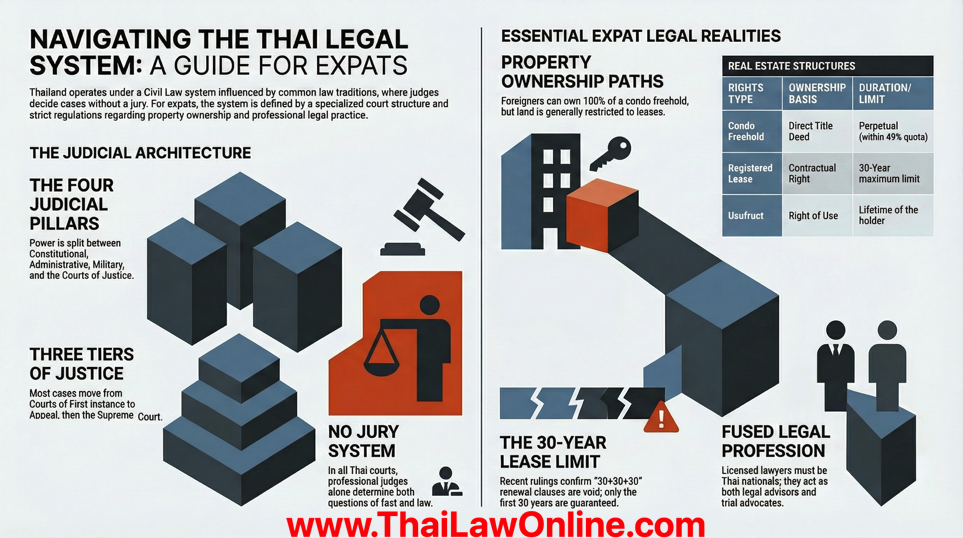
This guide explains how Thailand’s civil law framework works, how courts operate, what the major laws are, and what foreign nationals need to know. By the end, you’ll understand your legal options and how to protect yourself in Thailand.
What Is the Thai Legal System Based On?
The Thai legal system rests on a civil law foundation. Written statutes are the principal source of law. A core private-law statute is the Thai Civil and Commercial Code. Books I and II were first promulgated in 1923 (B.E. 2466) and replaced by revised provisions in 1925 (B.E. 2468); the other books followed in stages.
Unlike the US or UK, where court decisions create binding precedent, judges in Thailand apply and interpret a comprehensive legal code. Their job is to resolve disputes by applying the code to the facts. Their decisions don’t bind future cases.
Civil Law Tradition
Civil law originated in Roman law and developed through continental Europe. It assumes that legal principles can be organized into a logical, comprehensive code. The code is the law. Statutes are primary; judicial decisions are interpretive.
Thailand adopted civil law because it provided a clean, modern framework for a developing nation. The system works well for straightforward disputes. It’s efficient when the law is clear. But it can struggle with novel situations that don’t fit existing code sections.
Historical Roots: French, German, and Japanese Influences
Thailand’s civil code didn’t emerge in isolation. It reflects influences from three major legal traditions.
The primary influence came from French civil law. Thailand’s code structure, contract principles, and family law all show French fingerprints. In the late 1800s, as European powers colonized Southeast Asia, Thailand adopted French legal concepts to modernize and avoid colonization itself.
German law also shaped Thai law, particularly in criminal procedure and commercial regulation. German jurisprudence is rigorous and systematic. You see this in Thai law’s careful classification of contract types and strict rules for written agreements.
Japanese influence arrived during World War II and the post-war period. Japanese law is another civil law system, and Japanese advisors helped Thailand refine commercial and property rules.
The result is a legal system that’s European in structure but adapted to Thai society, history, and governance.
The Constitution and Sources of Law
Thailand has had multiple constitutions. The current Constitution came into effect in 2017. It establishes the framework for government, defines rights and duties, and sets the hierarchy of legal authority.
The sources of Thai law, in order of authority, are:
- The Constitution. the supreme law. All other laws must conform.
- Statutes (Acts). laws passed by the National Assembly. The Civil and Commercial Code is a major statute.
- Subsidiary Legislation (Ministerial Regulations, Royal Decrees). rules issued under authority of a statute.
- Court Precedent and Judicial Reasoning. not binding, but highly persuasive, especially Supreme Court decisions.
- Custom and Practice. in specialized areas like commercial custom.
This hierarchy matters. A regulation that contradicts a statute is invalid. A court judgment that contradicts the Constitution can be challenged. Understanding this pyramid helps you assess the weight of any rule you encounter.
Civil Law vs Common Law: What Western Clients Need to Know
If you’re from North America, Australia, or the UK, you’re accustomed to common law. The differences between civil law and common law aren’t academic. They affect how disputes are resolved, how courts operate, and what strategy your lawyer uses.
No Binding Precedent
In common law systems, a decision by a higher court binds lower courts. If the Supreme Court of Canada rules on a contract issue, all Canadian courts must follow that precedent. Precedent is the engine of the legal system.
Thailand works differently. A Supreme Court decision is persuasive. Judges read it carefully. But it doesn’t bind other judges. Each judge applies the code independently. Two judges can interpret the same statute differently and both be “correct.”
Why does this matter to you? Your case doesn’t benefit from a line of favorable precedent. If a Supreme Court judge ruled your way last year, the court hearing your case today can ignore that decision. You must argue your case on the merits of the code itself, not on what courts have done before.
No Jury Trials
The Thai system has no jury. A professional judge hears your case, evaluates evidence, and decides. This surprises Americans accustomed to jury trials in civil cases.
In practice, this is often favorable for business disputes. Judges understand contract law. They don’t get confused by emotional appeals. They focus on the written agreement and statutory rules. Your lawyer argues to a trained legal mind, not twelve citizens.
The downside: you can’t use jury psychology. You can’t tell a compelling narrative designed to move ordinary people. You must lay out the legal rules and facts precisely.
Inquisitorial vs Adversarial Elements
Common law is highly adversarial. The two sides present evidence. The judge acts as a neutral referee. Discovery rules let each side investigate the other’s documents and testimony. The side that prepares better usually wins.
Civil law systems are more inquisitorial. The judge takes a more active role in investigating facts. The judge can request documents directly from the parties. The judge can question witnesses closely. The judge isn’t a passive referee.
Thai courts blend both approaches. The judge isn’t fully inquisitorial like a French court. Thai procedure does require parties to exchange some documents. But discovery is narrower than in the US. You won’t get months of depositions and endless document requests.
This matters for strategy. You can’t rely on discovery to surprise your opponent with damaging documents in trial. You must gather evidence upfront. Your lawyer needs all facts before filing suit.
How This Affects Your Case
Here’s a concrete example. You have a contract dispute with a Thai company. The contract says disputes are governed by Thai law and Thai courts.
In the US, your lawyer would spend months on discovery. You’d depose the opposing company’s manager. You’d request every email mentioning the contract. You’d hire an expert to show the company breached. Then you’d go to trial with a jury.
In Thailand, the process is faster but less investigative. You file a complaint. You attach all documents you have. The court may ask the other side for specific documents. There are no depositions. The trial is shorter. The judge reads the contract, listens to both sides, and decides based on the code.
The advantage: litigation is faster and cheaper. The disadvantage: you need solid evidence before you sue. If the smoking gun email is buried in your opponent’s files, you may never find it.
| Feature | Common Law (US, Canada, UK) | Civil Law (Thailand) |
|---|---|---|
| Primary Source of Law | Court decisions (case law) | Written statutes (codes) |
| Binding Precedent | Yes, higher courts bind lower courts | No, persuasive but not binding |
| Juries in Civil Cases | Yes (in US and some common law nations) | No, always judge only |
| Discovery Process | Extensive depositions and document requests | Limited, court-directed |
| Judge’s Role | Neutral referee | Active investigator and decider |
| Case Management | Party-driven, lengthy pre-trial | Court-managed, faster track to trial |
| Burden on Plaintiff | Prove by preponderance of evidence | Prove by preponderance of evidence |
| Emphasis in Arguments | Legal strategy, persuasion, precedent | Statutory interpretation, code application |
Structure of Thai Courts
Thailand’s court system is hierarchical. Different courts handle different types of cases. Understanding this structure is essential if you’re filing suit or defending a claim.
Courts of Justice: Three Tiers
The main court system is called the Courts of Justice. It operates under the Court of Justice Act B.E. 2543 (2000). There are three tiers.
Supreme Court (Dika)
The highest court in the system. Handles appeals from the Court of Appeal only. Focuses on legal principles and whether lower courts applied the law correctly. Usually doesn’t re-examine facts. Located in Bangkok.
Courts of Appeal (Appellate Courts)
Regional courts that review decisions from the trial courts. Located in major cities (Bangkok, Chiang Mai, Khon Kaen, Nakhon Ratchasima, Songkhla). Can examine facts and law. Can reverse trial court decisions.
Lower Courts (District and Provincial Courts)
These are trial courts where cases begin. District Courts handle cases in Bangkok and major urban areas. Provincial Courts handle cases in smaller provinces. These courts hear evidence, determine facts, and apply the law.
Administrative Courts
Administrative courts handle disputes between citizens and government agencies. If you contest a tax decision, a business license denial, or a licensing regulation, you file in the Administrative Court, not the regular courts.
The Administrative Court system also has three tiers: first instance, appeal, and Supreme Administrative Court. Rules are specialized.
Constitutional Court
The Constitutional Court reviews whether laws and government actions conform to the Constitution. You don’t file here directly. Cases reach it through referrals from other courts or through petitions by government bodies.
Military Courts
Military courts handle crimes involving soldiers. They’re rare for foreign civilians unless you’re involved in a serious crime during military rule.
Specialized Courts
Thailand has specialized courts for specific matters:
| Specialized Court | Jurisdiction |
|---|---|
| Intellectual Property and International Trade (IP&IT) | Patent, trademark, copyright, trade secret, unfair competition cases |
| Labor Court | Disputes between employers and employees, wrongful termination, wage claims |
| Tax Court | Disputes with the Revenue Department over assessments and penalties |
| Bankruptcy Court | Insolvency, debt restructuring, receivership proceedings |
| Family and Juvenile Court | Divorce, custody, inheritance disputes, juvenile offenses. See our Thai family law guide. |
If your case falls within a specialized court’s jurisdiction, it must be filed there. You can’t choose the regular court instead.
The Thai Civil and Commercial Code
The Thai Civil and Commercial Code governs contracts, property, family law, succession and much of commercial relations. Books I and II were first promulgated on 11 November 1923 (B.E. 2466). The Royal Decree of 11 November 1925 (B.E. 2468) replaced those original provisions with revised text. The Code developed book by book and has been amended many times since.
Six Books Overview
The code is organized into six books:
- Book 1: Persons (Sections 15-193). Defines legal personhood, legal capacity, domicile, names, and legal status. Covers natural persons and juristic persons (companies).
- Book 2: Obligations (Sections 194-452). The largest book. Governs how obligations are created, performed, and discharged. Covers contracts, torts, unjust enrichment, and general contract principles.
- Book 3: Specific Contracts (Sections 453-679). Detailed rules for particular contract types: sale, rent, loan, agency, employment, deposit, and partnership.
- Book 4: Property (Sections 1298-1434). Rules on ownership, possession, security interests, and immovable property rights (including land and condominiums). Our Thai property law guide covers these sections in detail.
- Book 5: Family (Sections 1435-1598). Marriage, divorce, parental rights, guardianship, and succession within families. We cover the practical side in our Thai family law overview.
- Book 6: Succession (Sections 1599-1755). Wills, trusts, intestate succession, and estate administration.
Key Sections Foreign Clients Encounter Most
If you’re doing business in Thailand, you’ll encounter these sections repeatedly:
Sections 354 and following (Offer and Acceptance). A contract is formed when an offer and an acceptance correspond. The code requires essential terms (price, parties, subject matter). Unclear contracts are interpreted against the drafter.
Section 456 (Sale of Land). A sale of immovable property is void unless it is made in writing and registered by the competent official, and an agreement to sell needs written evidence to be enforceable. This is critical for property transactions. An oral land sale is void.
Section 456-475 (Sale Generally). Defines when risk of loss transfers, when title passes, and the seller’s warranties.
Sections 587 and following (Hire of Work). Governs contracts where one party pays another for labor or services. Construction contracts and service agreements fall here.
Book 4, Property Rights (Section 1298-1434). If you’re buying property or land, these sections define ownership, possession, encumbrances, and how title transfers.
Sections 1465 and following (Property of Husband and Wife). Married couples’ property rights and how assets are divided. Section 1468 is the narrower rule that clauses in an ante-nuptial agreement have no effect against third persons acting in good faith.
Other Major Codes You Should Know
The Civil and Commercial Code isn’t the whole story. Several specialized statutes matter for different situations:
Criminal Code B.E. 2499 (1956). Defines crimes and penalties. You don’t need to know this unless you’re charged with a crime.
Land Code B.E. 2497 (1954). Governs land registration, titles, and ownership. Foreign citizens face restrictions here. See our guide on buying property in Thailand for details.
Condominium Act B.E. 2522 (1979). Foreigners can own condominiums in Thailand (up to 49% of the total floor area of all units in the building). This Act sets the rules.
Revenue Code B.E. 2481 (1938). Governs income tax, property tax, and business tax. If you earn income in Thailand, you pay taxes under this code.
Land Code B.E. 2497 (1954). Section 86 restricts foreign nationals from owning land. Foreigners can lease land for up to 30 years. See our article on foreign ownership restrictions in Thailand.
Thai Arbitration Act B.E. 2545 (2002). Governs arbitration agreements and awards. If your contract includes arbitration, this Act applies.
Civil Procedure Code B.E. 2477 (1934). Sets the rules for filing lawsuits, serving documents, discovery, and trial procedure.
How Civil Litigation Works in Thailand
You’re considering filing a lawsuit in Thailand. What happens? Here’s the step-by-step process.
Filing a Lawsuit
You must file a written complaint with the appropriate court. The complaint states your claim, the facts, the legal basis, and the relief you seek (usually money damages). You pay a court fee based on the amount in dispute.
Statute of Reference: Civil Procedure Code B.E. 2477, Sections 1-24.
The complaint must include:
- Parties’ full legal names and addresses
- Statement of facts (clear and specific)
- Legal grounds (which statute or contract was violated)
- Amount claimed or relief sought
- Your signature (usually through a lawyer)
- Court fee payment proof
The court fee is calculated on the damages claimed. For a money claim, Table 1 annexed to the Civil Procedure Code sets the fee at 2% of the amount claimed up to 50 million baht, capped at 200,000 baht, plus 0.1% of any part above 50 million. Relief that cannot be valued in money, such as a declaration or an injunction, costs 200 baht per matter. These fees can add up for large claims but are generally much lower than US litigation costs.
Service and Response
The court serves the defendant with your complaint. Service must be done properly under Civil Procedure Code rules. The defendant has usually 15 days to file a response and answer.
The defendant’s answer will admit or deny your allegations. The defendant may also file a counterclaim against you.
At this stage, the court may hold a preliminary conference to clarify issues and see if settlement is possible.
Discovery and Evidence Rules
Thai discovery is limited compared to US litigation. You don’t get broad rights to demand documents or depose witnesses. Instead, the judge controls what evidence is presented.
Both sides must file evidence with their pleadings (written submissions). This typically includes:
- Contracts and written agreements
- Business records and invoices
- Email or correspondence
- Expert reports (if claiming special damages)
- Witness statements (often in affidavit form)
The other side can request the judge to order you to produce specific documents. But you can’t serve broad document requests. Discovery is controlled and narrow.
There are usually no depositions (question-and-answer sessions before trial). You won’t be questioned under oath by opposing counsel before trial. Instead, witnesses testify at trial.
Trial Process: No Jury, Judge-Led
Your case will be assigned to a judge. Trials are public but often brief compared to US trials. Each side presents opening arguments and evidence.
The judge asks questions throughout. The judge may request additional documents or witness testimony. The judge is actively investigating, not passively listening.
Thai trials can be spread over multiple hearings. The judge may break a trial into several sessions over weeks or months. This differs from US trials, which often happen over consecutive days.
You must present all your best evidence at trial. There’s no surprise evidence at the last minute. The judge needs time to understand complex facts. Your lawyer must explain the case clearly and logically.
Judgment and Appeals
After all evidence is presented, the judge issues a written judgment. The judgment states the facts found, the law applied, and the decision. Thai judgments are often quite detailed.
If you lose, you have one month from the day the judgment is read to appeal to the Court of Appeal, not thirty days. Both Codes use the same wording: Criminal Procedure Code section 198 for criminal appeals and Civil Procedure Code section 229 for civil ones each give one month, not a count of days. The difference bites in every month of thirty-one days, because a judgment read on 31 January must be appealed by 28 February while thirty days would take you to 2 March and out of time. Unlike a US appeal, the Thai Court of Appeal may re-examine the facts, though a fact appeal is barred in the smaller criminal cases described in Criminal Procedure Code section 193 bis and in civil cases worth 50,000 baht or less under Civil Procedure Code section 224.
If you lose at the appellate level, you can petition the Supreme Court. The Supreme Court is highly selective. It hears only cases that involve important legal principles or conflicts between appellate courts.
Enforcement of Judgments
You won a judgment. How do you collect?
Thai law allows judgment debtors (the losing party) to appeal indefinitely until the Supreme Court issues final judgment. This can delay enforcement by years. Once the judgment is final, you can request the court’s enforcement officer to seize the debtor’s assets or bank accounts.
The enforcement process is slower in Thailand than in the US. You can’t garnish wages easily. Judgment debtors often have ways to hide or protect assets. Enforcement is a challenge in Thailand even if the judgment is in your favor.
This is why contracts should include arbitration clauses. Arbitration awards are often easier to enforce internationally than court judgments.
| Stage of Case | Typical Timeline | Cost Estimate (Simple Contract Dispute, 500k Baht Claim) |
|---|---|---|
| Filing to preliminary conference | 1-3 months | 10,000 baht (court fee: 2% of the claim) |
| Written pleadings and evidence exchange | 3-6 months | 15,000-25,000 baht (lawyer fees) |
| Trial hearings (first instance) | 6-24 months (often spread over multiple sessions) | 20,000-50,000 baht (lawyer fees) |
| Judgment rendered | 1-3 months after final hearing | None |
| Appeal (optional) | 12-24 months | 20,000-40,000 baht (lawyer fees) |
| Supreme Court petition (optional) | 6-12 months (if accepted) | 15,000-30,000 baht (lawyer fees) |
| Total (from filing to final judgment) | 2-5 years | 80,000-180,000 baht |
Alternative Dispute Resolution in Thailand
Litigation isn’t the only way to resolve disputes in Thailand. In fact, many smart businesses avoid court altogether by using arbitration or mediation.
Arbitration
Arbitration is a private process where an arbitrator (not a judge) hears the dispute and issues a binding award. Thailand has the Thai Arbitration Act B.E. 2545 (2002), which governs domestic arbitration.
How it works: Your contract includes an arbitration clause that says disputes will be arbitrated, not litigated. If a dispute arises, you each pick an arbitrator or agree on a panel. The arbitrator(s) hear the case and issue an award. The award is enforceable like a court judgment.
Advantages of arbitration in Thailand:
- Faster than court litigation (usually 1-2 years vs 3-5 years for court)
- Private (court cases are public)
- Arbitrator has expertise in your industry (you pick them)
- Awards are enforceable internationally under the New York Convention
- Limited appeal rights (harder to overturn an award)
International arbitration is also available through the Thai-Singapore Joint Business Council arbitration center in Bangkok. Foreign companies often prefer this because it feels neutral to both parties.
Mediation
Mediation is a non-binding process where a mediator helps the parties negotiate a settlement. The mediator doesn’t decide the case. The mediator helps you find common ground.
Thailand has growing mediation programs. Many business contracts include a mediation clause as a first step before arbitration or litigation. The process is fast (often weeks) and cheap. If it succeeds, you avoid more expensive dispute resolution.
Mediation often works well in Thai business culture. Many Thai businesses prefer to settle rather than fight publicly. A mediator can bridge cultural differences.
When ADR Makes Sense vs Litigation
Use arbitration if:
- You expect the dispute to be significant (over 1 million baht)
- You need a faster resolution (business can’t wait 3-5 years)
- You’re working with international parties (enforcement is easier)
- You want privacy (no public court record)
Use litigation if:
- The claim is small (under 500k baht) and you want minimal cost
- You need a judicial decision (arbitration awards can be limited)
- You want to set legal precedent (arbitration doesn’t)
- You’re unsure of your facts (court discovery might help)
Most sophisticated Thai contracts use a tiered approach: negotiate first, then mediate, then arbitrate.
How Thai Law Applies to Foreigners
You’re not Thai. Does Thai law apply to you? The answer is mostly yes. But you face special restrictions.
Standing and Legal Rights
Foreigners have legal standing to enter contracts and use Thai courts. Section 15 of the Thai Civil and Commercial Code provides that legal personality begins on the full completion of birth as a living child and ends at death, and it draws no distinction by nationality.
You can sue in Thai courts if you have a claim. You can be sued. You must follow Thai law when contracts are governed by Thai law.
However, you should understand that Thai courts, like courts everywhere, may favor local parties. If there’s ambiguity, judges may interpret the law in ways that protect Thai interests. This isn’t overtly biased, but it’s a reality. Hiring a skilled local Thai lawyer is essential.
Property Ownership Restrictions
Foreigners face significant restrictions on land ownership. Section 86 of the Land Code B.E. 2497 (1954) generally prohibits foreign nationals from owning land.
However, you can lease land for up to 30 years (renewable). You can own condominiums, subject to the 49% rule (foreigners together can own no more than 49% of the combined area of all the units in a building, not 49% of the number of units: Condominium Act section 19 bis). Learn more in our detailed guide on foreign ownership restrictions in Thailand.
You can own a house if it’s built on leased land. You own the structure but lease the land. A usufruct agreement is another option that gives you stronger rights than a simple lease. Many foreigners use this approach.
You can also own a house through a Thai company. If you set up a Thai limited company and own it, the company can own land. But this requires proper structure and compliance with tax and foreign investment rules. Be aware of the recent crackdowns on nominee structures before going this route.
Business Entity Requirements
If you’re running a business in Thailand, you must comply with Thailand’s business laws. You typically need one of these:
- Sole Proprietorship. You operate under your name. Simple but you’re personally liable.
- Partnership. Multiple owners, shared liability and profit.
- Limited Liability Company. A legal entity separate from owners, limiting their liability.
- Public Company. For larger businesses; more complex requirements.
Most foreign businesses use a limited liability company. You must register with the Department of Business Development and get a tax ID. You must have a Thai bank account and maintain accounting records.
Certain businesses require special licenses or have foreign ownership caps. For example, teaching foreign languages requires work permits. Owning a hotel requires foreign investment approval.
Visa requirements also matter. Many foreigners operate businesses in Thailand on a Non-B Business Visa or the newer Long Term Resident (LTR) Visa. Visa compliance is separate from business law but equally important.
Foreign Judgment Enforcement
If you have a court judgment from your home country, can you enforce it in Thailand?
The short answer is no, not directly. Thailand has no statute for recognising foreign court judgments, so the creditor has to bring a fresh action on the original claim and prove it again under Thai law. Foreign arbitral awards are the opposite: they do enforce, by petition, under the Arbitration Act. Our guide to enforcing a foreign judgment or arbitral award in Thailand sets out both routes, the three-year deadline on awards and the prescription trap that catches judgment creditors.
Thai courts will not automatically enforce foreign judgments. You must file a new lawsuit in Thailand seeking recognition of the foreign judgment. Thai courts may recognize foreign judgments if:
- The foreign court had jurisdiction (Thai courts agree it did)
- The foreign judgment is final (not appealable)
- The defendant was properly served
- The judgment doesn’t violate Thai public policy
- The defendant had a fair chance to be heard
This process can take 1-2 years in Thailand. It’s expensive and uncertain. This is why international contracts should include arbitration (awards are enforced much more easily) or include jurisdiction clauses that agree to Thai courts upfront.
Costs of Legal Proceedings in Thailand
One advantage of Thailand’s legal system is cost. Thai litigation is much cheaper than US litigation. Here’s what to expect:
| Cost Type | Simple Contract Dispute (500k Baht Claim) | Complex Commercial Dispute (5M Baht Claim) | Property Dispute (1M Baht Claim) |
|---|---|---|---|
| Court Filing Fee | 5,000 baht | 30,000 baht | 10,000 baht |
| Lawyer Fees (Hourly or Flat) | 25,000-50,000 baht | 150,000-300,000 baht | 50,000-100,000 baht |
| Expert Reports (if needed) | 0 (usually not needed) | 50,000-100,000 baht | 20,000-40,000 baht |
| Miscellaneous (service, translation, travel) | 10,000 baht | 30,000-50,000 baht | 15,000-25,000 baht |
| Total (first instance to judgment) | 40,000-65,000 baht | 260,000-480,000 baht | 95,000-175,000 baht |
| Total (first instance + appeal + Supreme Court) | 75,000-150,000 baht | 450,000-900,000 baht | 175,000-350,000 baht |
For context, a similar contract dispute in the US would cost $50,000-200,000 in lawyer fees alone. Thai litigation is a bargain.
Lawyer fees vary. Some lawyers charge hourly rates (1,500-3,000 baht per hour for experienced counsel). Others charge flat fees for cases. Corporate and commercial lawyers cost more than lawyers handling simple disputes.
One cost that’s NOT typically high in Thailand: expert witnesses. In the US, expert witnesses cost thousands. In Thailand, expert reports cost a few thousand baht. This is one reason Thai litigation stays affordable.
Frequently Asked Questions
What is the Thai legal system based on?
Thailand’s legal system is built on civil law tradition. It relies on comprehensive written statutes (codes) rather than judge-made case law. The Thai Civil and Commercial Code is a core private-law statute. Books I and II were first promulgated in 1923 and revised in 1925. The system was influenced by French, German, and Japanese legal traditions.
Is Thailand a civil law country?
Yes. Thailand is firmly in the civil law tradition. Judges apply written codes rather than creating binding precedent. Statutes are primary; court decisions are interpretive. This makes Thailand fundamentally different from common law countries like the US, UK, and Canada.
How do Thai courts work?
Thai courts operate in three tiers under the Court of Justice Act B.E. 2543 (2000). Lower courts (district and provincial courts) hear trials. Appeals courts review decisions. The Supreme Court (Dika) handles only high-level appeals. Thailand also has specialized courts for administrative, labor, tax, IP, family, and bankruptcy matters. Judges, not juries, decide cases.
What is the Thai Civil and Commercial Code?
The Thai Civil and Commercial Code is Thailand’s primary civil law statute. Developed in stages, with Books I and II first promulgated in 1923 and revised in 1925, the Code is divided into six books: Persons, Obligations, Specific Contracts, Property, Family, and Succession. It governs contracts, property rights, family relations, and inheritance. Foreign nationals doing business in Thailand deal with it constantly.
Does Thai law apply to foreigners?
Yes. Foreigners have legal standing under Thai law. You can enter contracts, own condominiums, sue, and be sued in Thai courts. However, you face restrictions on land ownership (you can lease for up to 30 years but generally can’t own land). You must follow visa requirements and business licensing rules. Thai law applies equally, but special restrictions apply to foreigners on property and business.
How long do legal cases take in Thailand?
First-instance trials typically take 2-4 years from filing to judgment. Appeals add another 1-2 years. Complex commercial disputes may extend to 4-7 years. Court congestion in Bangkok affects timelines. Arbitration is often faster, taking 1-2 years. These timelines are shorter than in the US but longer than some other Asian countries.
How is Thai law different from Western law?
Thai law follows the civil law tradition with no binding precedent. There are no jury trials. Judges hold more investigative authority than in Western courts. Discovery is limited, and foreigners face property ownership restrictions. Litigation tends to be faster and cheaper than in Western countries. Judgment enforcement is slower and requires persistence.
Can foreigners sue in Thai courts?
Yes. Foreigners have standing to file lawsuits in Thai courts if they have a direct interest in the dispute. You can sue for contract breaches, property disputes, personal injury, and other civil matters. You must file in the correct court, pay court fees, and usually work with a Thai lawyer. Courts recognize foreign parties’ rights, though hiring skilled local counsel is essential.
How ThaiLawOnline Can Help
Understanding Thailand’s civil law system is the first step. Applying that understanding to your specific situation requires expert guidance.
At ThaiLawOnline, we bring 20+ years of legal experience to help you navigate Thai law. Whether you’re entering a contract, buying property, managing a business dispute, or settling long-term in Thailand, we can advise you on your rights and options.
We specialize in helping Western clients understand and work within Thailand’s legal framework. We can help you:
- Review and draft contracts compliant with Thai law
- Navigate property acquisition and ownership rules for foreigners
- Set up business entities and understand tax obligations
- Resolve disputes through litigation, arbitration, or mediation
- Understand visa requirements and compliance
- Protect your assets and plan succession
Need advice on your situation? Book a one-hour online consultation for 2,000 THB or see our fixed-fee services. Meetings are by appointment only.
Key Takeaways
- Thailand uses a civil law system based on written statutes, not judge-made precedent like Western countries.
- The Thai Civil and Commercial Code is the primary statute governing contracts, property, and family matters.
- Thai courts have three tiers (lower courts, appeals courts, and the Supreme Court) plus specialized courts for specific matters.
- Thai litigation is faster and cheaper than in the US but slower than in some other countries; expect 2-4 years for first-instance judgment.
- There are no jury trials in Thailand; trained judges decide all cases.
- Foreigners can sue and be sued in Thai courts, but face restrictions on land ownership and must comply with visa and business rules.
- Arbitration and mediation are often faster and more private than court litigation.
- Judgment enforcement requires persistence; Thai courts can be slow to collect awards.
- Contracts should include arbitration clauses and choice of law provisions for clarity.
- Hiring a skilled Thai lawyer is essential; local expertise matters in navigating cultural and legal differences.
Last reviewed: 7 September 2026. Every provision this page cites by number was read verbatim from the statute library, and five citations were corrected. Section 220 is a debtor’s responsibility for the fault of an agent or employee, not contract formation, which begins at section 354. Section 398 is the management of another’s affairs to avert imminent danger, not the sale of land, which is section 456, and the page already cited 456 correctly two lines further on. Section 545 is sub-hire inside the hire of PROPERTY; hire of WORK is defined at section 587. Section 1468 is only the rule that ante-nuptial clauses do not bind third persons acting in good faith, so the general property regime of spouses is now cited from section 1465 onward. And section 15 is when legal personality begins and ends; it carries nothing about nationality, so the page’s true point about foreigners having standing no longer rests on a provision that does not say it. Checked and found correct: Book 4 on property really does run from section 1298 to 1434, and the thirty year ceiling on a lease of immovable property is section 540. This review covered the numbered citations and nothing else. It did not check the Land Code, the Revenue Code or the Arbitration Act, which are not in our statute library; the court structure and procedure described here; the timescales and cost estimates; or the general narrative, which is a long explainer and was not read line by line for accuracy. Re-checked on 11 October 2026: Table 1 annexed to the Civil Procedure Code, as replaced by the Civil Procedure Code Amendment Act (No. 24) B.E. 2551, read in Thai from the Royal Gazette; the court fee is 2% capped at 200,000 baht up to 50 million baht and 200 baht per matter for non-money relief, so the “1-2%” description and the 500,000 baht example (now 10,000 baht) were corrected; the other cost estimates and timescales remain unverified.
Thai Law Updates, free by email
Plain-English updates on Thai law changes that affect foreigners: property, visas, marriage, business and wills. One short email a month from a firm practicing since 2006. No spam, unsubscribe anytime.