


Reviewed by ThaiLawOnline, a licensed Thai law firm practising in Thailand since 2006. Thai lawyer of record: Wichuda Atthamethakon, LL.M., Thai Bar Licence 3149/2556.
Last updated on
Last reviewed: 22 September 2026. Read in Thai against the Civil Procedure Code: sections 60 and 61 (appointing a lawyer), 150 and 151 (court fees on appeal and refunds), 155 to 156/1 (fee exemption), 177 (the fifteen days to answer), 189 and 190/4 (petty cases and their 1,000 baht fee cap), 228(1), 247 (permission to appeal to the Supreme Court) and 253 (security for costs). The 300,000 baht petty-case threshold is consistent with Supreme Court Decision 9500/2556, which applies the Royal Decree B.E. 2546. Not verified in this review: the rates in Tables 1 and 6 annexed to the Code, section 27 of the Labour Court Act, section 18 of the Consumer Case Procedure Act, and the case-duration regulation of the Courts of Justice. Re-checked on 5 October 2026: section 61 of the Civil Procedure Code (this site’s statute library), section 27 of the Labour Court Act B.E. 2522 and section 18 of the Consumer Case Procedure Act B.E. 2551 (Council of State consolidated text) read in Thai; the consumer exemption now lists all the grounds on which the court can order the fees paid. Still unverified: Tables 1 and 6 (no copy of the annexed tables in this firm’s stores) and the case-duration regulation. Re-checked on 6 October 2026: the case-duration regulation of 18 January 2023 read in its Royal Gazette text (volume 140, part 5 Kor, pages 8 to 13); every period stated below matches clauses 4 to 19, and the six-month target for a criminal case with a defendant in custody, which was missing, has been added; Tables 1 and 6 remain unverified.
For what leads up to a hearing, see our overview of criminal law in Thailand.
Table of Contents
Do you have to go to Court in Thailand? If yes, this text can help you. The Thai legal system is a unique blend of traditional Thai customs and Western legal principles. Before making a mistake, you should learn about what to know before you go to Court in Thailand. Thailand’s legal system rests on a civil law foundation: the law is codified in written statutes rather than built from judge-made precedent, which is the difference that catches most Western clients out. Our guide to the Thai legal system explains what that changes in practice. Courtroom etiquette is strict, down to how you sit, and the section on dress code below explains it.
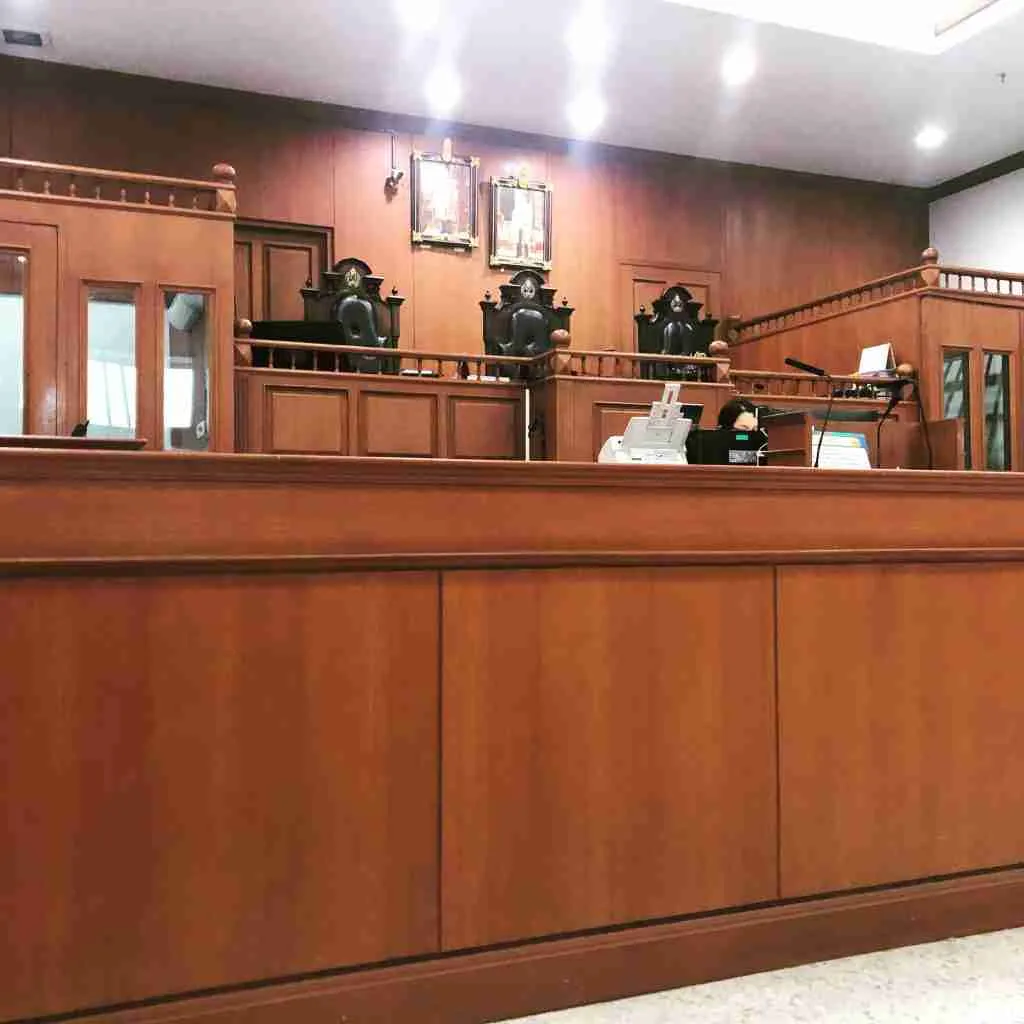
Example of a Thai Court.
Codified system
In Thailand, the legal system is based on written laws. These laws are carefully recorded and easy for the public to access. The Constitution is the foundation of our legal system. Acts and statutes are also important but come after it. This hierarchical structure ensures that all legal provisions are in harmony with the fundamental principles enshrined in the Constitution. The Thai legal system has three main levels. These are the Court of First Instance, the Court of Appeal, and the Supreme Court (also known as the Dika Court). Alongside them sit specialised courts, among them the Juvenile and Family Courts, the Labour Courts, the Tax Court, the Bankruptcy Court and the Intellectual Property and International Trade Court. Disputes with the state go to a separate system, the Administrative Courts, which are not part of the Courts of Justice.
Mediation and conciliation are prioritized, Very important to know
One should be aware that the Thai legal process emphasizes mediation and reconciliation, particularly in civil disputes. Litigation can be a lengthy process, so alternative dispute resolution methods are often encouraged. Before you go to court in Thailand, you should know they will try to settle things. They want to mediate and help both sides agree. They also want to avoid losing face.
Documents must be signed so a Thai lawyer can represent you
Representation by a Thai lawyer in court requires signing a “lawyer’s appointment” document. You also need to provide copies of your identification. This formalizes the attorney-client relationship and authorizes the lawyer to act on the client’s behalf. Clients sign and date the appointment, a form of power of attorney, with the name of the lawyer left blank, and provide a copy of their passport. The signed appointment is what the law requires: under Section 61 of the Civil Procedure Code, the appointment of a lawyer must be in writing, signed by the client and by the lawyer, and filed with the court, and it is valid only for the case in which it is filed. Keeping the document blank lets the firm update or change the appointed attorney easily. This means no new signatures are needed if schedules or workloads change. For example, if another lawyer from our office needs to take over, it can be done smoothly. If the form is fully completed ahead of time, any changes would require new paperwork. This means clients would have to sign again, which can cause delays. This process is safe. Every attorney is registered with the Lawyers Council of Thailand. The power of attorney is only for legal representation. It cannot be used to withdraw funds from a bank account, conduct real estate transactions or serve any other purpose. By signing a blank power of attorney at the start, clients help us work better. This allows us to provide smooth service during their case.
Court fees
Court fees apply in civil cases in Thailand, and they are separate from what you pay your lawyer.
Where you sue for a sum of money, the filing fee is set by Table 1 annexed to the Civil Procedure Code: 2 percent of the amount claimed, capped at 200,000 baht, on a claim of up to fifty million baht. So a claim of 500,000 baht costs 10,000 baht to file and a claim of 5 million costs 100,000. Two percent of 10 million is exactly 200,000, so from 10 million upwards the cap binds and every claim up to fifty million pays the same 200,000. The rate does not change at 10 million; the ceiling simply takes over. Above fifty million the excess is charged at 0.1 percent, so a claim of 60 million baht pays 200,000 on the first fifty million and 10,000 on the ten million above it. A case that asks for something which cannot be valued in money, a declaration or an injunction for instance, is not charged on a percentage at all: Table 1 sets it at 200 baht per matter, and an appeal against an order under Section 228(1), the provision covering orders that detain, fine or imprison someone under the Code, carries no filing fee at all.
Three points matter more to a foreign litigant than the rate itself. The fee falls due again on appeal. Under Section 150 the appellant pays on the amount still in dispute at that level, which is the same figure over again unless the judgment below reduced what is at stake. Part of it can come back. Section 151 requires the whole fee to be refunded where the court refuses the complaint, the appeal or the Dika petition outright, and gives the court a discretion to return all or part of it where the case is withdrawn or ends in a settlement. A party who cannot pay can ask to be excused. Sections 155 to 156/1 allow an application for exemption, which the court grants only if it is credible that the applicant has no property sufficient to pay the fees or would otherwise suffer undue hardship, and, where the applicant is the one bringing the claim or the appeal, that it also has reasonable grounds. If the court dismisses that application or grants it only in part, the applicant has seven days from the order to appeal, and the Court of Appeal’s decision on that appeal is final.
One provision surprises foreign claimants more than any other. Under Section 253, if you are the plaintiff and you have no domicile or place of business in Thailand and no property here that could be seized to satisfy a costs order, the defendant may apply at any time before judgment for an order that you deposit money with the court or give security for the defendant’s court fees and costs. The same applies if the court is satisfied you would evade paying them. If you do not comply with the order, the court strikes the case off the list unless the defendant asks for it to continue. Budget for that possibility before you file.
The court fees above are not the only sum the losing side carries. Under Table 6, annexed to the same Code, the court also orders the loser to contribute towards the fee of the lawyer on the winning side, and it fixes that figure itself, weighing the difficulty of the case against the time and work the lawyer had to put in. The table gives a floor and a ceiling and leaves everything between them to the court: never less than 3,000 baht for a case, and never more than 5 percent of the amount in dispute at first instance, or 3 percent on appeal or in the Supreme Court. Where the claim cannot be valued in money the two ceilings are fixed sums instead, 30,000 baht and 20,000 baht. On a claim of one million baht the first-instance maximum is therefore 50,000 baht. These are limits, not a price list: what the court awards is a contribution towards what the winning side paid, not the bill it received. Both Table 1 and Table 6 took their present form in the Civil Procedure Code Amendment Act (No. 24) B.E. 2551.
Two kinds of claim carry no filing fee at all, and they are the two a foreign resident is most likely to bring. A labour claim is free: section 27 of the Act Establishing Labour Courts and Labour Case Procedure B.E. 2522 exempts the filing of the complaint and every step of the proceedings from court fees, without condition. A consumer claim is free at the outset but not unconditionally: section 18 of the Consumer Case Procedure Act B.E. 2551 exempts a consumer, or a body suing on behalf of consumers, from all court fees, yet it does not reach final liability for costs, and it lets the court order the exempted fees to be paid after all where it finds the claim was brought without reasonable cause, the damages claimed were excessive, the consumer behaved improperly, the proceedings were being drawn out unnecessarily, or there is some other circumstance the court considers justifies it. If that order is not obeyed the case is struck off the list. The exemption is real, and it is not a licence to file anything.
Small claims: a procedure, not a separate court
Thailand has no separate “small claims court”. What it has is a faster procedure inside the ordinary civil courts, which the Civil Procedure Code calls a petty case (khadi manosare). Sections 189 to 196 set out how it works, and the court that hears it is the ordinary civil court that would have had the case anyway.
What counts as a petty case. Section 189 sets two gateways, and in both of them the figure printed in the Code has since been raised. A money claim qualifies if it is not more than 300,000 baht. An eviction claim qualifies if the rent is not more than 30,000 baht a month. The Code itself still reads 40,000 baht and 4,000 baht a month, but each of those figures is followed by the words or such amount as is fixed by Royal Decree, and the Royal Decree Fixing the Amount of Money in Petty Cases B.E. 2546 is the decree that fixed the higher ones. The Supreme Court applies it that way, so the working figures are 300,000 and 30,000.
How the amount is counted. Section 190 takes the figure from what the plaintiff claims, and leaves out both the court fee itself and interest that is not yet due when the complaint is filed. Interest that has already accrued by the day you file is a different matter, because it counts towards the total. A claim of 300,000 baht with interest running from an earlier date is therefore above the line rather than on it, and the same arithmetic decides which court may hear the case at all.
What it costs, which is the point of the procedure. Section 190 quattuor sets the filing fee: you pay under Table 1 in the ordinary way, but the court fees together are capped at 1,000 baht. On a claim of 300,000 baht the ordinary 2 percent would be 6,000 baht, so the cap saves 5,000 baht at the outset. Two limits on it are worth knowing. It is a cap for the court of first instance, so if you appeal, or go on to the Supreme Court, the fee at that level is worked out on the amount still in dispute there. And it does not reach a case brought into the procedure under section 196 below, which section 196 expressly leaves out.
Why the procedure is worth asking for. Under section 191 you may bring the claim orally: you state it at the court and the court writes it down and has you sign it, instead of filing a drafted complaint. Under section 193 the court sets an early hearing and the summons tells the defendant to come for conciliation, to answer, and to give evidence on the same day, with the court attempting to settle the matter first. Under section 194 the judgment itself may be given orally.
It can reach a case that is not small. Section 196 lets an ordinary claim for a fixed sum on a dishonoured bill of exchange, or on a written contract that appears genuine and enforceable on its face, be tried under the petty-case procedure where the court finds the case uncomplicated, whether or not you asked for it. If the case stops being simple, the same section lets the court revoke that order and move it back to the ordinary track.
How long a case takes
Since 2023 the courts publish their own targets, and a party can hold them to the published figure. The Act on the Determination of Time Periods for Operations in the Justice Process B.E. 2565 sets no timetable of its own. What it does is require every body in the justice system to fix and publish a completion period for each stage of its work, to record and explain a delay, and to run a system through which a party can check progress. For the Courts of Justice those periods are set by a regulation made by the President of the Supreme Court, published in the Royal Gazette on 23 January 2023 and in force the following day.
At first instance. The regulation sorts cases into three classes. A special management case is one that is not complicated and can realistically be finished in a single hearing, and the class expressly includes petty cases, consumer cases, cases where the defendant does not answer, and uncontested applications such as an application to administer an estate. Those are to be decided within six months of the complaint being accepted. An ordinary case is one year, and so is a complex ordinary case, meaning one that cannot be heard straight through and has to be set down in blocks of two to four days. Any case in a Kwaeng court, which is the district court, is six months whether it is civil or criminal and whatever its type. And a criminal case in which any defendant is held in custody during the trial is six months from the date of the detention warrant.
On appeal. The Court of Appeal works to one year from the day it receives the file from the court below, and to six months where the only question is the sentence. The regional and specialised Courts of Appeal work to four months for the simplest class of appeal, six months for the next, and one year for everything else. The Supreme Court is one year from receipt of the file, and six months to decide an application for permission to appeal to it. That permission is the gate: under section 247 you cannot appeal a Court of Appeal judgment as of right, you must ask the Supreme Court to allow it, and the request goes in with the appeal itself within one month of the Court of Appeal judgment being read.
Applications along the way. An application for release on bail is to be decided on the day the court receives it. An application to have money returned to you is decided within three working days and paid out within seven. Other applications are three working days at first instance and three months in the appellate courts.
These are targets, not guarantees, and the regulation says so in terms. It allows the period to be exceeded where the file has to be transferred, where a draft judgment goes to consultation or to a full court, where the parties cause the delay themselves by mediating or by waiting for the result of another case, and where the hold up comes from outside the court, such as service of process abroad, the mapping of disputed land or the forensic examination of evidence. What the regulation gives you is not a deadline but a right to an answer. If your case runs over, the reason has to appear in the court record, you can ask the court office about it, and that office must check the progress and tell you the result within fifteen days. You can also follow the file yourself on the Courts of Justice tracking system at cios.coj.go.th/tracking.
Dresscode, What to Know Before you Go to Court in Thailand
Courtroom decorum in Thailand is taken very seriously. Appropriate attire is very important, which means you should avoid wearing flip-flops, shorts, sleeveless shirts, or casual clothing. Men are advised to wear long pants and a collared shirt, while women should dress modestly, avoiding short skirts, tight clothing, or sleeveless tops. This dress code shows respect for the court, which represents His Majesty the King. It requires a high level of respect and formality. It is not always necessary, but it is also good idea to follow the dress code when visiting government offices. Places such as Immigration or the Labour Department. Officials in these departments may interpret respectful attire as an indication of seriousness, professionalism, and courtesy. Dressing appropriately can significantly influence how smoothly interactions proceed and can often positively impact the outcome of your visit. Behavior within the courtroom and government offices should also reflect utmost respect and politeness. Disruptions, informalities, or casual postures, such as crossing your legs when seated, are prohibited in court settings. Furthermore, to protect privacy and maintain dignity, photography is strictly forbidden within court premises. Adhering to these guidelines demonstrates cultural awareness and respect, helping you avoid misunderstandings or potential accusations of contempt.
Foreigners need interpreters
Foreigners face additional layers of complexity in the Thai legal system. Visa regulations, property ownership laws, and business regulations have nuances that require careful navigation, often necessitating local legal expertise.
Foreigners also need interpreters in Courtbecause all the procedures are done in Thai language. What to know before you go to Court in Thailand? Know that your interpreter can make a huge difference.
Civil Litigation in Thailand: What the Process Looks Like
If a dispute cannot be settled, civil litigation is the route. Civil cases are governed principally by the Civil and Commercial Code, and they cover contractual disputes and breaches, property and landlord-tenant matters, tort claims such as personal injury and defamation, family matters including divorce, custody and inheritance disputes, and debt collection.
The Steps, in Order
- Pre-action notice. A formal notice is normally sent first, setting out the dispute and the action contemplated.
- Filing the complaint. If no settlement is reached, a complaint is filed with the court setting out the claims and the remedies sought.
- Defendant’s answer. The defendant has a set period, usually 15 days, to respond.
- Mediation. Thai courts actively push mediation before trial. This is not a formality: see the section above on why it matters.
- Trial. If mediation fails, both sides present evidence and argument before a judge. There is no jury.
- Judgment. The court may award money, or order a party to do or refrain from doing something.
- Appeal. Either party may appeal to a higher court.
Three Things That Decide Cases Early
Prescription. Thai law sets limitation periods for bringing an action. Miss the period and the claim is lost regardless of its merits, so the first question in any dispute is how long you have.
Jurisdiction. The right court depends on where the events happened, where the defendant lives, the nature and value of the claim, and whether you are suing a person, a company or a state body. Filing in the wrong court costs time you may not have.
Language. Proceedings are conducted in Thai. Documents in other languages need certified translation, and a foreign party needs an interpreter.
A lawyer’s value here is concentrated at the start: assessing whether the claim is worth bringing, getting the limitation period and the forum right, drafting the pleadings correctly, and negotiating at mediation before costs mount. If you need representation in a civil dispute, contact us.
Thai Law Updates, free by email
Plain-English updates on Thai law changes that affect foreigners: property, visas, marriage, business and wills. One short email a month from a firm practicing since 2006. No spam, unsubscribe anytime.