


Reviewed by ThaiLawOnline, a licensed Thai law firm practising in Thailand since 2006. Thai lawyer of record: Wichuda Atthamethakon, LL.M., Thai Bar Licence 3149/2556.
Last updated on
If you are planning to start or expand a business in Southeast Asia, Thailand offers one of the most attractive investment landscapes in the region. At the core of this appeal is the Thailand Board of Investment (BOI), a government agency under the Office of the Prime Minister that has been promoting foreign direct investment for over six decades. Understanding the BOI benefits in Thailand can significantly impact your investment decisions.
Whether you are a startup founder, a technology pioneer, or a multinational corporation, securing a Thailand BOI promotion can be a game-changer. It unlocks unparalleled tax relief, grants 100% foreign ownership, and removes notorious bureaucratic red tape that has historically made investing in Thailand a complex undertaking.
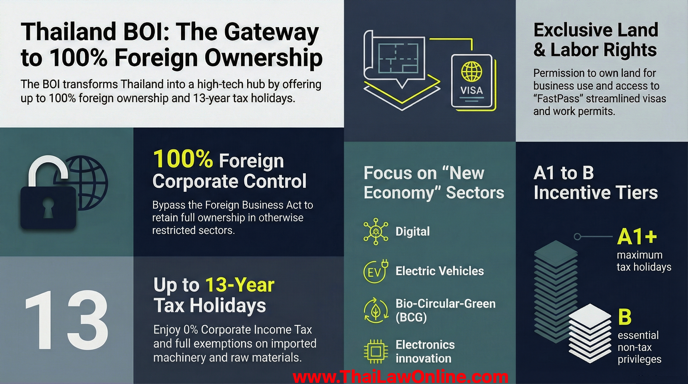
This guide breaks down everything you need to know about BOI tax incentives in Thailand, eligible industries, the 2025-2026 strategic updates, and how to apply for BOI promotion successfully. In this post, we will explore the various BOI benefits in Thailand that can enhance your business growth.
Table of Contents
Last reviewed: 16 September 2026; foreign-staff section added 3 October 2026 from Office of the BOI Announcement No. Por. 8/2568, read in Thai. The statutory incentives on this page were read in Thai against the Investment Promotion Act B.E. 2520, as amended up to the Investment Promotion Act (No. 4) B.E. 2560: sections 25 and 26 (foreign experts and their work permits), 27 (land), 28, 30, 30/1 and 36 (import duties), 31 and 31/1 (corporate income tax exemption of up to 8 and, for advanced technology, innovation or R&D, up to 13 years), 34 (dividends), 35 (zone-based reductions and deductions) and 37 (remittance). Sections 4 and 12 of the Foreign Business Act B.E. 2542 were read for foreign ownership. Not verified, because they come from BOI announcements and policy rather than the Acts: the category table and its caps, the priority sectors, the application timelines and reporting schedule, the minimum capital figures, Thailand FastPass, the four-to-one employment ratio, and the EEC figures. Re-checked on 10 October 2026: section 24 of the Competitiveness Enhancement Act for Targeted Industries B.E. 2560 and sections 56 and 59 of the Eastern Economic Corridor Act B.E. 2561 read in Thai for the 15-year ceiling.
What Is a BOI Company in Thailand?
Understanding the BOI Benefits in Thailand
A BOI company is a business entity registered in Thailand that has been granted an investment promotion certificate by the Board of Investment. The BOI’s primary goal is to attract foreign direct investment (FDI) into targeted industries that align with Thailand’s economic development objectives, such as high-tech manufacturing, digital transformation, and green energy.
By receiving this promotion, your business essentially operates with a “VIP pass” that bypasses many of the standard restrictions placed on foreign-owned businesses in Thailand under the Foreign Business Act (B.E. 2542). For a broader overview of how foreign companies navigate these restrictions, see our guide on foreign ownership strategies in Thailand.
Top Benefits of Thailand BOI Promotion
The incentives offered by the BOI are broadly divided into two categories: Tax Incentives and Non-Tax Incentives.
1. Tax Incentives
For many investors, the fiscal benefits are the primary draw of a BOI promotion. Depending on your business activity and project location, you can receive:
- Corporate Income Tax (CIT) Exemption: Up to 13 years of full corporate income tax exemption for the highest-priority activities (Category A1+).
- CIT Reductions: A 50% reduction in CIT for up to 5 years after the initial tax holiday expires, available to projects located in an investment promotion zone that the Board designates by notice in the Royal Gazette (section 35(1) of the Investment Promotion Act B.E. 2520).
- Import Duty Exemptions: Zero import duties on essential machinery and raw materials used for export production or research and development (R&D).
- Double Deductions: Projects in a designated investment promotion zone can deduct twice the cost of transportation, electricity, and water supply expenses, on the conditions and for the period the Board sets (section 35(2)).
- Dividend Exemption: Dividends derived from promoted activities are exempt from tax during the CIT exemption period.
For a deeper look at tax savings, read our dedicated article on BOI tax incentives and 100% foreign ownership.
2. Non-Tax Incentives
Non-tax privileges often prove to be just as valuable as financial savings, as they drastically improve operational freedom for foreign investors:
- 100% Foreign Ownership: BOI companies can be wholly foreign-owned. A company is foreign under the Foreign Business Act once foreigners hold half or more of its capital (section 4). A promoted foreign company whose business is on List 2 or List 3 of that Act notifies the Department of Business Development, receives a certificate within 30 days, and is then exempt from most of the Act for as long as the business stays promoted (section 12). The exemption does not reach List 1 businesses.
- Land Ownership Rights: Unlike regular foreign companies, BOI-promoted companies are permitted to own land for the promoted business, in the amount the Board approves, even above limits in other laws (section 27). A foreign promoted company that stops or transfers the promoted business must dispose of that land within one year, or the Department of Lands may dispose of it. Learn more in our property law guide.
- Streamlined Visas & Work Permits: BOI companies enjoy quota exemptions and have access to the One Start One Stop Investment Center (OSOS) for expedited Long-Term Resident (LTR) and SMART visas. The standard requirement of hiring four Thai employees for every one foreign worker does not apply, but the BOI’s own foreign-staff criteria do (see below). See also: Non-B Business Visa guide and Work Permit rules in Bangkok.
- Capital Repatriation: Permission to remit foreign currency abroad for invested capital and the dividends on it, approved foreign loans and their interest, and payments under approved contracts (section 37). It is not unlimited: in a balance-of-payments difficulty the Bank of Thailand may restrict remittances temporarily, though not below 20% a year of capital brought in more than two years earlier, or 15% a year of that capital as dividends.
Foreign staff rules under BOI Announcement Por. 8/2568
The exemption from the four-to-one ratio does not mean unlimited foreign hiring. The Office of the Board of Investment applies its own criteria to every foreign position in a promoted company, set by Announcement No. Por. 8/2568 of 5 June 2025, made under sections 25 and 26 of the Investment Promotion Act. It replaced Announcement No. Por. 3/2567.
- Approval per position. A foreign position is approved where qualified Thai staff are in short supply, normally for up to two years at a time: one year for trade and investment support offices and business process outsourcing, four years for international headquarters, international trading and business centres, research and development, targeted technology and electronic design activities, and for science and technology researchers.
- The 70% rule. A manufacturing company that employs more than 100 people in total must keep Thai staff at 70% or more of its workforce. Manufacturing companies below that size and service activities are not bound by the ratio, and a manufacturing project of significant importance may ask the Board for an exception.
- Minimum average monthly income. Executive: 150,000 baht, with a minimum age of 27 and five years’ experience (waived for the Chairman, President, CEO and Managing Director). Management: 75,000 baht, or 50,000 baht with a bachelor’s degree. Operational staff: 50,000 baht. Engineer, information technology specialist or science researcher: 75,000 baht, or 50,000 baht with a degree in the field. Workstation-based operator in business process outsourcing: 35,000 baht.
- Short assignments. A position approved for a stay of six months or less is exempt from both the 70% rule and the income floor.
- After full operation. Once the project receives full operation approval, the company must reduce foreign operational staff to a level the Office considers appropriate.
The rules apply from 1 October 2025 to projects whose promotion certificate was issued on or after 5 June 2025, and from 1 January 2026 to projects certified before that date. Income is assessed on the employment contract and, on renewal, on the employer’s P.N.D.1 Kor withholding return. Source: Office of the Board of Investment Announcement No. Por. 8/2568, read in Thai and in the Office’s English translation. For the tax side, see BOI tax incentives; for foreign ownership, see BOI and the Foreign Business Licence.
BOI Tax Incentive Categories (2025-2026 Framework)
The BOI classifies projects into primary groups (A and B) based on their technological intensity and importance to national development. The following table provides a breakdown of the core incentive tiers:
| BOI Category | Target Activities | CIT Exemption | Import Duty Exemptions |
|---|---|---|---|
| A1+ | Vanguard tech, advanced R&D, synthetic biology, sustainable aviation fuel | 10-13 Years (No Cap) | Machinery & Raw Materials |
| A1 | Strategic advanced tech, high-value software, digital platforms | 8 Years (No Cap) | Machinery & Raw Materials |
| A2 | High-tech manufacturing, robust infrastructure, advanced electronics | 8 Years (Capped) | Machinery & Raw Materials |
| A3 | Medium-to-high tech, established industrial activities | 5 Years (Capped) | Machinery & Raw Materials |
| A4 | Entry-level tech, standard promoted activities | 3 Years (Capped) | Machinery & Raw Materials |
| B | Supporting industries, basic services, general manufacturing | None (Merit-based upgrades) | Machinery only |
Source: Thailand BOI Investment Promotion Guide (2025-2026)
BOI vs. EEC: How Do the Investment Frameworks Differ?
While the BOI is Thailand’s nationwide investment promotion agency, the Eastern Economic Corridor (EEC) is a geographically targeted initiative focused on three specific provinces, Chachoengsao, Chonburi, and Rayong, to advance the Thailand 4.0 industrial policy.
The key differences include:
- Geographic scope: The BOI supports a diverse range of industries across all of Thailand. The EEC is limited to the three eastern provinces, offering additional “zone-based” incentives on top of standard BOI benefits.
- Industry focus: The EEC specifically targets 12 S-Curve industries including next-generation automotive, smart electronics, automation & robotics, aviation & logistics, and digital economy. The BOI covers a broader range of promoted activities.
- Enhanced incentives: Projects located in the EEC may receive extended CIT exemptions (up to 15 years for a targeted industry, the ceiling in section 24 of the Competitiveness Enhancement Act for Targeted Industries B.E. 2560, which the EEC Policy Committee may apply under sections 56 and 59 of the EEC Act), additional CIT reductions, and access to special infrastructure, smart city initiatives, and free trade zones.
- Fast-track processing: EEC projects benefit from a dedicated one-stop service center and accelerated land lease approvals for up to 99 years in designated industrial zones.
In practice, many foreign investors apply for both BOI and EEC incentives simultaneously to maximize their benefits, particularly for large-scale manufacturing and technology projects. If you are considering setting up in Thailand’s eastern seaboard, our Chonburi legal services team can assist with EEC-specific applications.
Which Industries Are Prioritized for Maximum Tax Incentives?
The BOI frequently updates its list of promoted sectors. For 2025-2026, the focus is heavily on the “New Economy” and industries aligned with Thailand’s national competitiveness goals. Key sectors receiving the highest incentives (Categories A1+ and A1) include:
- Digital & Tech: Data centers, cloud services, software development, artificial intelligence (AI), and digital platforms.
- Advanced Manufacturing & EVs: Electric vehicle assembly, EV battery manufacturing, semiconductors, and printed circuit board (PCB) fabrication.
- BCG Economy (Bio-Circular-Green): Renewable energy (waste-to-energy), biotechnology, medical devices, pharmaceutical manufacturing, and agritech.
- High-Value Services: International Business Centers (IBC), engineering design, R&D centers, and regional procurement hubs.
- Aerospace & Defense: Aircraft maintenance, repair, and overhaul (MRO), and space technology.
Thailand FastPass: Accelerated BOI Approval for Large Projects
In 2025, the Thai government introduced the “Thailand FastPass” notification, a significant policy update designed to accelerate approval and permitting for large-scale, high-tech investment projects with a value exceeding 1 billion THB (approximately USD 28 million).
Under the FastPass system, qualifying projects benefit from compressed review timelines across all relevant government agencies, including the BOI, the Department of Business Development, the Revenue Department, and immigration authorities. This initiative directly addresses investor feedback about lengthy bureaucratic processes and signals Thailand’s commitment to competing with regional investment hubs like Singapore and Vietnam.
The BOI Application Process: Step by Step
Applying for BOI promotion requires careful planning. Here is the standard process:
Step 1, Feasibility Study & Preparation:
Ensure your business activity aligns with BOI-promoted categories and that you meet the minimum capital requirement (generally 1 million THB, excluding land and working capital).
Step 2, Submit Application:
Applications are submitted online via the BOI’s e-Investment platform.
Step 3, Project Evaluation:
Processing times depend on the investment size: 40 working days for projects under 200 million THB, 60 working days for 200 million, 2 billion THB, and 90 working days for projects exceeding 2 billion THB.
Step 4, Approval & Acceptance:
Once approved, you have 1 month to formally accept the BOI’s resolution.
Step 5, Company Registration & Certificate Issuance:
You must register your Thai limited company within 6 months of acceptance and transfer the required foreign capital within 4 months to receive your official BOI Promotion Certificate.
For a detailed walkthrough, see our complete guide: How to Apply for BOI in Thailand.
Post-Approval Compliance Requirements
Securing your BOI certificate is only the beginning. To maintain your privileges, your company must:
- Submit project progress reports at 6 months, 1 year, and 2 years after receiving the promotion certificate.
- Undergo a strict BOI compliance audit by an approved auditor after 3 years to verify that all investment, hiring, and operational conditions have been met.
- Maintain proper accounting records that clearly separate promoted and non-promoted business activities.
Failure to comply with these conditions can result in revocation of your BOI promotion and retroactive tax assessments. Working with an experienced Thai business law firm is essential to staying compliant.
Frequently Asked Questions (FAQs)
Can a foreigner own 100% of a business in Thailand?
Yes. While the standard Foreign Business Act restricts foreign ownership to 49% in many sectors, obtaining a BOI promotion allows foreign investors to own up to 100% of the company in eligible industries. A promoted business on List 2 or List 3 of the Foreign Business Act needs a certificate from the Department of Business Development, and the exemption lasts only while the business is promoted (section 12 of that Act). This is one of the most significant advantages of the BOI framework. Learn more about foreign ownership strategies in Thailand.
What is the minimum capital requirement for a BOI company?
The minimum capital investment is generally 1 million THB (approximately USD 28,000), excluding the cost of land and working capital. However, certain activities require substantially higher investment thresholds, for example, advanced data center projects may require a minimum of 5 billion THB.
Does BOI promotion allow me to buy land in Thailand?
Yes. A major non-tax benefit of BOI promotion is the permission for foreign-owned juristic persons to own land strictly for the purpose of carrying out the promoted business activity, such as constructing a factory, office building, or worker accommodations. For more on real estate rights, see our property law in Thailand guide.
How long does the BOI application process take?
Typically, the BOI evaluates applications within 40 to 90 working days from the date a complete application is submitted, depending on the size and complexity of the investment. The new Thailand FastPass system can further reduce timelines for qualifying large-scale projects. For a step-by-step breakdown, read How to Apply for BOI in Thailand.
Do I still need to hire 4 Thai employees for every 1 foreign employee?
No. BOI-promoted companies are exempt from the standard 4:1 Thai-to-foreigner employment ratio, but foreign hiring is not unlimited: under Office of the BOI Announcement No. Por. 8/2568 each foreign position must be approved and carries a minimum monthly income (for example 150,000 baht for executives and 50,000 baht for operational staff), and a manufacturing company employing more than 100 people must keep Thai staff at 70% or more of its workforce. Work permit and visa applications are also expedited through the BOI’s One Start One Stop Investment Center (OSOS). See also: Self-Sponsoring Your Work Permit and Thailand’s Electronic Work Permit System.
What happens if my project fails to meet BOI conditions?
If your company does not meet the conditions specified in your promotion certificate (such as minimum investment, hiring targets, or operational milestones), the BOI may revoke your promotion. This can result in retroactive tax liabilities, loss of foreign ownership rights, and potential penalties.
Can I apply for both BOI and EEC incentives?
Yes. Projects located within the designated EEC provinces (Chachoengsao, Chonburi, and Rayong) can apply for both BOI and EEC incentives simultaneously, and a targeted-industry project can reach the 15-year corporate income tax ceiling in section 24 of the Competitiveness Enhancement Act, as well as additional zone-based benefits.
Ready to Invest in Thailand?
Thailand’s BOI incentives offer a highly lucrative pathway for international business expansion into one of Southeast Asia’s most dynamic economies. However, the legal framework, application process, and long-term compliance reporting require careful navigation.
Partnering with experienced local legal and tax advisors is strongly recommended to successfully manage the application process, optimize your incentive package, and ensure your business thrives for the long term.
Links : BOI Thailand
Thai Law Updates, free by email
Plain-English updates on Thai law changes that affect foreigners: property, visas, marriage, business and wills. One short email a month from a firm practicing since 2006. No spam, unsubscribe anytime.