


Reviewed by ThaiLawOnline, a licensed Thai law firm practising in Thailand since 2006. Thai lawyer of record: Wichuda Atthamethakon, LL.M., Thai Bar Licence 3149/2556.
Last updated on
What Thai courts actually say about prenups, backed by fourteen Supreme Court decisions spanning six decades
These decisions sit within the broader framework described in our overview of family law in Thailand.
Last reviewed: 31 August 2026. Every one of the fourteen Supreme Court decisions cited on this page was checked against our own copy of the judgment, and all fourteen are real, in full text, and described here as they were decided. Sections 1356, 1357, 1463, 1465, 1466, 1467, 1468, 1469, 1471, 1474, 1476, 1477 and 1485 of the Civil and Commercial Code were read against the Thai text in our own annotated Code. One correction was made at this review: the section number in Dika 4268/2562 is a provision of the FORMER Book V, which the judgment itself marks (เดิม), and it is not the section that carries that number today. Re-checked on 12 October 2026: sections 1465, 1466 and 1467 read in Thai; the opening paragraph now says that only Section 1466 sets formal requirements and voids an agreement that misses them, Section 1465 governing content and Section 1467 later changes; the case summaries were not re-read.
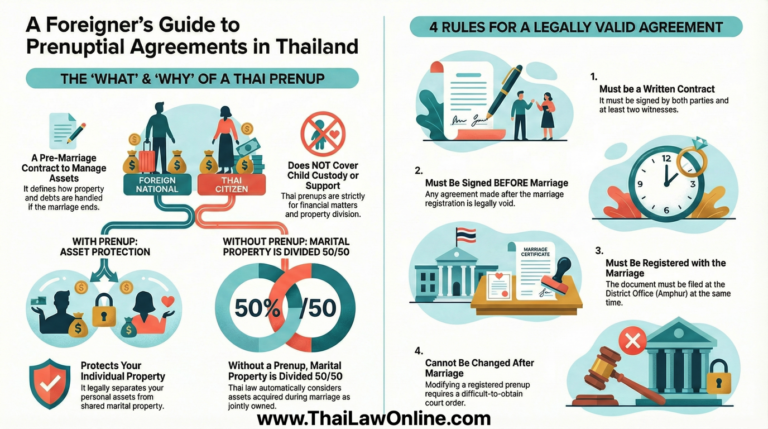
Table of Contents
What Is a Prenuptial Agreement Under Thai Law?
A prenuptial agreement in Thailand (known in Thai as สัญญาก่อนสมรส) is a legally binding contract between two people who intend to marry. Some also call it an ante-nuptial agreement. It governs how property and finances will be managed during the marriage and upon divorce or death.
Under the Thai Civil and Commercial Code (CCC), Book V, Family, a prenuptial agreement lets couples deviate from the default property regime. Without a prenup, all assets acquired during marriage become marital property (สินสมรส). Both spouses jointly own these assets in equal shares. A valid prenup can change these rules. For instance, it can keep certain assets as separate property (สินส่วนตัว). It can also designate pre-marital property as shared.
Prenuptial agreements have grown significantly in importance in Thailand. This is especially true for international marriages between a Thai and a foreign national. Thailand’s Land Code restricts foreign land ownership. A properly drafted prenup plays a critical role in protecting both parties’ financial interests.
Legal Requirements: Sections 1465, 1466 & 1467 CCC
Thai law governs prenuptial agreements in three key provisions of the Civil and Commercial Code. Section 1465 sets the limits on content, Section 1466 the formal requirements and Section 1467 the bar on changes after marriage. Failure to meet the formal requirements of Section 1466 renders the agreement void (โมฆะ); the decisions discussed below show how the courts apply it.
Understanding the Supreme Court Decision on Prenuptial Agreements is crucial for ensuring compliance with legal requirements and protecting your interests. The significance of the Supreme Court Decision on Prenuptial Agreements cannot be overstated. This decision shapes the interpretation and enforcement of prenuptial agreements in Thailand.
Section 1465: General Rule & Public Policy Limit
มาตรา ๑๔๖๕ ถ้าคู่สมรสมิได้ทำสัญญากันไว้ในเรื่องทรัพย์สินเป็นพิเศษก่อนสมรส ความสัมพันธ์ระหว่างคู่สมรสในเรื่องทรัพย์สินนั้น ให้บังคับตามบทบัญญัติในหมวดนี้ ถ้าข้อความใดในสัญญาก่อนสมรสขัดต่อความสงบเรียบร้อยหรือศีลธรรมอันดีของประชาชน หรือระบุให้ใช้กฎหมายประเทศอื่นบังคับเรื่องทรัพย์สินนั้น ข้อความนั้น ๆ เป็นโมฆะSection 1465, If spouses have not made a special agreement regarding their property before marriage, the relationship between them concerning property shall be governed by the provisions of this Chapter. Any clause in a prenuptial agreement that is contrary to public order or good morals, or that specifies the application of foreign law to govern property matters, shall be void.
This section establishes that default marital property rules apply unless a valid prenup exists. It imposes two key limits. First, the agreement must not violate public order or good morals. Second, it cannot choose a foreign governing law. Any clause attempting either is void.
Section 1466: Formal Requirements for Validity
มาตรา ๑๔๖๖ สัญญาก่อนสมรสเป็นโมฆะ ถ้ามิได้จดแจ้งข้อตกลงกันเป็นสัญญาก่อนสมรสนั้นไว้ในทะเบียนสมรสพร้อมกับการจดทะเบียนสมรส หรือมิได้ทำเป็นหนังสือลงลายมือชื่อคู่สมรสและพยานอย่างน้อยสองคนแนบไว้ท้ายทะเบียนสมรสและได้จดไว้ในทะเบียนสมรสพร้อมกับการจดทะเบียนสมรสว่าได้มีสัญญานั้นแนบไว้Section 1466, A prenuptial agreement shall be void unless: (1) the agreement is recorded in the Marriage Register at the time of marriage registration; or (2) the agreement is made in writing, signed by both spouses and at least two witnesses, annexed to the Marriage Register, and noted in the Register at the time of registration that such agreement is annexed thereto.
The Four Formal Requirements:
1. The agreement must be in writing
2. It must be signed by both spouses
3. It must be signed by at least two (2) witnesses
4. It must be recorded in or annexed to the Marriage Register at the time of marriage registration
Section 1466 is the most litigated prenuptial provision in Thai family law. The Supreme Court consistently holds that failure to satisfy any of these four requirements renders the prenup completely void. It is not merely voidable, it is void from the outset (ab initio).
Section 1467: No Modification After Marriage Without Court Order
มาตรา ๑๔๖๗ เมื่อสมรสแล้วจะเปลี่ยนแปลงเพิกถอนสัญญาก่อนสมรสนั้นไม่ได้ นอกจากจะได้รับอนุญาตจากศาล เมื่อได้มีคำสั่งของศาลถึงที่สุดให้เปลี่ยนแปลงเพิกถอนสัญญาก่อนสมรสแล้ว ให้ศาลแจ้งไปยังนายทะเบียนสมรสเพื่อจดแจ้งไว้ในทะเบียนสมรสSection 1467, After the marriage has been effected, the prenuptial agreement cannot be altered or revoked except by order of the Court. When a final court order for alteration or revocation has been made, the Court shall notify the Marriage Registrar to record it in the Marriage Register.
This means that once you are married, neither spouse can unilaterally change or cancel the prenuptial agreement. Only a court order can modify or revoke it. This underscores the importance of getting the prenup right before the wedding.
Do You Need a Lawyer to Sign a Prenuptial Agreement in Thailand?
This is one of the most common questions we receive at ThaiLawOnline from foreign nationals planning to marry in Thailand. The short answer is: no, Thai law does not require a lawyer to be present.
As established by Section 1466 CCC, the only persons who must sign the agreement are:
Required signatories under Thai law:
• Both spouses (คู่สมรส)
• At least two witnesses (พยานอย่างน้อยสองคน)
Not required by law:
• A lawyer (ทนายความ)
• A notary public
• Any government official (other than the Marriage Registrar for the registration itself)
The Supreme Court has never required a lawyer for validity. In every decision involving prenups, the Court focused exclusively on the four formal requirements of Section 1466. These are: (1) writing, (2) both spouses’ signatures, (3) two witnesses, (4) proper Marriage Register recording.
Practical Recommendation: While a lawyer is not legally required, we strongly recommend engaging experienced legal counsel. A poorly worded prenup may face challenges in court. Certain clauses can be declared void under Section 1465 if they violate public order or good morals. An experienced Thai family lawyer ensures your agreement is sound. They verify proper formatting for registration and protect your interests under both Thai and international law.
Supreme Court Decisions on Prenuptial Agreements in Thailand
The following is a comprehensive analysis of the most significant Supreme Court (ศาลฎีกา) decisions on prenuptial agreements. These decisions span six decades and cover formal validity, enforcement, modification, and cross-border recognition. They are drawn from Thailand’s official case law database.
1. Dika No. 574/2508 (1965), Admissibility of Prenuptial Agreement Evidence
คำพิพากษาศาลฎีกาที่ 574/2508
In this early decision, the Supreme Court addressed the evidentiary requirements for proving a prenuptial agreement existed. The plaintiff submitted a copy of the prenuptial agreement. The original had been filed in another pending case at a different court. The defendant argued the copy was inadmissible.
The Supreme Court held that when the original signatories testify under oath confirming the copy is accurate, it is admissible as evidence. The Court focused on substance and party authentication. It did not require involvement of any lawyer or notary.
Key Takeaway: A prenuptial agreement can be proven by certified copy if authenticated by testimony from the signing parties. This reinforces that the law does not impose formalities beyond those in Section 1466.
2. Dika No. 1082/2504 (1961), Prenup Cannot Override Third-Party Good Faith
คำพิพากษาศาลฎีกาที่ 1082/2504
A wife owned land before marriage and the couple executed a prenuptial agreement stipulating that the husband would have no rights over her property. However, the wife allowed the husband to register the land in his own name. The husband subsequently mortgaged it to a third party who acted in good faith.
The Supreme Court held that even though the prenuptial agreement existed, the mortgage was valid and binding on the wife. A prenuptial agreement, while valid between spouses, cannot defeat the rights of a bona fide third party. The mortgagee had relied in good faith on the land title.
Key Takeaway: A prenuptial agreement has effect between spouses only. Its terms cannot be enforced against good-faith third parties who relied on public records.
3. Behavioural (Fidelity) Clauses: What the Law Actually Supports
A prenuptial agreement under Section 1465 governs property relations between the spouses. A promise about personal conduct, such as fidelity, is not a property term, so it does not gain force from being written into the prenup itself.
Thai law protects conduct promises through a different instrument: a written bond of good behaviour (ทัณฑ์บนเป็นหนังสือ). Under Section 1516(8) of the Civil and Commercial Code, breach of such a written bond is itself a statutory ground for divorce. The Supreme Court examines these bonds strictly on their facts: in Dika No. 5161/2538 (1995) the Court analysed an alleged breach of a written bond and held that the conduct proven did not amount to a breach serious enough to ground divorce. Any monetary penalty attached to such a bond remains subject to the court’s power to reduce excessive penalties (Section 383).
Note (August 2026): an earlier version of this section cited a 1983 decision said to uphold a 50,000-baht fidelity penalty. That citation could not be verified against the Supreme Court database and has been removed. The position above rests on the statutory text of Sections 1465 and 1516(8).
Key Takeaway: Keep the prenup for property. If a couple wants consequences for conduct, use a separate written bond of good behaviour, whose breach can serve as grounds for divorce under Section 1516(8).
4. Dika No. 3838/2528 (1985), Prenuptial Agreement Upon Remarriage
คำพิพากษาศาลฎีกาที่ 3838/2528
A couple divorced, then reconciled and re-married with a new prenuptial agreement. The husband included a behavioral bond (ทัณฑ์บน) promising not to associate with a former lover. He breached this bond, and the wife sought divorce enforcement.
The Supreme Court confirmed that a prenuptial agreement upon remarriage is fully valid. It must meet the requirements of Section 1466. The behavioral bond was enforceable as a ground for divorce. The Court also held that a spouse who refuses to proceed with an agreed written divorce can be compelled by court order.
Key Takeaway: Couples who divorce and remarry can enter into a new prenuptial agreement. Behavioral bonds carry over and remain enforceable.
5. Dika No. 3346/2532 (1989), Prenup Void for Failure to Register
คำพิพากษาศาลฎีกาที่ 3346/2532 VOID
This is one of the most cited decisions on prenuptial agreements in Thailand. The couple made an agreement stating that pre-marital property would become marital property. However, they failed to record the agreement in the Marriage Register. They did not annex it with proper signatures.
The Supreme Court declared the prenuptial agreement void under Section 1466 CCC. The wife could not claim a share of the husband’s pre-marital property that had been seized by creditors. The Court stated clearly:
The prenuptial agreement was neither recorded in the Marriage Register at the time of marriage registration, nor was it made in writing with signatures of both spouses and at least two witnesses annexed to the Register. Therefore, it is void under Section 1466.
Key Takeaway: This is the leading case confirming that strict compliance with Section 1466 is mandatory. Even a genuine agreement between parties is void if registration formalities are not followed.
6. Dika No. 6711/2537 (1994), Prenup Recorded at Registration Is Valid
คำพิพากษาศาลฎีกาที่ 6711/2537 VALID
The husband agreed at the time of marriage registration that his house and land (which were his separate property) would become marital property. This was recorded directly in the Marriage Register at the time of registration.
The Supreme Court upheld this as a valid prenuptial agreement under Section 1466. Recording the agreement in the Marriage Register at the time of registration is sufficient. The clause did not violate public order or good morals under Section 1465, paragraph 2. Therefore it was enforceable.
Key Takeaway: A prenuptial agreement does not need to be a separate written document. It can be validly made by recording the terms directly in the Marriage Register. This is the simpler of the two methods permitted under Section 1466.
7. Dika No. 2497/2552 (2009), Post-Registration Agreement Is Not a Prenup
คำพิพากษาศาลฎีกาที่ 2497/2552
The couple initially told the Marriage Registrar they did not wish to record any property arrangements. Later the same day, they returned and asked the Registrar to add a note. The note stated the husband would transfer land to the wife.
The Supreme Court held this was not a prenuptial agreement under Section 1466. It was not recorded “at the time of marriage registration” but added later. Instead, the Court classified it as a spousal property agreement under Section 1469. Either spouse can revoke this during marriage or within one year after the marriage ends.
Key Takeaway: Timing is critical. A property agreement recorded after the marriage registration is not a prenuptial agreement. It is subject to different rules including being revocable.
8. Dika No. 1523/2565 (2022), Cross-Border Prenup (Thailand-Sweden)
คำพิพากษาศาลฎีกาที่ 1523/2565
A Thai woman and a Swedish man lived together and ran a restaurant business in Sweden. The order of events decides this case. The land and house in Thailand were bought on 14 March 2011, using funds the couple had earned together while cohabiting. They registered their marriage in Sweden only afterwards, on 7 December 2014, and executed a prenuptial agreement under Swedish law at that point, stipulating that the restaurant business was the husband’s separate property. Because the purchase came first, the property was never marital property acquired during a marriage, so the marital property regime did not reach it and ordinary co-ownership did. The husband, being a foreigner, could not hold Thai land title. Therefore he placed it in the wife’s name.
The Supreme Court examined the substance of the financial arrangements. It examined the flow of funds and the parties’ actual intentions. Despite the prenuptial agreement designating the business as separate property, the Court found that funds used to buy the Thai property came from jointly earned income during cohabitation. This made the wife a co-owner of one half under Sections 1356 and 1357 CCC.
The outcome: the Swedish partner lost at every level and recovered nothing. The loan agreement he had her sign, which he sued on to recover the purchase money, was held to be a sham and void under Section 155 paragraph 1 of the Civil and Commercial Code. This decision is often cited the other way round, as authority that a foreign funder can reclaim the money, and it is not.
Key Takeaway: Thai courts will examine the substance of financial arrangements even when a foreign prenuptial agreement exists. A prenup executed abroad does not automatically determine property rights over assets in Thailand. Thai courts apply Thai property law principles. They particularly focus on the source of funds.
9. Dika No. 416/2538 (1995), Joint Management Without a Prenup
คำพิพากษาศาลฎีกาที่ 416/2538
The Court confirmed the general principle under the revised Book V CCC (1976): unless a prenuptial agreement provides otherwise, both spouses must jointly manage marital property. This applies under Sections 1476 and 1477. This includes the power to dispose of marital property. A sale of marital property by one spouse without the other’s consent is not automatically void. The other spouse may ask the court to revoke it, unless it was ratified or the buyer acted in good faith and gave value (Section 1480).
Key Takeaway: Without a prenuptial agreement, Thai law requires joint management of marital property. A prenup can designate one spouse as the sole manager of specific assets.
10. Dika No. 101/2510 (1967), Prenup Required for Sole Management Rights
คำพิพากษาศาลฎีกาที่ 101/2510
The husband petitioned the court to be formally appointed as sole manager of the marital estate. He claimed his wife was interfering. The Court held that in the absence of a prenuptial agreement granting the wife management power, the husband (under the old law) already had the legal right to manage. His petition was therefore unnecessary.
Key Takeaway: Under the pre-1976 law, the husband was the default property manager. Under the current law (post-1976), management is shared unless a prenuptial agreement provides otherwise.
Additional Significant Decisions
Dika No. 3445/2524 (1981)
The Court confirmed that under the revised CCC, the general principle is joint management by both spouses. This applies unless a prenuptial agreement or post-marriage agreement provides otherwise. Either spouse may petition the court under Section 1485. This is for sole management of specific valuable assets, regardless of what the prenup says.
Dika No. 3092/2530 (1987)
Under the old Section 1468, the husband had sole power to manage the marital estate unless the prenuptial agreement provided otherwise. The Court held that a mortgage executed by the husband alone over marital property was valid and binding on the wife. This was because no prenup had altered the default management power.
Dika No. 4268/2562 (2019)
The Court held that when a couple cohabited before marriage without a prenuptial agreement, and then married, the property they had acquired together beforehand was already theirs in co-ownership, and on marriage it became สินเดิม (prior assets) under Section 1463(1) of the FORMER Book V, which the judgment cites as (เดิม). It is not marital property. Do not look that number up in the Code as it stands today: the couple married in 1974 and the case is decided on the pre-1976 provisions, and the present section 1463 is about guardianship of a spouse adjudged incompetent. The equivalent idea in the current Code is sin suan tua under section 1471(1), property belonging to either spouse before marriage. The absence of a prenuptial agreement was noted as a factual finding.
Dika No. 1704/2527 (1984)
In the absence of a prenuptial agreement regarding property management, the husband (under the transitional provisions) retained sole power. He could manage and dispose of marital property, including the power to sell land. This applied even if the wife’s name appeared on the title deed.
Summary Table: Key Supreme Court Decisions on Prenuptial Agreements
| Decision | Year | Core Issue | Outcome | Key Sections |
|---|---|---|---|---|
| 574/2508 | 1965 | Admissibility of prenup copy as evidence | Copy admissible with party testimony | , |
| 1082/2504 | 1961 | Prenup vs. good-faith third party | Third party’s mortgage upheld despite prenup | , |
| 101/2510 | 1967 | Sole management without prenup | Husband already had default management rights | s.1468 (old) |
| 5161/2538 | 1995 | Alleged breach of written good-behaviour bond | Bond recognized; breach not established on the facts | s.1516(8) |
| 3838/2528 | 1985 | Prenup on remarriage with behavioral bond | VALID, fully enforceable | s.1466, s.1514 |
| 3346/2532 | 1989 | Prenup not registered with Marriage Register | VOID, failed Section 1466 | s.1466 |
| 6711/2537 | 1994 | Agreement recorded directly in Marriage Register | VALID, Section 1466 satisfied | s.1465, s.1466 |
| 416/2538 | 1995 | Joint management principle without prenup | Both spouses must manage jointly | s.1476, s.1477 |
| 2497/2552 | 2009 | Agreement added after registration (same day) | Not a prenup, classified as s.1469 agreement | s.1466, s.1469 |
| 1523/2565 | 2022 | Cross-border prenup (Sweden); property in Thailand | Thai courts applied Thai property law; examined source of funds | s.1356, s.1357 |
| 3445/2524 | 1981 | Joint management as default rule | Prenup can alter management rights | s.1476, s.1485 |
| 3092/2530 | 1987 | Husband’s sole management under old law | No prenup = husband manages alone (pre-1976) | s.1468 (old) |
| 4268/2562 | 2019 | No prenup; pre-marital property classification | Jointly acquired property before marriage = co-owned | s.1463(1) (former), now s.1471(1) |
| 1704/2527 | 1984 | Disposal of marital property without prenup | Husband could sell land alone under old law | s.1476, s.1477 |
Common Reasons a Prenuptial Agreement Is Declared Void in Thailand
Based on the Supreme Court decisions analyzed above, there are four principal reasons Thai courts declare a prenuptial agreement void:
1. Failure to Register at the Time of Marriage Registration
This is the most common cause of invalidity. As established in Dika 3346/2532, if the agreement is not recorded in the Marriage Register, it is void. There is no “grace period.” As confirmed by Dika 2497/2552, even returning later the same day is too late.
2. Missing Signatures (Spouses or Witnesses)
Section 1466 requires the signatures of both spouses and at least two witnesses on the written agreement. If the annexed document lacks any of these signatures, the agreement is void.
3. Clauses Violating Public Order or Good Morals
Under Section 1465, any clause that violates ความสงบเรียบร้อยหรือศีลธรรมอันดีของประชาชน (public order or good morals) is void. The safest course is to keep conduct promises out of the property prenup entirely and record them, if wanted, in a separate written bond of good behaviour recognized by Section 1516(8).
4. Attempting to Apply Foreign Law
Section 1465 explicitly states that a clause purporting to apply foreign law to govern marital property in Thailand is void. This is particularly relevant for international couples with prenuptial agreements from their home countries.
Prenuptial Agreement vs. Post-Marriage Property Agreement
Thai law recognizes two distinct types of property agreements between spouses. The Supreme Court has been careful to distinguish between them:
| Feature | Prenuptial Agreement (s.1465-1467) | Post-Marriage Agreement (s.1469) |
|---|---|---|
| Timing | Must be made at or before marriage registration | Made after marriage |
| Registration | Must be in Marriage Register at time of registration | No registration requirement |
| Revocability | Cannot be changed without court order (s.1467) | Either spouse can revoke at any time during marriage or within 1 year after (s.1469) |
| Binding force | Irrevocable between spouses | Revocable; weak enforceability |
| Key case | Dika 3346/2532, 6711/2537 | Dika 2497/2552 |
As Dika 2497/2552 demonstrates, the Supreme Court strictly interprets timing. An agreement made even a few hours after marriage registration is not a prenuptial agreement. It is therefore revocable under Section 1469 instead.
International & Cross-Border Prenuptial Agreements
For foreign nationals marrying a Thai citizen, the enforceability of a prenuptial agreement made abroad is a critical concern. Based on Supreme Court jurisprudence:
A foreign prenuptial agreement may be recognized in Thailand, but Thai courts will apply Thai law to determine property rights over assets located in Thailand. This was made clear in Dika 1523/2565. The Court acknowledged a prenuptial agreement made under Swedish law. However, it ultimately applied Thai property principles (source-of-funds analysis) to determine ownership of Thai land.
Additionally, under Section 1465, any clause that specifies the application of foreign law to govern property matters is void. Even if your prenup was validly executed in another country, Thai courts will not enforce a choice-of-law clause. This applies to Thai property matters.
Practical Advice for International Couples: If you own or plan to acquire property in Thailand, we recommend having a separate Thai prenuptial agreement. This agreement should comply with Section 1466. Execute it in addition to any prenup from your home country. This dual-agreement approach provides the strongest possible protection under both legal systems. It can also address key issues like buying a condominium or protecting a foreigner’s interests in Thai land.
Frequently Asked Questions About Prenuptial Agreements in Thailand
Is a prenuptial agreement legally enforceable in Thailand?
Yes. A prenuptial agreement is fully enforceable in Thailand provided it complies with the formal requirements of Section 1466 of the Civil and Commercial Code. It must be in writing, signed by both spouses and at least two witnesses, and recorded in or annexed to the Marriage Register at the time of marriage registration. Additionally, its terms must not violate public order or good morals under Section 1465.
Do I need a lawyer to sign a prenuptial agreement in Thailand?
No. Thai law requires only the signatures of both spouses and at least two witnesses. No lawyer, notary, or government official (beyond the Marriage Registrar) is required. However, engaging an experienced family lawyer is strongly recommended to ensure the agreement is properly drafted and will withstand judicial scrutiny. For assistance, consult legal services or arrange an online consultation with a Thai lawyer.
Can I change my prenuptial agreement after marriage?
Only with a court order. Under Section 1467 CCC, once you are married, the prenuptial agreement cannot be altered or revoked without permission from the court. The court will then notify the Marriage Registrar to update the register accordingly. Learn more about going to court in Thailand if you need to modify your agreement.
What happens if my prenuptial agreement is not registered at the time of marriage?
It is void. The Supreme Court confirmed in Dika 3346/2532 that a prenuptial agreement that is not recorded in the Marriage Register at the time of marriage registration is automatically void under Section 1466. There is no grace period. Even returning later the same day to add the agreement is insufficient, as established in Dika 2497/2552.
Is a prenuptial agreement made abroad valid in Thailand?
It depends. Thai courts may recognize a foreign prenuptial agreement, but they will apply Thai law to determine property rights over assets located in Thailand. Any clause that attempts to apply foreign law to Thai property matters is void under Section 1465. For maximum protection, international couples should execute a separate Thai-compliant prenup in addition to their home-country agreement.
Can a prenuptial agreement include clauses about behavior or fidelity?
Not in the prenup itself: a Thai prenup governs property relations only (Section 1465). If a couple wants consequences for conduct such as adultery, Thai law recognizes a separate written bond of good behaviour, whose breach is a statutory ground for divorce under Section 1516(8) CCC. Courts examine such bonds strictly (Dika 5161/2538) and can reduce excessive monetary penalties (Section 383).
What is the difference between a prenuptial agreement and a post-marriage agreement?
A prenuptial agreement (Sections 1465-1467) must be registered at the time of marriage and can only be changed by court order. A post-marriage property agreement (Section 1469) is made after the marriage and can be revoked by either spouse at any time during the marriage or within one year after it ends. Prenuptial agreements offer much stronger protection because they are irrevocable without court approval.
How many witnesses are required for a Thai prenuptial agreement?
A minimum of two witnesses must sign the prenuptial agreement under Section 1466 CCC. There is no requirement for the witnesses to be lawyers, relatives, or officials. Any competent adult can serve as a witness. For important documents, notary services can help verify witness authenticity but notary is not a requirement under Thai law.
Can a prenuptial agreement protect a foreigner’s investment in Thai property?
A prenuptial agreement can help protect a foreigner’s financial interests, but it cannot override the Land Code restrictions on foreign land ownership. As shown in Dika 1523/2565, Thai courts will examine the actual source of funds used to purchase property. This applies regardless of what the prenup states. A well-drafted prenup can establish clear terms about how property will be treated upon divorce. However, the foreigner still cannot directly own Thai land. Learn more about property law in Thailand and buying a house.
Does a prenuptial agreement need to be in Thai language?
While there is no statutory requirement that the agreement be in Thai, the Marriage Register at the Amphur (district office) is maintained in Thai. For practical purposes, the agreement should be in Thai or bilingual Thai-English. This ensures the Marriage Registrar can verify and record it. If only an English version exists, it may need to be translated by a certified translator before it can be annexed to the Register.
Where This Leaves You
Thailand’s Supreme Court has built a detailed, practical body of law around prenuptial agreements. The decisions in our database cover topics from registration requirements to international property disputes to same-sex partnerships. Taken together, they offer a clear picture of what Thai courts expect, what they enforce, and what they reject.
The key point in these decisions is this: Thai courts respect prenuptial agreements. They do so only when the required steps are followed. The agreement must cover only property. Both spouses must act in line with the agreement. Courts will not rescue a poorly drafted agreement, and they will not enforce one that the parties themselves have ignored.
If you are considering a prenuptial agreement in Thailand, you may need legal guidance. With 20 years of experience in Thai family law, ThaiLawOnline has helped hundreds of international and Thai couples draft, review, and register legally bulletproof prenuptial agreements.
Our bilingual legal team ensures your prenup complies with Sections 1465-1467 CCC, is properly registered at the Amphur, and protects your assets under both Thai and international law.
Thai Law Updates, free by email
Plain-English updates on Thai law changes that affect foreigners: property, visas, marriage, business and wills. One short email a month from a firm practicing since 2006. No spam, unsubscribe anytime.