


Reviewed by ThaiLawOnline, a licensed Thai law firm practising in Thailand since 2006. Thai lawyer of record: Wichuda Atthamethakon, LL.M., Thai Bar Licence 3149/2556.
Last updated on
Thailand’s Foreign Business Act, B.E. 2542 (1999), sets the ground rules for foreign participation. The law groups restricted activities into three Lists, with different approval tracks. Your options include BOI promotion, a Foreign Business License, and the U.S., Thai Treaty of Amity for eligible Americans. You also have lawful control tools that follow the FBA
These restrictions shape the structure you choose, as explained in our guide to business setup in Thailand.
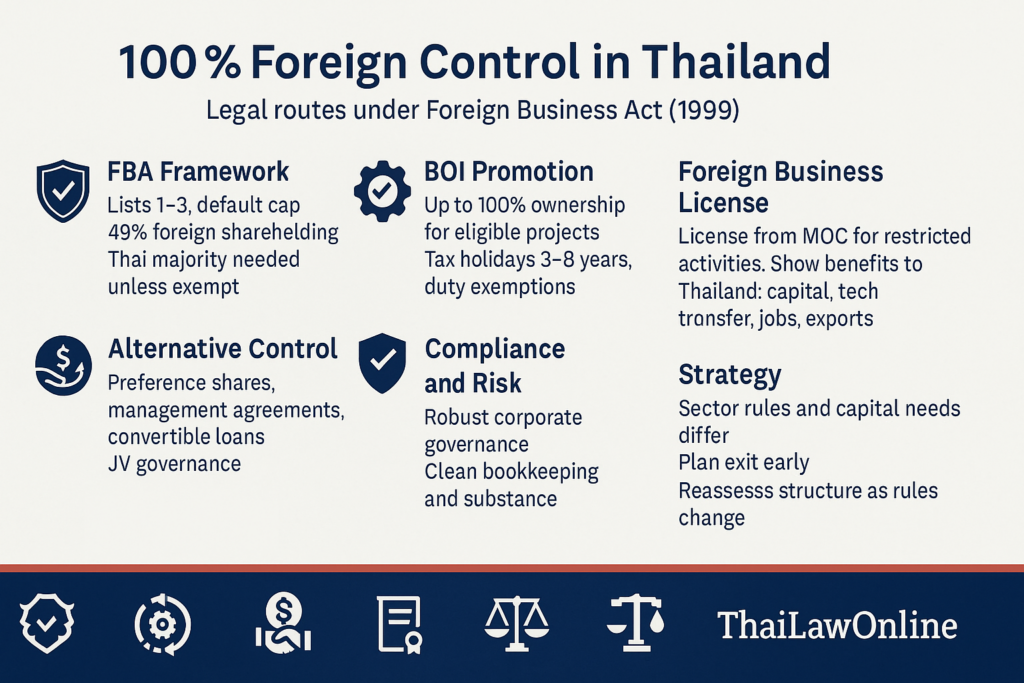
Table of Contents
Understanding the Foreign Business Act Framework
Understanding Foreign Ownership Restrictions in Thailand
The Foreign Business Act, B.E. 2542 (1999), serves as Thailand’s primary legislation governing foreign business participation, categorizing restricted activities into three distinct lists. List One encompasses activities reserved exclusively for Thai nationals, including rice farming, livestock breeding, and certain forestry operations. List Two covers businesses affecting national security or safety, arts, culture, traditions and folk crafts, or natural resources and the environment; a foreigner may operate them only with the Minister’s permission granted with Cabinet approval. List Three covers businesses in which Thais are not yet ready to compete with foreigners; a foreigner may operate them with a licence from the Director-General of the Department of Business Development, granted with the Foreign Business Committee’s approval (Section 8).
The FBA does not impose a universal 49% shareholding cap. Section 4 defines a Thai-registered company as foreign where non-Thai persons hold half or more of its capital shares, with additional rules for other structures. Section 8 then restricts the listed activities. An unlisted activity may be wholly foreign owned, subject to other laws. List Two permission ordinarily requires at least 40% Thai shareholding; the authorised reduction cannot go below 25%, and at least two-fifths of directors must be Thai under Section 15. Do not apply the List Three route or a generic 49% slogan to every business.
Board of Investment Promotional Privileges
The Board of Investment (BOI) plays a crucial role in facilitating foreign business ownership in Thailand. The BOI represents the most straightforward path to 100% foreign ownership in Thailand. Established to attract foreign investment and promote economic development, the BOI offers promotional privileges that override standard FBA restrictions for qualified projects.
The BOI promotion allows foreign investors to own 100% of their businesses in Thailand. This is true if their projects help Thailand’s economic goals. Manufacturing enterprises, particularly those incorporating advanced technology, environmental sustainability, or significant job creation, often qualify for these privileges. Service sector businesses, such as regional offices, trading companies, and logistics operations, can get BOI approval. This depends on how much they benefit the Thai economy.
BOI promotion is the cleanest path to 100% foreign ownership in many targeted activities. It offers tax holidays for up to 8 years. In certain priority groups, the total period can reach 13 years under the 2025 guide. Thailand’s top-up tax applies to qualifying multinational groups for accounting periods beginning on or after 1 January 2025. The EUR 750 million consolidated-revenue threshold and the two-of-four preceding-years test matter; this is not a 15% tax on every Thai company. BOI incentives do not remove an in-scope group from the top-up-tax analysis.
The application process requires comprehensive project documentation, including detailed business plans, financial projections, and evidence of technical expertise or market advantages. Successful applicants typically demonstrate substantial capital investment, technology transfer capabilities, or export potential that benefits Thailand’s economic objectives.
BOI incentives depend on the promoted activity, approval and certificate conditions. They might include tax exemptions, machinery-duty relief and facilities for approved foreign experts. Promotion is not a general exemption from every tax, work-authorisation or sector-licensing requirement.
Foreign Business License Pathway
For businesses that cannot get BOI promotion, a Foreign Business License allows them to operate legally with foreign control. The Ministry of Commerce grants these licenses for certain activities. This allows foreign ownership that would otherwise break FBA rules.
The licensing process involves demonstrating benefits to Thailand’s economy, including capital investment, technology transfer, employment creation, or export development. Applications need clear documents about business operations, financial ability, and the benefits of foreign involvement in the Thai market.
Approval criteria emphasize the applicant’s ability to contribute specialized knowledge, advanced technology, or significant investment that Thai competitors cannot readily provide. Businesses in sectors such as international trading, consulting services, and specialized manufacturing often succeed in obtaining these licenses. Licensed operations must comply with the conditions attached to the licence. Under Section 14, minimum capital for a licensed activity is at least 3 million THB, and for any other business a foreigner starts in Thailand at least 2 million THB, or more where the ministerial regulation requires.
US-Thai Treaty of Amity Commercial Advantages
American investors get special benefits from the Treaty of Amity and Economic Relations. This treaty was signed between the United States and Thailand in 1966. This agreement allows US citizens and companies to receive the same treatment as Thai businesses in many sectors. It also avoids usual FBA restrictions.
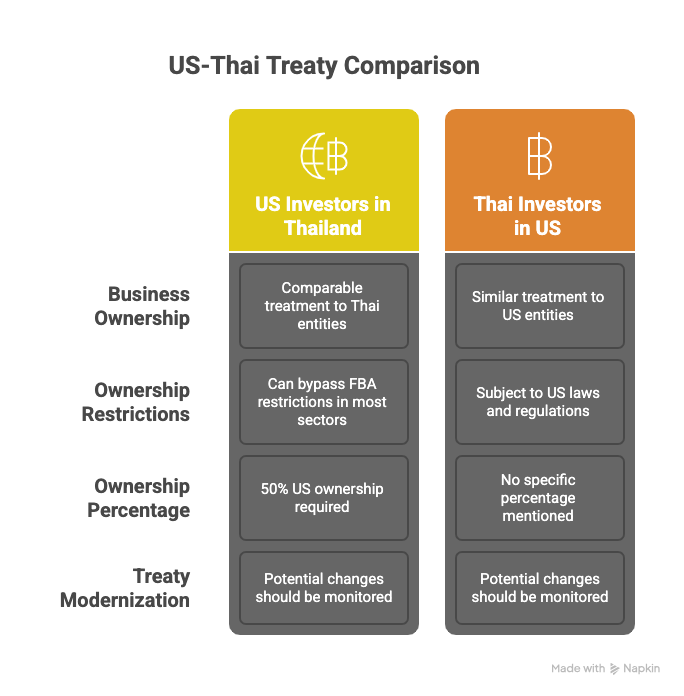
The Treaty of Amity has its own reservations; they are not simply the FBA’s List One. Article IV reserves communications, transport, fiduciary functions, deposit-taking banking, exploitation of land or other natural resources, and domestic trade in indigenous agricultural products. Reserved professions are separately addressed. Check the actual activity and obtain the required certification before operating.
A majority (at least 51%) of the company’s shares must be owned by US citizens or US-controlled entities, and a majority of the directors must be American or Thai. Corporate structures involving American parent companies often satisfy this requirement. The treaty is reciprocal, so Thai nationals get similar treatment in the United States. Recent discussions about treaty modernization suggest investors should monitor potential changes.
Alternative Control Mechanisms to Foreign Ownership Restrictions in Thailand
A genuine joint venture may allocate voting, board representation and reserved decisions through lawful corporate documents. These arrangements do not authorise Thai shareholders to hold shares for a foreign principal or disguise a restricted foreign business. Review the actual investment, economic risk, control and activity together; a management agreement does not cure a nominee structure.
A loan or proposed equity conversion needs a separate review of company-law procedures, share issuance, payment rules and foreign-business restrictions. Do not promise automatic conversion into shares or treat a contract as an exception to the FBA.
Land: the restriction the FBA does not cover, and 2026 enforcement
The Foreign Business Act governs what a foreign-majority company may do. It does not govern who may own land. That is the Land Code. In 2026 the two began to interact directly.
Chapter 8 of the Land Code bars foreign nationals from owning land except under narrow exceptions. Chapter 9, sections 97 to 100, extends the same bar to juristic persons that count as foreign. The test in section 97 is mechanical: foreigners holding more than 49 per cent of the registered capital, or foreign shareholders exceeding half the total number of shareholders, with parallel tests for partnerships, associations, co-operatives and foundations. Section 98 applies the same test one layer up: where a juristic person that is itself foreign under section 97 holds shares in another juristic person to the extent described in section 97, that other one is treated as foreign too. Section 99 applies the Chapter 8 restrictions to all of them. Holding land as owner in place of a foreigner is caught by section 96 of the Land Code and, as a nominee arrangement, by section 36 of the Foreign Business Act.
What changed in 2026
Registration. At incorporation, clauses 2 and 3 of DBD Order No. 2/2569 apply where foreign partners or shareholders hold less than 50% of capital, or where a company has no foreign shareholder but a foreign authorised signatory. The filing requires the Investment Explanation Letter, three months of the relevant Thai investors’ payment-account statements and receiving-account evidence. Later qualifying amendments use a different form under clause 4; clause 5 adds evidence for specified first-year amendments. See the incorporation and amendment checklists. Order No. 2/2569 prescribes documents and payment evidence. It does not itself state that every mismatch must lead to outright rejection without an opportunity to correct the filing. Reconcile the records before submission and respond to any registrar query.
The land office. On 15 May 2026 the Department of Lands sent circular MT 0515.2/W 10722 to every provincial land office, followed by two further circulars marked most urgent on 21 and 25 May, activating the department’s consolidated enforcement manual. Land officers now screen the shareholding chain including indirect layers, the source of each Thai shareholder’s funds, directors and signatories, capital increases and post-acquisition share transfers, actual land use, and ultimate beneficial ownership. Note what that last item does. The statutory tests in section 97 are arithmetic, but the circulars instruct officers to look for real control regardless of the percentages, and they are explicit that a 51 per cent Thai and 49 per cent foreign split on paper is not sufficient. These are administrative circulars. They create no new law and impose no new reporting duty on the public.
Data. On 29 April 2026 twenty-one agencies signed a data-sharing memorandum at Government House, among them the DBD, the Department of Lands, the Revenue Department, the Royal Thai Police, AMLO and the DSI. Land offices must check the juristic persons in their area that have foreign shareholders or directors every month and report to the Department of Lands every quarter (W 10722, restated in W 11266), and the Department of Lands has passed its records of juristic persons holding land to the DBD. Against Department of Lands records covering 144,706 juristic persons holding land, the DBD has identified 36,277 with foreign shareholders, 31,516 of them at 49 per cent or below, and 35,154 of them in sixteen provinces. Across all sectors, roughly 118,000 companies with foreign holdings between 0.01 and 49.99 per cent are queued for inspection, with the 40 to 49.99 per cent band prioritised.
What enforcement actually does to a flagged structure
Annulment of the registration is available. Section 61 of the Land Code empowers the Director-General to order the annulment or amendment of a title deed or of the registration of rights and juristic acts where the registration was inaccurate or unlawful, after a committee of enquiry has called for documents, notified interested parties and allowed thirty days for objection.
Forced disposal is the more common outcome, and it is the mechanism the 2026 circulars operationalise. Section 94 requires disposal of land acquired unlawfully within a period the Director-General fixes, not less than 180 days and not more than one year, after which he disposes of it under the Chapter 3 forced-sale provisions. Section 96 applies that machinery to land held as owner in place of a foreigner or a foreign-controlled juristic person. Section 100 reaches a company that acquired land lawfully and whose nature later brings it within sections 97 or 98, which is the exposure most existing owners overlook.
Criminal exposure is separate and cumulative. Land Code section 111 for the foreigner and section 113 for the Thai holding as agent, each a fine of up to 20,000 baht or up to two years in prison or both, and section 112 for the juristic person, a fine of up to 50,000 baht. Section 36 of the Foreign Business Act, up to three years in prison or a fine of 100,000 to 1,000,000 baht or both, with a court order to end the assistance, joint operation or shareholding, and a fine of 10,000 to 50,000 baht for every day that order is disobeyed. Criminal Code sections 137 and 267 where false statements were made at registration, section 267 carrying up to three years or a fine of up to 60,000 baht or both.
The arrangement is also unenforceable. Thai courts treat nominee holdings as void under section 150 of the Civil and Commercial Code, since the object of the act is expressly prohibited by law. The foreign party is left with no claim against the nominee.
Under discussion, not yet law: the Ombudsman has recommended amending the Land Code so that land a nominee holds for a foreigner is forfeited to the State, instead of being sold under section 94 with the proceeds going to the holder. The Cabinet noted that recommendation on 24 June 2025 and, on 24 February 2026, a Ministry of Commerce progress report that lists the Land Code among the laws under review. No amending bill has been published.
For the enforcement history in full, see the 2026 nominee crackdown. If you are a foreign buyer rather than an investor, start with foreigners buying land in Thailand.
Regulatory Compliance and Risk Management
Legitimate foreign control requires strict compliance with Thai regulations. Due diligence is essential, especially when ownership structures involve Thai shareholders. Keep proof of capital contributions, avoid nominee arrangements, and maintain clear governance and transparent accounts.
Compliance should include several key points
, Name the list item or exemption used.
, State the minimum capital and remittance schedule.
, Confirm that there are no nominee structures.
, Track BOI or FBL conditions.
, File reports on time.
, Check structures each year for rule updates.
Strategic Considerations for Implementation
Foreign control strategies must align with business objectives, regulations, and sector rules. BOI projects usually need large capital. Treaty companies may work with smaller bases. For work permits, the usual rule is 2 million THB in capital for each foreigner. If married to a Thai, it is 1 million THB. There must be 4 Thai employees for each foreign worker, unless BOI rules apply. Plan initial and ongoing compliance costs. Exit strategies for mergers, sales, or restructuring should be considered early.
FACTS about Foreign Ownership Restrictions in Thailand
What is the Foreign Business Act (FBA) in Thailand and how do Lists 1-3 restrict foreign business?
The FBA defines which persons and entities count as foreign, then restricts specified activities through Lists One to Three. It does not impose a universal 49% shareholding cap. The correct route depends on the activity, ownership, treaty or statutory entitlement and other sector laws. List Two also has specific Thai-shareholding and director requirements under Section 15.
Can a foreigner own 100% of a company in Thailand?
Yes, where the activity is not restricted and no separate sector law prevents it. For restricted activities, check whether a licence, a BOI-related Foreign Business Certificate, treaty entitlement or another exemption applies. Approval is activity-specific and does not automatically cover every activity in the company’s objects.
BOI vs. Foreign Business License: what’s the difference and which one fits my plan?
BOI promotion concerns an eligible investment project and its certificate conditions. An FBL concerns permission to conduct a restricted activity under the FBA. A promoted foreign business may instead need an FBC under Section 12. Tax incentives and permission to operate are separate questions; compare the actual activity and conditions before selecting a route.
How does the US-Thai Treaty of Amity allow majority American ownership?
Qualifying US investors may receive national treatment for covered activities after the required certification. The treaty has its own reserved sectors, including communications, transport, fiduciary functions, deposit-taking banking, land or natural-resource exploitation and domestic trade in indigenous agricultural products. Its limits are not simply the FBA’s List One.
What legal mechanisms help foreigners keep control without holding a majority of shares?
Lawful governance provisions may protect a genuine minority investor through board representation, voting arrangements and reserved decisions. They do not legalise nominee shareholding or disguised foreign operation of a restricted activity. Any proposed option or equity conversion requires separate company-law and FBA review.
What compliance risks should foreign investors avoid under the FBA?
The biggest warning sign is using illegal nominee shareholders to fake Thai majority ownership. This can lead to criminal penalties, losing licenses, and forced shutdowns. Keep clear records of the Ultimate Beneficial Owner (UBO). Make sure voting and control match the real capital at risk. Also, maintain clean accounting records for intercompany charges. You should continue to file and review with the Department of Business Development (DBD) and the Ministry of Commerce. Follow the license conditions if you have BOI or FBL. Make sure your immigration and work permit status matches your job role. A proactive compliance calendar, internal controls, and periodic legal audits are essential risk-management tools.
How should I choose the best entry route, BOI, FBL, Treaty company, or JV, for my sector and timeline?
Map your business model to the route that best balances eligibility, speed, and operating flexibility. Tech, advanced manufacturing, clean energy, research and development, logistics hubs, and high-value services often match BOI priorities. US-backed service or trading companies may prefer the Treaty of Amity. Specialized consulting or international trading might work under an FBL. Certain partnerships work best as well-designed Thai-foreign joint ventures. Consider capital intensity, hiring plans, IP location, transfer pricing, potential permanent establishment exposure, exit options, and reporting workload. Create a step-by-step plan that includes setup, licensing, operations, and scaling up. Make sure to have clear decision points and backup plans. This will help you stay compliant while ensuring lasting foreign control.
Conclusion
Choose the route after classifying the proposed activities. An unrestricted activity, a licensed activity, a promoted project and a treaty business have different requirements. Keep the licence or certificate conditions, genuine ownership and other sector rules aligned with the business as operated. Read the FBA and the Treaty of Amity.
Success in implementing these strategies depends on thorough understanding of regulatory requirements, careful structure planning, and ongoing compliance management. Professional legal help is important for understanding complex rules. It ensures that control systems meet their goals and follow the law.
Expatriate entrepreneurs and international businesses can find strong options in the Thai market by partnering with local Thai companies. These legal pathways offer good alternatives to the usual joint venture model. They allow for more control over business operations, strategy, and long-term success.
Links:
, Department of Business Development in Thailand
Last reviewed: 30 September 2026. Read in Thai: Foreign Business Act B.E. 2542 sections 4, 8, 12, 14, 15 and 36; Land Code sections 61, 94, 96, 97 to 100 and 111 to 113; Criminal Code sections 137 and 267. The BOI incentive periods, the Treaty of Amity reservations and director rule, the DBD and Department of Lands 2026 orders and circulars, the enforcement statistics and the work-permit capital ratios are taken from agency publications and reports, not read in a Gazette primary.
Thai Law Updates, free by email
Plain-English updates on Thai law changes that affect foreigners: property, visas, marriage, business and wills. One short email a month from a firm practicing since 2006. No spam, unsubscribe anytime.