


Reviewed by ThaiLawOnline, a licensed Thai law firm practising in Thailand since 2006. Thai lawyer of record: Wichuda Atthamethakon, LL.M., Thai Bar Licence 3149/2556.
Last updated on September 5, 2026
A foreigner pays for a house on his Thai wife’s land. He registers a right at the Land Office, sleeps well for fifteen years, and dies. Whether his children receive that house turns on one word in the register. Register a superficies and they inherit it. Register a usufruct or a right of habitation and they get nothing, because both rights die with him.
Table of Contents
Most English-language guides to this subject get that answer backwards. The page currently ranking first for the three-way comparison tells readers that all three rights end at the death of the holder. Section 1411 of the Civil and Commercial Code says the opposite about superficies, in one sentence, with no ambiguity.
This page compares five registrable rights, not three, and it names the section behind every claim. ThaiLawOnline has drafted and registered these instruments for foreign clients since 2006.
The five rights, side by side
Thai law offers you five ways to hold a registered interest in land you cannot own. Read the table on the two columns that decide most real cases: transferable and inheritable.
| Right | Thai term | Sections | Maximum term | Transferable | Inheritable | Income rights |
|---|---|---|---|---|---|---|
| Registered lease | สัญญาเช่า | CCC ss.537-571 | 30 years | Only if the lease says so | No, unless stipulated | Yes, subletting if permitted |
| Usufruct | สิทธิเก็บกิน | CCC ss.1417-1428 | 30 years or life | Exercise only, s.1422 | No, ends at death, s.1418 | Yes, full management, s.1417 |
| Superficies | สิทธิเหนือพื้นดิน | CCC ss.1410-1416 | 30 years or life | Yes by default, s.1411 | Yes by default, s.1411 | Owns the building, so yes |
| Habitation | สิทธิอาศัย | CCC ss.1402-1409 | 30 years, renewable, or life | No, s.1404 | No, s.1404 | No, dwelling only, s.1402 |
| Sap Ing Sith | ทรัพย์อิงสิทธิ | Act B.E. 2562 (2019) | 30 years | Yes | Yes | Yes, and mortgageable |
Every one of these must be in writing in Thai and registered against the title at the Land Office. Sign a usufruct agreement and leave it in a drawer, and it binds the person who signed it and nobody else. A buyer of the land takes free of it. Registration is the whole point.
Usufruct: possession, management and income, for your lifetime
Section 1417 gives the usufructuary possession, use and enjoyment of the property, plus the right of management. That is the broadest bundle of the three code rights. You live there, you collect the rent, you decide who maintains the roof.
Section 1418 sets the term. You take it for a fixed period or for your life, and if the instrument fixes no period, Thai law presumes a lifetime usufruct. A fixed term cannot exceed 30 years. The section ends with the line that matters most: in any case the usufruct comes to an end on the death of the usufructuary. Your heirs receive nothing. No drafting trick changes that.
You also carry the running costs. Section 1426 puts management expenses, taxes, duties and interest on charges over the property on you. Section 1424 gives you ordinary maintenance and petty repairs, while section 1425 leaves extraordinary expenses with the owner. Section 1421 holds you to the care a person of ordinary prudence takes of his own property, and section 1420 makes you liable for destruction or depreciation unless you prove no fault.
One misunderstanding runs through nearly every competing page: the claim that a usufructuary cannot transfer anything. Section 1422 says that unless the creating instrument provides otherwise, the usufructuary may transfer the exercise of his right to a third person, and the owner may then sue that person directly. The right itself does not move. Its exercise does. If you are the landowner granting the usufruct, you can switch that default off in the drafting. Almost nobody tells grantors this.
A practical ceiling sits on top of the statute. On the face of the Code a usufructuary holding the right of management may grant a registered lease of more than three years. Land Offices refuse to register a foreign national as lessor, reasoning that a foreigner may not control or manage land. So a foreign usufructuary in practice lets the property in terms of three years or less, unregistered, under section 538. That restriction comes from administrative practice, not from the Code. Competitors state it as a hard rule and cite nothing.
Watch the clock at the end. Section 1428 bars any action between the owner and the usufructuary, or his transferee, more than one year after the usufruct ends. An owner who could not have known of the ending gets the year from the date he knew or should have known. Miss it and the claim disappears.
Read more on usufruct agreements in Thailand and on usufruct for foreigners.
Superficies: you own the building
Section 1410 lets the landowner create a right for another person to own buildings, structures or plantations on or under the land. The land stays hers. The house becomes yours, as property, recorded separately through the building’s own records rather than on a title deed of its own.
Section 1411 then does the work: unless the act creating it provides otherwise, the right of superficies is transferable and transmissible by way of inheritance. Your children inherit the house. You can sell the right. The default runs in your favour, and the parties can contract out of it, which means you read that clause before you sign anything a developer hands you.
Section 1412 offers three shapes and no others. A fixed period capped at 30 years, the life of the landowner, or the life of the superficiary. Guides that describe a superficies “in perpetuity” as technically possible have no section to point at. Where no period is fixed, section 1413 lets either party terminate on reasonable notice, and where rent is payable, one year’s notice or one year’s rent.
Section 1416 governs the ending, and buyers should negotiate it at the start. You may take away your buildings and restore the land to its former condition. If the landowner instead notifies an intention to buy them at market value, you may not refuse except on reasonable ground. That converts “do I lose my house” into a valuation question. Fix the valuation method in the instrument and you have removed the worst fight before it starts.
More detail on the right of superficies in Thailand.
Habitation: a place to live, nothing more
Section 1402 entitles the grantee to occupy a building as a dwelling place without paying rent. Charge rent and you have created a lease, whatever the paper says. Section 1404 removes any exit: the right of habitation is not transferable, even by way of inheritance.
Section 1405 lets your family and household live with you unless the grant limits the right to you personally. Section 1406 lets you take natural fruits or products of the land, but only as much as your household needs. You cannot run the property as a business.
Habitation earns one point that the rest of the market ignores. Section 1403 caps a fixed term at 30 years and then permits renewal for a further period not exceeding 30 years from the time of renewal. The Code says so directly. Compare that to the lease renewal problem, where the Supreme Court in Decision 4655/2566 struck down pre-paid automatic renewal clauses reaching past the 30 year cap. Habitation renewal is textually cleaner. It is still useless to anyone who needs income or heirs.
See the right of habitation in Thailand.
The two the comparison pages leave out
The registered lease still does most of the work in the market. It runs 30 years, section 538 requires registration above three years, and after Decision 4655/2566 you should treat pre-paid 30+30+30 structures as unsafe. Our page on 30 year lease renewal options and the Supreme Court lease decisions set out where the line now sits.
Sap Ing Sith sits outside the Civil and Commercial Code, in its own Act of B.E. 2562 (2019). It creates a registrable right to use and take benefit from immovable property for up to 30 years, over land with a full title deed, buildings on titled land, and condominium units under the Condominium Act. The right is transferable, inheritable and mortgageable. The Act contains no renewal clause, so continuing past year 30 requires a fresh agreement and a fresh registration with whoever owns the land then. Read Sap Ing Sith in Thailand and the Sap-Ing-Sith Act itself.
One right people arrive at by mistake: a servitude burdens a neighbouring plot for the benefit of yours, under sections 1387 onward. It gives access and utility routes, not a place to live. If you bought a landlocked plot, you want servitudes, not a usufruct.
If your Thai spouse owns the land, read section 1469 first
The most common pattern in the market is a Thai wife granting her foreign husband a lifetime usufruct over the land she holds. Guides recommend it constantly. Almost none of them mention section 1469.
Section 1469 lets either spouse avoid any agreement concluded between them during the marriage, at any time during the marriage or within one year from the day of dissolution, without proving anything. The rights of third persons acting in good faith survive. A usufruct granted by a wife to her husband during their marriage is exactly such an agreement.
The accurate version has five parts, and it is more reassuring than the panic version:
- Your wife cannot walk into the Land Office and cancel a registered usufruct. It is a real right entered on the title.
- She can avoid the underlying agreement under section 1469 and ask a court to order the entry removed. That takes litigation, time and a judgment.
- Third parties acting in good faith keep their rights, which is why a registered usufruct still beats an unregistered promise by a wide margin.
- The exposure window closes one year after the marriage dissolves.
- A right granted before the marriage, or granted by someone who is not your spouse, sits outside section 1469 entirely.
Point five is the practical fix, and no competitor states it. Register the usufruct or superficies before the wedding, or take the grant from the seller at the moment of purchase rather than from your spouse afterwards. Same protection, no section 1469 exposure. See also marital property under Thai law.
What it costs, and who pays afterwards
Where no consideration passes between the parties, the Land Office charges a nominal fee, commonly quoted at around THB 75 per plot for a usufruct registration. Where the parties declare a consideration, the registration fee runs at 1% of the declared or appraised value, plus stamp duty. Practitioners usually apply 0.1% stamp duty to these registrations, though published figures differ between sources and one widely read guide states 0.5%. Confirm the rate with the office handling your file before you budget. [verification needed on the exact stamp duty rate for superficies registrations]
Each right takes its own filing and its own fee. Registering a lease, a superficies and a usufruct over the same villa means three applications, not one.
Running costs follow the instrument. A usufructuary pays management costs, taxes and duties under section 1426 and handles ordinary repairs under section 1424, while the owner covers extraordinary expenses under section 1425. Habitation carries no such allocation, so the parties must write one. Buyers costing out a structure almost never see this until the first tax bill.
One 2026 development belongs in your planning. The Department of Lands issued Urgent Circular มท 0515.2/ว 10722 on 15 May 2026, followed by further Most Urgent instructions, requiring registrars to investigate the source of funds on a cash payment of THB 2 million or more, or an appraised value of THB 5 million or more. Land Office officers hold discretion over these registrations and can impose conditions or refuse. Whether the circulars are being applied to usufruct and superficies filings, or only to transfers of title, varies by province. [verification needed] Our note on recent nominee crackdowns covers the enforcement context.
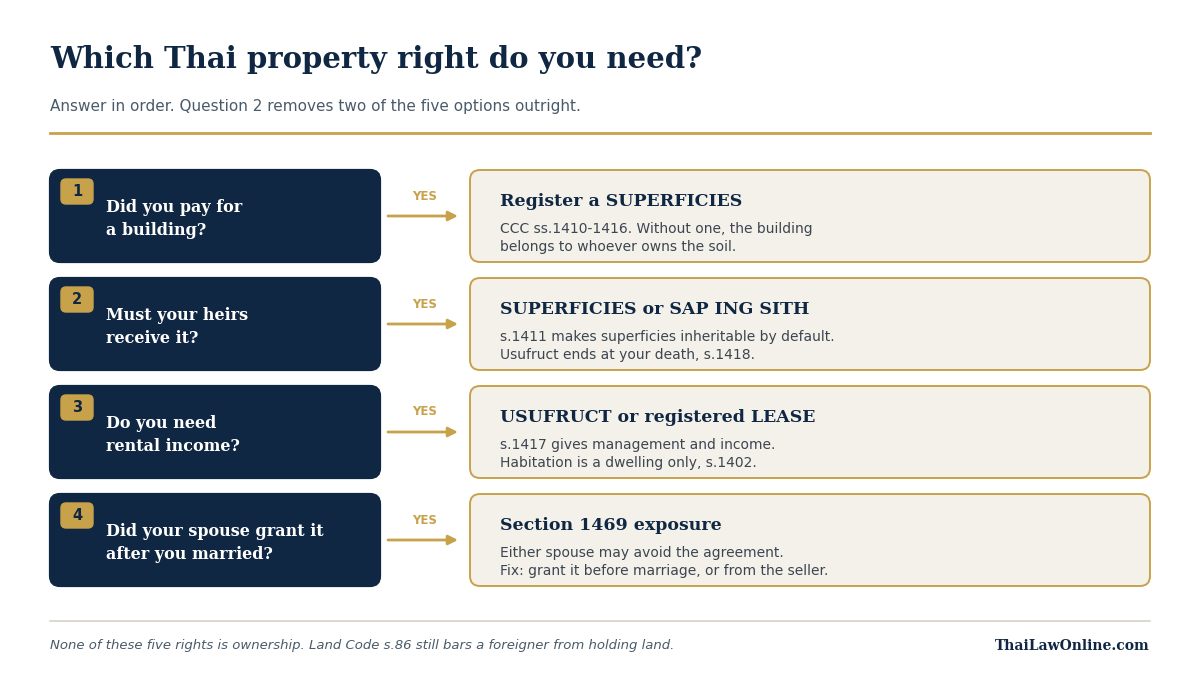
Which one do you need? Four questions
- Did you pay for a building? If yes, register a superficies over it. Without one, the building belongs to whoever owns the land under the ordinary rule that a structure follows the soil.
- Do your heirs need to receive it? If yes, superficies or Sap Ing Sith. Usufruct ends at your death under section 1418. Habitation cannot pass under section 1404.
- Do you need rental income? If yes, usufruct or a registered lease. Habitation gives you a dwelling and nothing more.
- Is the grantor your spouse, and were you already married when she granted it? If yes, price in section 1469 and consider whether a pre-marriage grant or a grant from the seller does the same job with less risk.
Stacking rights, and where stacking stops working
Clients often register more than one right over the same property. A 30 year lease secures occupation and a rent-based claim. A superficies puts the building in your name and passes it to your children. A usufruct adds management and income. The three coexist because they answer different questions, and Thai law registers them separately.
Stacking costs three sets of fees and three sets of drafting. It also has a ceiling. None of these rights is ownership. Section 86 of the Land Code still forbids a foreigner to acquire land, and section 94 gives a foreigner who ends up holding land between 180 days and one year to dispose of it before the Director-General sells it for him. Stack as high as you like. The land stays hers.
Frequently asked questions
Can my Thai wife cancel my usufruct?
Not at the Land Office counter. A registered usufruct is a real right on the title. She can ask a court to avoid the underlying agreement under section 1469, because you concluded it during the marriage, and the court can then order the entry removed. She loses that option one year after the marriage dissolves, and she never had it if you registered the right before you married.
Is a superficies inheritable in Thailand?
Yes. Section 1411 makes the right transferable and transmissible by inheritance unless the instrument creating it says otherwise. Read that clause before signing, because the parties may contract out of it.
Can a foreigner register a usufruct on a condominium unit?
Yes, subject to the registrar. No statute bars a foreigner from holding a usufruct, and Land Offices register them over condominium units. The officer handling your file keeps discretion to impose conditions or refuse. Most foreign buyers who qualify under the 49% foreign quota take freehold title instead, so the usufruct route usually appears where the unit sits in the Thai quota.
What does a usufruct cost to register?
A nominal fee per plot where no money changes hands, commonly around THB 75. Where the parties declare a consideration, expect 1% of the declared or appraised value plus stamp duty. Our page on usufruct costs for foreigners breaks down a worked example.
Can I rent out a property I hold under usufruct?
Section 1417 gives you management and section 1422 lets you transfer the exercise of your right, so the Code permits it unless your instrument forbids it. In practice Land Offices decline to register a foreigner as lessor, so foreign usufructuaries let in terms of three years or less without registration.
What happens to my house when a superficies ends?
Section 1416 gives you the right to remove the buildings and restore the land. If the landowner notifies an intention to buy them at market value, you may refuse only on reasonable ground. Agree the valuation method in the original instrument.
Which is better, usufruct or superficies?
They answer different questions. Superficies gives your heirs the building. Usufruct gives you management and income over the whole property for your lifetime and stops at your death. Clients who built a house and want to pass it on register both.
Does a usufruct survive a sale of the land?
A registered usufruct is a real right attached to the property, so a purchaser takes the land subject to it. Secondary sources cite Supreme Court authority to that effect. [verification needed on the specific decision number] An unregistered agreement gives you nothing against a buyer.
Where to start
Bring us the title deed, the identity of the grantor, and the answer to question two above. We will tell you which instrument fits, draft it bilingually, and attend the Land Office registration with you. ThaiLawOnline has handled Thai property rights for foreign clients since 2006.
Thai Law Updates, free by email
Plain-English updates on Thai law changes that affect foreigners: property, visas, marriage, business and wills. One short email a month from a firm practicing since 2006. No spam, unsubscribe anytime.