


Obtenir un devis à forfait
Un cabinet d'avocats thaïlandais pour étrangers depuis 2006. Plus de 5 000 dossiers clients. Avocate thaïlandaise inscrite : Wichuda Atthamethakon, LL.M., barreau thaïlandais n° 3149/2556. Anglais, thaï et français. Nous répondons sous 24 heures.
Révisé par ThaiLawOnline, un cabinet d'avocats thaïlandais agréé exerçant en Thaïlande depuis 2006. Avocate thaïlandaise en charge du dossier : Wichuda Atthamethakon, LL.M., licence du barreau thaïlandais 3149/2556.
Dernière mise à jour :
Siège social : les justificatifs de l’adresse
L’ordonnance n° 4/2568 du Bureau central d’enregistrement des sociétés de personnes et sociétés s’applique depuis le 1er janvier 2026. Lors d’une constitution ou d’un changement de siège social, le greffier vérifie le code du logement, son numéro et les indications de localisation au regard des données du registre civil. Lorsque cinq sociétés ou sociétés de personnes, ou davantage, sont déjà enregistrées dans les mêmes locaux, le demandeur doit également fournir le consentement écrit de la personne habilitée à en autoriser l’usage et des copies des justificatifs de ce droit. Il s’agit d’une exigence documentaire supplémentaire, non d’une interdiction des bureaux virtuels ni d’un plafond de cinq sociétés par adresse.
Avant de payer une formule de domiciliation, demandez combien d’entités utilisent déjà les locaux et si le prestataire fournira le consentement et les justificatifs nécessaires. L’enregistrement au DBD ne confirme pas, à lui seul, que l’adresse convient pour l’immatriculation à la TVA, un permis de travail ou une autorisation sectorielle. Lire l’ordonnance officielle n° 4/2568.
Payroll deadline: Employee Welfare Fund
Fonds de protection des salariés : cinq étapes pour préparer la paie d’octobre
Before the October 2026 payroll, companies employing ten or more staff should establish which employees fall within the Employee Welfare Fund and which have a qualifying provident-fund or other statutory exemption. Contributions start on 1er octobre 2026, initially at 0.25% of wages from the employee and 0.25% from the employer. The ordinary remittance deadline is the 15th of the following month. See the commencement decree and the coverage and payroll guidance in our Thai labour-law guide.
Créer une entreprise en Thaïlande peut être une formidable opportunité. Cependant, la procédure d'immatriculation exige une attention particulière aux règles et démarches légales. Il est essentiel de connaître les étapes à suivre et les problèmes potentiels. Cela permettra à votre entreprise de bien démarrer et d'éviter des retards coûteux ou des litiges lors de l'immatriculation.
MODÈLE RÉDIGÉ PAR UN AVOCAT · ฿890
Service / Contractor Agreement (Bilingual English & Thai)
Deliverable-based payments, acceptance and rework procedure, IP assignment, 3% withholding handled, and the contractor-versus-employee test explained so nobody claims indemnité de départ later. Word + PDF, updated August 2026. สัญญาจ้างทำของ ฉบับสองภาษา
Registration is one step in the wider process covered in our guide to créer une entreprise en Thaïlande.
Dernière révision : 30 août 2026. Sections 1096, 1097, 1098, 1105, 1107, 1108, 1110, 1111, 1111/1 and 1112 of the Code civil et commercial were each read against the Thai text in our own annotated Code. Sections 14 and 36 of the Foreign Business Act B.E. 2542 were read in the Thai original, and sections 94, 96, 97 and 98 of the Code foncier in the Council of State text. Cour suprême Decisions 6412/2560, 1038/2538 and 2252/2560 were each read in full in Thai. The government fees are those in the Department of Business Development’s current registration guide, and the Thai actionnaire evidence requirements were read from the primary text of Central Registrar Order 2/2569. The tax deadlines in Step 5 were not re-verified against the Revenue Code in this review, so confirm them with the Revenue Department when you file.

Table des matières
Comprendre les bases : Structure d'une société à responsabilité limitée thaïlandaise
The most popular business structure for foreigners in Thailand is the private société à responsabilité limitée (บริษัทจำกัด). This structure provides limited liability protection for shareholders while offering flexibility in operations and the ability to obtain permis de travail pour les employés étrangers.
Exigences clés pour les sociétés à responsabilité limitée thaïlandaises :
- Minimum de 2 actionnaires, of any nationality. Section 1097 of the Civil and Commercial Code required three promoters until the Civil and Commercial Code Amendment Act (No. 23) B.E. 2565, published in the Royal Gazette vol. 139 part 69 Kor on 8 November 2022 and in force on 7 February 2023, rewrote it to read “any two or more persons”. The Code does not require any of them to be Thai.
- Au moins 1 directeur (peut être de nationalité thaïlandaise ou étrangère)
- You need enough capital social for your business. Usually, this means 2 million baht for one permis de travail. This amount is higher under the Traité d'amitié
- Thai business address (virtual offices are permitted but TVA registration need a physical office)
Règles relatives à la propriété étrangère et exigences en matière de capital
One of the most important aspects for foreigners to understand is Thailand’s ownership restrictions. Under the Loi sur les entreprises étrangères (FBA), la propriété étrangère est généralement limitée à 49% d'actions in most sectors. Thai nationals must own the other 51%. However, there are legal pathways to achieve majority or even 100% foreign ownership through:
- Promotion du Conseil d'investissement (BOI)
- Licence commerciale étrangère (FBL)
- Traité d'amitié (Réservé aux citoyens américains)
- Certaines activités commerciales non restreintes sont nécessaires aux sociétés à responsabilité limitée en Thaïlande.
Besoins en capitaux par type d'entreprise
Les besoins en capitaux varient considérablement en fonction de la structure de votre entreprise et de vos plans de dotation en personnel :
- entreprise à majorité thaïlandaisePas de minimum légal, mais en pratique au moins 100 000 THB
- Entreprises employant des étrangers: Minimum 2 millions de THB par employé étranger
- Entreprises à majorité étrangèreExigences minimales de 2 à 3 millions de THB plus FBL
Registered capital is not the same as cash in the bank on day one. Section 1105 of the Civil and Commercial Code sets the floor: the first payment on each share must be at least 25% of its nominal amount, and under section 1110 the directors must call for that payment before they apply to register the company. The balance can be called later. What the capital figure decides immediately is what the company can do, which is why the work permit and Foreign Business Act figures above are worth settling before the memorandum is filed rather than after.
Étape par étape Procédure d'enregistrement d'une société en Thaïlande
Étape 1 : Réservation du nom de l'entreprise (1 à 3 jours ouvrables)
La procédure d'immatriculation commence par la réservation du nom de votre entreprise auprès du Département du développement des entreprises (DBD). Points clés à retenir :
- Soumettre 3 noms alternatifs classés par préférence
- Company name must end with “Limited” (จำกัด)
- Les noms doivent être différents de ceux des sociétés déjà enregistrées.
- L'approbation prend généralement de 1 à 3 jours ouvrables.
- Moment critiqueLes noms approuvés ne sont valables que pour un certain temps. 30 jours sans possibilité de prolongation
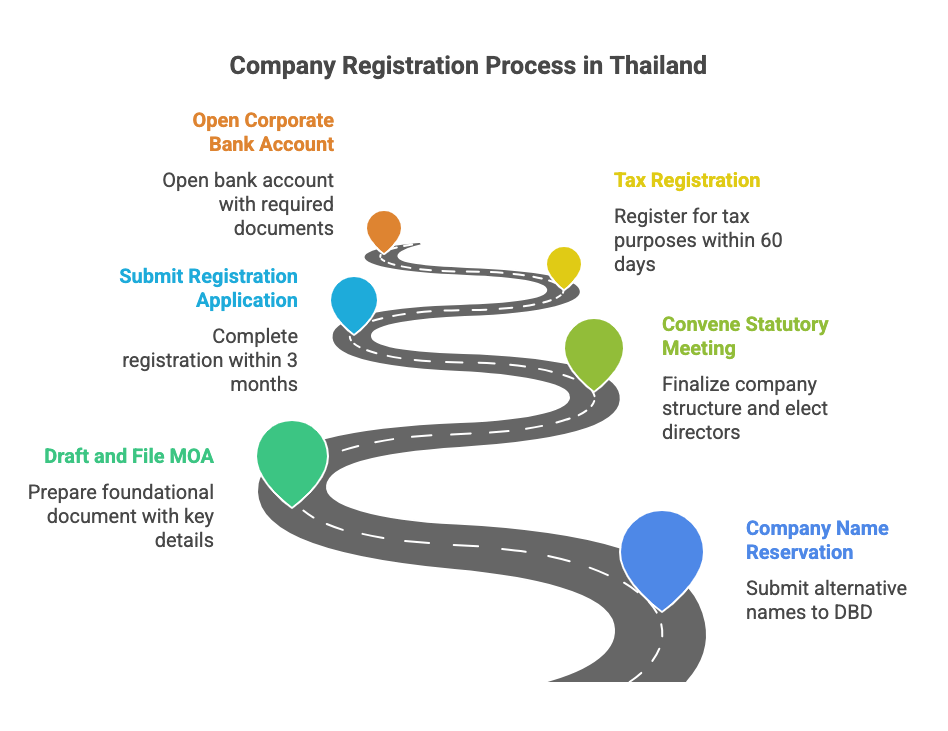
Étape 2 : Rédiger et déposer les statuts (1 à 2 jours)
The Memorandum of Association (MOA) serves as your company’s foundational document and must include:
- Nom de l'entreprise approuvé
- Province où sera situé le siège social
- Objectifs commerciaux détaillés
- Montant du capital social et structure du capital social
- Noms, adresses et coordonnées de tous les promoteurs
- Registration fee for the memorandum: see the government fee list under Step 4. These are fixed sums set by ministerial regulation, not a percentage of your registered capital, so confirm the current schedule with the DBD when you file.
Étape 3 : Convoquer une réunion statutaire (préavis minimum de 7 jours)
Cette réunion formelle est cruciale pour finaliser la structure de votre entreprise :
Activités requises pour enregistrer une entreprise en Thaïlande :
- Adoption des statuts
- Élection des premiers administrateurs et commissaires aux comptes
- Ratification des dépenses du promoteur
- Approbation de la répartition et de la structure des actions
- Détermination des pouvoirs et responsabilités des administrateurs
What the seven days actually is. Section 1107 of the Civil and Commercial Code requires the promoters to send every subscriber a certified statutory report at least seven days before the day of the meeting. It is notice of the meeting, not a waiting period between the meeting and your filing, and a copy of the same report goes to the Registrar as soon as it has been sent to the subscribers.
The three-month cliff. Under section 1112, if registration does not happen within three months of the statutory meeting the company is not formed at all, and every baht received from subscribers must be repaid in full without deduction. Directors still holding that money three months after the meeting are jointly liable to repay it with interest.
You can often skip the seven days entirely. Section 1111/1 lets the directors register the memorandum and register the company together on the same day the promoters sign the memorandum, provided four things are done that day: subscribers have been found for the whole of the shares the company is to register; a statutory meeting under section 1108 is held with the promoters and all subscribers present and all of them approving its business; the promoters hand the whole of the business over to the directors; and the directors call for payment of the shares under section 1110 paragraph two and that payment is completed. Where the shareholders are all available and the money is ready, this is what turns a multi-week registration into a single filing. It is the provision most English guides to Thai company registration leave out.
Étape 4 : Soumettre la demande d'enregistrement de l'entreprise (1 à 7 jours)
L'inscription définitive doit être effectuée dans un délai imparti. 3 mois of the statutory meeting. Thailand’s e-Registration system was withdrawn on 16 janvier 2025 and replaced by “DBD Biz Regist”, so the platform had been running for about eighteen months before the counter closed. How long a filing takes depends on who is in the company rather than on the platform. Section 1111/1 of the Civil and Commercial Code lets the directors register the memorandum and the company on the same day the promoters sign the memorandum, provided every share the company will register is subscribed, the statutory meeting is held with all promoters and subscribers present and in agreement, the promoters have handed the business over to the directors, and the share money called under Section 1110 has actually been paid. And for any company with a foreign shareholder or a foreign authorised director the evidence burden became heavier on 1 August 2026 under Order 2/2569.
Government fees. The Department of Business Development publishes these in its own company registration guide. The incorporation fee is a flat sum and does not scale with your registered capital, which is the point most often got wrong:
- Registering the company: 5 000 THB
- Registration certificate: 100 THB per copy
- Company affidavit: 40 THB per item certified
- Certified copy of a filed document: 50 THB per page
- Memorandum filing: 500 THB, and stamp duty: 200 THB. Neither of these two appears on the DBD list above, so treat them as indicative and confirm them when you file.
⚠️ An older fee table is still circulating online and it is out of date. It charges incorporation on a sliding scale, 500 THB for every 100,000 THB of registered capital with a 250,000 THB ceiling, so on that table a company with 10 million THB of capital would pay 50,000 THB. The copy we found carries a file date of 2014. The DBD’s current guide gives the flat 5,000 THB above, whatever your capital. If a quote you are given scales with your registered capital, ask which schedule it is based on.
Étape 5 : Inscription fiscale (dans un délai de 60 jours)
Toutes les entreprises doivent s'inscrire. à des fins fiscales dans 60 jours d'incorporation:
- Obtenez votre numéro d'identification fiscale auprès du service des impôts.
- L'immatriculation à la TVA est obligatoire si le chiffre d'affaires annuel dépasse 1,8 million de THB
- L'inscription à la TVA doit être effectuée dans les délais impartis. 30 jours de dépassement du seuil
Étape 6 : Ouverture d’un compte bancaire d’entreprise (1 à 5 jours)
Ouvrir un compte bancaire professionnel est devenu de plus en plus difficile en raison du durcissement de la réglementation bancaire. Les exigences comprennent :
- La présence de tous les administrateurs autorisés est cruciale pour le processus d'immatriculation de la société.
- Documents d'immatriculation de société complets
- Un permis de travail peut être requis pour les signataires étrangers.
- Une lettre de recommandation d'un prestataire de services juridiques est souvent utile.
Quelles erreurs causent des retards lors de l'enregistrement d'une entreprise en Thaïlande ?
Problèmes de traduction et de certification de documents
Poor translation quality or improper certification is one of the most common causes of registration delays. Filings at the DBD are made in Thai, so every foreign-language document has to arrive with a Thai translation, and a document issued abroad also has to carry whatever legalisation its own issuing authority and the Thai embassy or consulate require. Most of the delay we see comes from the translation rather than the legalisation.
Problèmes de traduction courants entraînant des retards :
- Romanisation des noms incohérente dans les documents
- Usage incorrect de la terminologie juridique
- L'absence de sceaux et de cachets officiels dans les traductions peut compliquer l'enregistrement d'une entreprise en Thaïlande.
- Recourir à des traducteurs non agréés dont le travail est rejeté par les autorités
Les conséquences d'une traduction incorrecte peuvent être graves, pouvant rendre l'enregistrement entier juridiquement invalide et nécessiter une nouvelle soumission complète.
Documentation financière des actionnaires thaïlandais
Depuis 1er août 2026, l'Ordre du Registraire des partenariats et des sociétés centrales N° 2/2569 requires Thai shareholders and partners to prove that the capital they subscribed was genuinely their own money. It expressly repeals two earlier orders, No. 2/2568 of 1 December 2568 and No. 1/2569 of 16 March 2569, and it is wider than either of them: it covers amendment filings as well as the original registration.
Constitution : champ d’application des articles 2 et 3. Les justificatifs de première immatriculation sont exigés dans l’une ou l’autre des situations suivantes :
- A foreign shareholder or partner holds moins de 50% of the registered capital.
- Il y a aucun actionnaire étranger, but a foreign director holds sole or joint authority to sign for the company. This is the limb applicants almost never expect.
Constitution : pièces à déposer. La lettre explicative d’investissement prescrite doit être accompagnée des relevés des comptes de paiement des investisseurs thaïlandais et des justificatifs du compte recevant les fonds décrits ci-dessous :
- Relevés bancaires couvrant la les trois mois précédant la souscription, affichant les retraits qui correspondent à la cotisation.
- Déclarations de compte bénéficiaire, showing the money arriving from each shareholder.
- Le prescrit Lettre d'explication d'investissement, traçant le flux des fonds.
L’ordonnance n° 2/2569 prescrit des documents et des justificatifs de paiement. Elle n’impose pas elle-même le rejet immédiat de toute discordance sans possibilité de régularisation. Rapprochez les pièces avant le dépôt et répondez aux demandes du registraire.
Une modification utilise un formulaire différent. L’article 4 exige une attestation d’investissement pour les modifications visées introduisant une participation étrangère ou un signataire étranger parmi des signataires auparavant tous thaïlandais. L’article 5 ajoute une lettre explicative d’investissement et des justificatifs bancaires du capital libéré uniquement si l’entité a été constituée à compter du 1er août 2026 et si la modification concernée est déposée dans l’année suivant sa constitution. Lire les articles 2 à 5 et les formulaires annexés.
Le fait de ne pas fournir suffisamment de documents peut entraîner des contrôles pour arrangements illégaux de prête-nom. Section 36 of the Foreign Business Act B.E. 2542 reaches both sides of that arrangement: the Thai national or Thai-majority company who holds shares on a foreigner’s behalf, and the foreigner who lets them. The penalty is imprisonment not exceeding three years, or a fine of 100,000 to 1,000,000 baht, or both. The part that is usually left out is what follows the sentence: the court must also order the shareholding or the joint business to be unwound, and defying that order carries a further fine of 10,000 to 50,000 baht pour chaque jour the breach continues. See our guide to the campagne d'application des nominations de 2026.
Gestion du temps et des échéances
Le processus d'inscription comporte plusieurs échéances strictes dont le non-respect peut vous obliger à recommencer certaines étapes du processus :
- Réservation de nomValable 30 jours seulement, sans prolongation.
- Avis de réunion statutaire: Minimum 7 jours avant l'inscription
- soumission d'inscription: Dans les 3 mois suivant l'assemblée statutaire
- Immatriculation fiscaleDans les 60 jours suivant l'incorporation
Conformité en matière de capital et d'emploi
Erreur de calcul besoins en capitaux is a frequent error that can prevent hiring foreign employees or obtaining work permits. The figure to plan around is 2 million baht of registered capital for each foreign employee you intend to put on a work permit, alongside the Thai-to-foreign employee ratio. This is the single most common thing to get wrong at registration, because the capital is fixed when the company is formed and increasing it later is a separate shareholders’ resolution and a separate DBD filing. A company registered on a token capital because nobody asked about work permits has to be amended before it can make its first foreign hire.
Registering a New Company Online Since 1 July 2026: What Actually Changed
The sections above describe what you file and what evidence goes with it. This section describes the channel you file it through, because the paper counter for setting up a new company closed on 1 July 2026 and the rules behind the system that replaced it are not where most guides look for them. Every date below comes from the department’s own announcements and every rule from the instrument itself, each one linked.
What the Department Switched Off, and What It Did Not
The “DBD Biz Regist” platform has been the only route for establishing a new limited company since 1er juillet 2026, when the DBD stopped accepting walk-in applications for new juristic persons at its counters. The platform itself was available and in heavy use well before that date, so what changed on 1 July is the closing of the counter, not the arrival of the platform. It allows:
- Identity verification without flying in, for a foreign founder: the DBD e-Service app runs e-KYC from a photograph of your face and your passport. The alternative is to appear in person before an officer. Those are the only two channels the department lists for a foreign national
- Electronic signing, for a foreign founder through the DBD e-Service app or a username, password and OTP. A Thai national can also use ThaID or Paotang, and has four verification channels rather than two
One instruction from the department catches people out, and it applies to Thai and foreign founders alike: whoever registers to use the system must verify their own identity, and verification cannot be delegated to anyone else in any case. A lawyer or an accountant can file for you; nobody can be you at the verification step.
The announcement itself is narrower than most English summaries of it. The Lopburi Provincial Commerce Office reproduced the department’s notice on 29 May 2026 in these words:
DBD ยุติการรับจดทะเบียนจัดตั้งห้างหุ้นส่วนบริษัทแบบ Walk-in (ยื่นกระดาษ) ทั่วประเทศ (เฉพาะจดทะเบียนจัดตั้งใหม่)
In translation: the DBD ends walk-in, meaning paper, filing of partnership and company establishment registrations nationwide, and the words in the second bracket confine that to new establishment registrations only. The notice is about setting up a partnership or a limited company. It says nothing about amendment filings, dissolutions or any other entry in the register, so do not read it as closing those counters and do not read it as keeping them open. This is also an operational announcement rather than a statutory instrument: no ministerial regulation or registrar regulation was published with it that we have been able to find.
The Date That Moved Three Times, and Why Older Guides Disagree
Guides written at different points in 2025 and 2026 give different dates for this change, and most of them were right when they were written. The department moved the deadline three times, and each announcement was reproduced by provincial commerce offices as it was issued:
- 17 March 2025: a countdown to closing walk-in business registration counters nationwide by 1 July 2025, with counters to stay open to advise on documents and on completing the electronic forms.
- 17 June 2025: walk-in filing extended to the end of 2025, with Biz Regist to be the only channel from 1 January 2026. The same notice cancelled cross-district filing of new establishments from 1 July 2025, so a new entity had to be filed in the province of its head office or online.
- 26 juin 2025: the department confirmed that extension in its own words, moving the single-channel date from 1 July 2025 to 1 January 2026.
- 29 May 2026: walk-in filing of new establishments ends nationwide on 1er juillet 2026.
So a guide that tells you the switch happened on 1 January 2026 is quoting the second extension and has not been updated since. The platform itself has been live throughout, at edbr.dbd.go.th. Our glossary entry for the Département du développement des affaires carries the same dates in short form.
What the Old Rulebook Said, and What It Means for a Foreigner
The department has not published a rulebook for DBD Biz Regist that we can read. What it has published is the regulation governing the system Biz Regist replaced, and reading that shows which door opened for foreign founders and which one closed.
Le Central Registrar Regulation on the registration of partnerships and companies through the electronic juristic person registration system (e-Registration) B.E. 2564 came into force on 8 March 2021. It was made under clauses 3 and 4 of the Ministerial Regulation of B.E. 2549, which is the enabling power behind every Central Registrar regulation and order in this family, including Order 2/2569 above. Its clause 10 set out four ways to verify identity:
- In person before an officer with an unexpired Thai identity card, or for a foreigner an unexpired passport or an identity document issued by a Thai government body (clause 10(1.1)).
- e-KYC through the system, and clause 10(1.2) confined that route to ressortissants thaïlandais, using a Thai identity card and nothing else.
- An electronic certificate issued by a certification authority (clause 10(1.3)).
- A power of attorney given to a Thai natural person to carry out the verification instead (clause 10(1.4)).
Set that against what the department publishes for Biz Regist and two things have moved in opposite directions. A foreign founder can now verify by app, which clause 10(1.2) did not allow. And nobody can have verification done for them, which clause 10(1.4) expressly allowed. The route opened for the founder and closed for the agent.
On signing, clause 4 of the same regulation defines signing as creating a Digital Signature under the law on electronic transactions, either through the username and password issued under the regulation or through the system’s own identity verification. That is the reason a password and a one-time code bind you to what was filed in your name.
Treat the 2564 Regulation as history rather than as the current rules. e-Registration was withdrawn on 16 janvier 2025. Whether the department has since issued a positive regulation for Biz Regist, or whether the platform runs under the general Central Registrar Regulation of B.E. 2561 that clause 6 of the 2564 Regulation makes the fallback, we have not been able to establish from a published source, and this page will not guess.
Who May File for You, and What Nobody Can Do for You
Under the 2564 Regulation a founder could appoint a representative to do the filing: to complete the application, lodge it, comply with the registrar’s orders, pay the fee, and certify that what was filed matched the founder’s intention. Clause 4 named six categories of person who could act in that role: a bookkeeper, the head of a certified accounting office, a signature certifier for public limited companies, a security enforcer, a certified public accountant, and an ordinary or extraordinary member of the Thai Bar Association.
That is the provision a foreign founder cares about, because it is the one that puts a Thai lawyer or accountant in charge of the filing. What no representative could do then, and what the department says nobody can do now in any case, is verify your identity for you. Read together, the two rules give the practical answer. Your lawyer can do the paperwork, and you still have to show your face, to the app or to an officer. Our guide to créer une entreprise en Thaïlande en tant qu'étranger covers the choices that come before the filing, and appointing and removing a director covers who ends up holding the signature afterwards.
Where Order 2/2569 Fits, and Why a Foreign-Linked Filing Is Not a One-Day Job
Order 2/2569 of the Central Partnership and Company Registrar was signed on 15 July 2026 and came into force on 1er août 2026, four weeks after the counter closed. Its scope and its documents are set out above. What matters for the channel is that those documents are uploads: the Investment Explanation Letter and the bank statements go into the platform with the application. That is what turns the same-day registration section 1111/1 permits into a longer exercise for a company with a foreign shareholder or a foreign authorised director, and it is the reason the timeline depends on who is in the company rather than on the software. The order itself is published by the department, and our page on the Répression des candidats de 2026 sets it in context.
Do not read the digital rollout as a general loosening. For foreign-linked filings, 2026 moved the other way. Order 2/2569, in force since 1 August 2026, adds the three-month bank statement trail, the receiving-account statements and the Investment Explanation Letter described above. The order prescribes documents and attaches no consequence to a discrepancy: its clauses contain no rejection wording and no referral wording at all. Reports that a mismatch between declared and actual transfers is refused outright describe how the requirement is being applied in practice, not what the order says.
What the Register Proves, and What It Does Not
The platform records the structure you type into it. It does not approve that structure, and two provisions of the Civil and Commercial Code set the limits.
Article 1023 provides that until the registered particulars are published, the partners, the partnership or the company may not take advantage of them against a third person, while a third person may take advantage of them. The asymmetry is deliberate: registration exists for the protection of people dealing with the company, not for the company’s own convenience. Article 1023/1 closes the obvious move, providing that a partnership or company may not set up section 1023 against a third person acting in good faith in order to escape liability by alleging that a partner, the partnership, the company or a director had no authority to act.
Two Supreme Court decisions show what that means in practice.
Dans Dika 159/2566 a creditor sued a company on a guarantee signed by its authorised director. The company’s registered objects did not include guaranteeing another person’s debt. The Court held that under section 66 a representative binds a juristic person only by acting within its objects, so the guarantee did not bind the company. It also rejected the argument that the director’s signature was itself a ratification: ratification by its nature comes after the act, and if signing could be its own ratification then every act outside a company’s objects would bind the company and giving juristic persons objects at all would serve no purpose. The claim against that company was dismissed. The objects you type into the platform are not boilerplate.
Dans Dika 17923/2557 two foreign buyers bought land and asked the court to order the seller to transfer it to a Thai limited company that would hold it in name on their behalf. The Court held that the object of the contract was expressly forbidden by section 86 of the Land Code, a provision of public order carrying a penalty under section 111, so the sale was void under section 150 of the Civil and Commercial Code. It reversed the Court of Appeal and dismissed the claim. The company was properly registered. That did not make the purchase lawful.
Neither decision is about electronic filing, and that is the point. The register shows what was filed. What was filed still has to be lawful, which is why the shareholding, the objects and the signing authority deserve more thought than the platform does. Once the company exists, the next deadline is tax: see registering a tax ID number, and if you are American, the Traité d'amitié route changes the ownership question entirely.
Si votre entreprise doit un jour détenir des terres, la règle des 49% n'est pas le seul test.
Most people arrive at a 49/51 shareholding because of the Foreign Business Act. If the company is ever going to buy land, a second and stricter statute applies, and it does not use the same test.
Section 97 of the Land Code treats a limited company as a foreigner for land purposes in soit of two cases: foreigners hold more than 49% of the registered capital, ou foreigners are more than half the number of shareholders. That second limb is the one that catches people. A company with two foreign shareholders holding 49% between them and one Thai shareholder holding 51% is inside the capital limit and is still treated as a foreigner for land purposes, because two of its three shareholders are foreign and either limb of section 97 is enough on its own.
Section 98 extends this up the chain: if a company that is foreign under section 97 holds shares in another company, that second company is foreign too. So a Thai holding company does not launder the position.
The consequence is in section 94. Land acquired by a foreigner unlawfully or without permission must be disposed of within a period the Director-General fixes, which cannot be shorter than 180 days or longer than one year. Miss it and the Director-General sells the land himself. Section 96 applies the same machinery to anyone found to be holding land as owner on behalf of a foreigner or of a section 97 or section 98 company, which is the land-side mirror of the nominee offence described above.
How the courts have actually decided this. Three Supreme Court decisions, read in the Thai original, set the boundaries better than any summary of the rule:
- Dika 6412/2560. Section 86 is not an absolute bar. A foreigner may apply to the Minister of Interior for permission to hold land, and even without permission still holds the right to dispose of the land within the period the Director-General fixes under section 94. The Court drew the consequence most English guides miss: a foreigner therefore has the capacité to enter a contract to buy land, and the contract does not have to spell out an intention to seek ministerial permission. A contract of that kind is not a juristic act with an unlawful object.
- Dika 1038/2538. A Dutch buyer had a Thai national hold title for him. Even though the acquisition contravened section 86 paragraph one, section 94 means the disposal decision belongs to the foreigner and then to the Director-General, so the registered holder had no power to sell the land on her own initiative. Selling it to a third party was an infringement of the foreigner’s rights and he had standing to sue under section 55 of the Civil Procedure Code. A void acquisition is not the same thing as no interest at all.
- Dika 2252/2560. The substance-over-the-register case. A company appeared on its share register with foreign holdings below half, but the foreign side had contributed more than half the real capital. The Court treated the company and the foreigner as carrying on land trading, a List One activity, with the result that the foreign plaintiff was not a lawful injured party and could not prosecute at all. The register is where the enquiry starts, not where it ends.
What changed at the counter in May 2026. The Department of Lands issued circulars to every provincial land office, led by letter no. Mor Tor 0515.2/Wor 10722 of 15 May 2026, signed by the Director-General, directing closer scrutiny of company-held land where the Thai shareholding may be nominal. They are internal enforcement guidance: they create no new law and no new filing duty on the public. What they change is how carefully an existing rule is applied when a company registers an acquisition.
None of this stops a foreign-linked company from operating. It means the shareholding you choose at registration, and the number of shareholders as much as the percentages, decides whether the company can ever hold land in its own name. If that is part of the plan, say so before the memorandum is filed rather than after. Our page on restructuring a Thai company that holds property covers what it takes to unwind it later.
L'importance d'une assistance juridique spécialisée Créer une entreprise en Thaïlande
Comprendre les complexités de la langue thaïlandaise est essentiel lorsqu'on tente de s'inscrire en Thaïlande.
L'administration thaïlandaise fonctionne principalement en thaï, et même de petites erreurs de traduction peuvent compromettre la procédure d'enregistrement. Les professionnels du droit spécialisés en droit des sociétés thaïlandais apportent une aide précieuse :
- Garantir la traduction exacte de tous les documents juridiques
- Understanding nuanced regulatory requirements that aren’t obvious to foreign entrepreneurs
- Filing in the form the registrar expects, which is what actually prevents a rejection and a second submission
- Éviter les erreurs coûteuses qui pourraient nécessiter de recommencer l'ensemble du processus
Comprendre les nuances culturelles et administratives
La culture d'entreprise thaïlandaise met l'accent sur la hiérarchie, les procédures établies et le développement des relations. Des conseillers juridiques expérimentés aident les entrepreneurs étrangers à s'adapter à ces attentes culturelles tout en veillant au respect d'une réglementation complexe et susceptible d'évoluer rapidement.
Atténuation des risques et conformité
L'assistance juridique professionnelle devient particulièrement cruciale lorsqu'il s'agit de :
- Conformité des actionnaires: S'assurer que les actionnaires thaïlandais répondent aux véritables exigences d'investissement
- Conformité à la loi sur les entreprises étrangèresDéterminer si vos activités commerciales nécessitent des licences supplémentaires
- Obligations continues: Respecter les obligations de déclaration annuelle et maintenir une bonne réputation
Considérations relatives aux coûts et planification Créer une entreprise en Thaïlande
Au-delà des frais d'inscription de base, les entrepreneurs doivent prévoir un budget pour l'ensemble des coûts d'installation :
Frais d'enregistrement initiaux pour la création d'une entreprise en Thaïlande :
- Frais gouvernementaux : 6 000 à 12 000 THB
- Services juridiques : 10 000 à 25 000 THB
- Authentification de documents : 2 000 à 5 000 THB par dossier
Coûts annuels d'entretien :
Permis de travail : 3 000 THB par employé étranger et par an
Services comptables : un budget mensuel de plus de 5 000 THB est indispensable pour les entreprises étrangères opérant en Thaïlande.
Audit obligatoire : 20 000 à 50 000 THB par an
Impôt sur les sociétés : 20% des bénéfices nets
FAQ concernant l'enregistrement d'une société en Thaïlande
Quelles sont les premières étapes pour enregistrer une entreprise en Thaïlande ?
Pour créer une entreprise en Thaïlande, vous devez d'abord choisir sa forme juridique et lui donner un nom unique. Ensuite, vous devez enregistrer les statuts. Enfin, vous devez déposer une demande d'enregistrement auprès du Département du développement des entreprises.
Quelle est la différence entre une société thaïlandaise à responsabilité limitée et les autres types d'entités commerciales ?
Une société à responsabilité limitée thaïlandaise est une société dont le capital est divisé en actions. L'article 1096 du Code civil et commercial fixe cette limite avec précision : la responsabilité d'un actionnaire est limitée au montant, le cas échéant, encore non libéré des actions qu'il détient. Elle n'est pas limitée au nombre d'actions qu'il possède. Une fois qu'une action est entièrement libérée, son titulaire ne doit plus rien à la société et les créanciers de la société n'ont aucun droit sur ses biens personnels.
Combien d'actionnaires thaïlandais sont nécessaires pour enregistrer une entreprise en Thaïlande ?
Aucun. L'article 1097 du Code civil et commercial dispose que deux personnes ou plus peuvent promouvoir et constituer une société à responsabilité limitée, et il ne dit rien sur la nationalité. Une entreprise entièrement détenue par des étrangers est enregistrée exactement selon les mêmes dispositions. La question de l'actionnariat thaïlandais relève d'une autre loi qui répond à une autre question : la loi sur les entreprises étrangères ne régit pas qui peut constituer une société, mais quelles activités cette société peut exercer. Lorsque l'activité est restreinte, les réponses légales sont l'obtention de la promotion du BOI, une licence d'entreprise étrangère ou le traité d'amitié avec les États-Unis. Mettre des noms thaïlandais sur le registre des actions pour atteindre 51 % sans que ces personnes n'investissent réellement est la seule solution qui constitue une infraction pénale, en vertu de l'article 36 de cette loi.
Quelle est la procédure d'enregistrement d'une entreprise en Thaïlande ?
La procédure d'immatriculation d'une société comporte plusieurs étapes. Tout d'abord, vous choisissez un nom pour votre société. Ensuite, vous déposez une demande de création d'entreprise. Puis, vous enregistrez les statuts. Enfin, vous déposez le pacte social. Les nouvelles sociétés doivent également s'immatriculer à la TVA, le cas échéant.
Puis-je enregistrer un bureau de représentation en Thaïlande ?
Oui, vous pouvez enregistrer un bureau de représentation en Thaïlande. Ce type d'entité commerciale permet aux entreprises étrangères de mener des activités de marketing et autres activités non transactionnelles dans le pays.
Existe-t-il des exigences particulières pour les administrateurs de la société ?
Oui, les administrateurs de la société doivent être des personnes physiques responsables de sa gestion. Ils peuvent être de nationalité thaïlandaise ou étrangère, mais il est essentiel qu'ils respectent les lois et réglementations locales.
Quels sont les frais d'enregistrement d'une entreprise en Thaïlande ?
Les frais gouvernementaux sont des montants fixes plutôt qu'un pourcentage de votre capital social, et ils sont fixés par règlement ministériel. Veuillez donc confirmer le barème actuel auprès du DBD lors du dépôt. Nos propres frais tout compris, qui couvrent déjà les frais gouvernementaux, sont publiés sur notre page des frais de création d'entreprise.
Est-il nécessaire d'ouvrir un compte bancaire en Thaïlande lors de la création d'une entreprise ?
You do not have to open a corporate bank account before you register. However, having a corporate bank account is important. It allows you to handle financial transactions for the company once it starts operating.
Les entreprises situées hors de Thaïlande peuvent-elles également enregistrer une société en Thaïlande ?
Yes. A company or an individual based abroad can form a Thai company. Section 1097 of the Civil and Commercial Code requires two or more promoters and says nothing about their nationality or residence, so there is no legal requirement to appoint a Thai director, and no Thai shareholding requirement arises at the registration stage. What does apply is the Foreign Business Act, which governs the activities the company may then carry on, and the practical requirements: a registered office in Thailand, foreign documents filed with a Thai translation and whatever legalisation the issuing authority requires, and the Order 2/2569 evidence described above where a foreigner will hold shares or sign for the company.
Can I register a Thai company without coming to Thailand?
You can do the filing from abroad, and you cannot have someone else prove who you are. The Department of Business Development lists two identity verification channels for a foreign national: e-KYC through the DBD e-Service application, which reads a photograph of your face and your passport, or appearing in person before an officer. Verification cannot be delegated to anyone else in any case, Thai or foreign. Signing is done through the same application or with a username, password and one-time code, and a Thai lawyer or accountant can prepare and lodge the application for you. What still needs someone on the ground is the corporate bank account, and any foreign document that has to be translated or legalised before it is filed.
Is paper company registration still possible in Thailand?
Not for setting up a new partnership or limited company. The Department of Business Development stopped accepting walk-in paper applications for new establishments nationwide on 1 July 2026, and its announcement is limited in terms to new establishment registrations. It says nothing about amendment filings or other entries in the register, so do not assume from that announcement either that those counters are closed or that they are open; ask the provincial commerce office that holds the file.
Does DBD Biz Regist check where my Thai shareholders’ money came from?
The platform is where the evidence is filed. Since 1 August 2026, Order 2/2569 of the Central Partnership and Company Registrar requires an Investment Explanation Letter and bank statements whenever a foreign shareholder holds less than 50% of the registered capital, or there is no foreign shareholder but a foreign director can sign for the company. Each Thai shareholder files three months of statements from the account the share money was paid from, and the managing partner or director files statements from the account that received it. Those documents are uploaded with the application. The order prescribes the documents; it says nothing about what happens if they do not match.
Conclusion
L'immatriculation d'une société en Thaïlande exige une grande rigueur, une documentation complète et le respect de délais stricts. Bien que les systèmes numériques aient simplifié la procédure, la réglementation thaïlandaise demeure complexe. Les erreurs pouvant avoir de graves conséquences, il est essentiel de se faire accompagner d'un avocat.
The key to successful registration lies in thorough preparation, understanding cultural expectations, and ensuring all documentation meets Thai legal standards. With good planning and expert help, foreign entrepreneurs can start their Thai companies. They can also navigate the company registration process easily. They can start building successful businesses in one of Southeast Asia’s most active economies.
N'oubliez pas que l'immatriculation de votre entreprise n'est que le point de départ. Vous devez également respecter vos obligations courantes. La compréhension des exigences fiscales est également importante. La maîtrise du droit du travail est essentielle à la réussite à long terme de votre entreprise en Thaïlande.
Combien ça coûte? Voir la version complète Répartition des coûts d'immatriculation des sociétés (2026) ou tous nos frais fixes sur le page sur les frais juridiques.
Nos frais d'immatriculation d'entreprise
| Service | Forfait | Ce qui est inclus | Délai |
|---|---|---|---|
| enregistrement de société thaïlandaise | 45 000 THB | Service de formation complet, tout compris : les frais d'enregistrement gouvernementaux auprès du DBD sont inclus dans les frais de 45 000 THB. | 14 à 21 jours ouvrés |
TVA (7%) non comprise, sauf indication contraire. Les frais administratifs sont facturés au prix coûtant, sauf si le service précise qu'ils sont inclus.
Prendre rendez-vous Réponse sous 24 heures EN · FR · TH
Ces frais proviennent d'une seule source et sont les mêmes partout sur ce site. Voir tous nos frais.
Prêt à obtenir un tarif fixe pour cela ?
Dites-nous ce dont vous avez besoin. Un avocat thaïlandais agréé le lit et répond avec un tarif fixe, et non une estimation horaire.
Actualités juridiques thaïlandaises, gratuites par courriel
Des informations claires et concises sur les changements législatifs thaïlandais concernant les étrangers : propriété, visas, mariage, affaires et testaments. Un court courriel par mois, envoyé par un cabinet d’avocats établi depuis 2006. Zéro spam, désabonnement possible à tout moment.